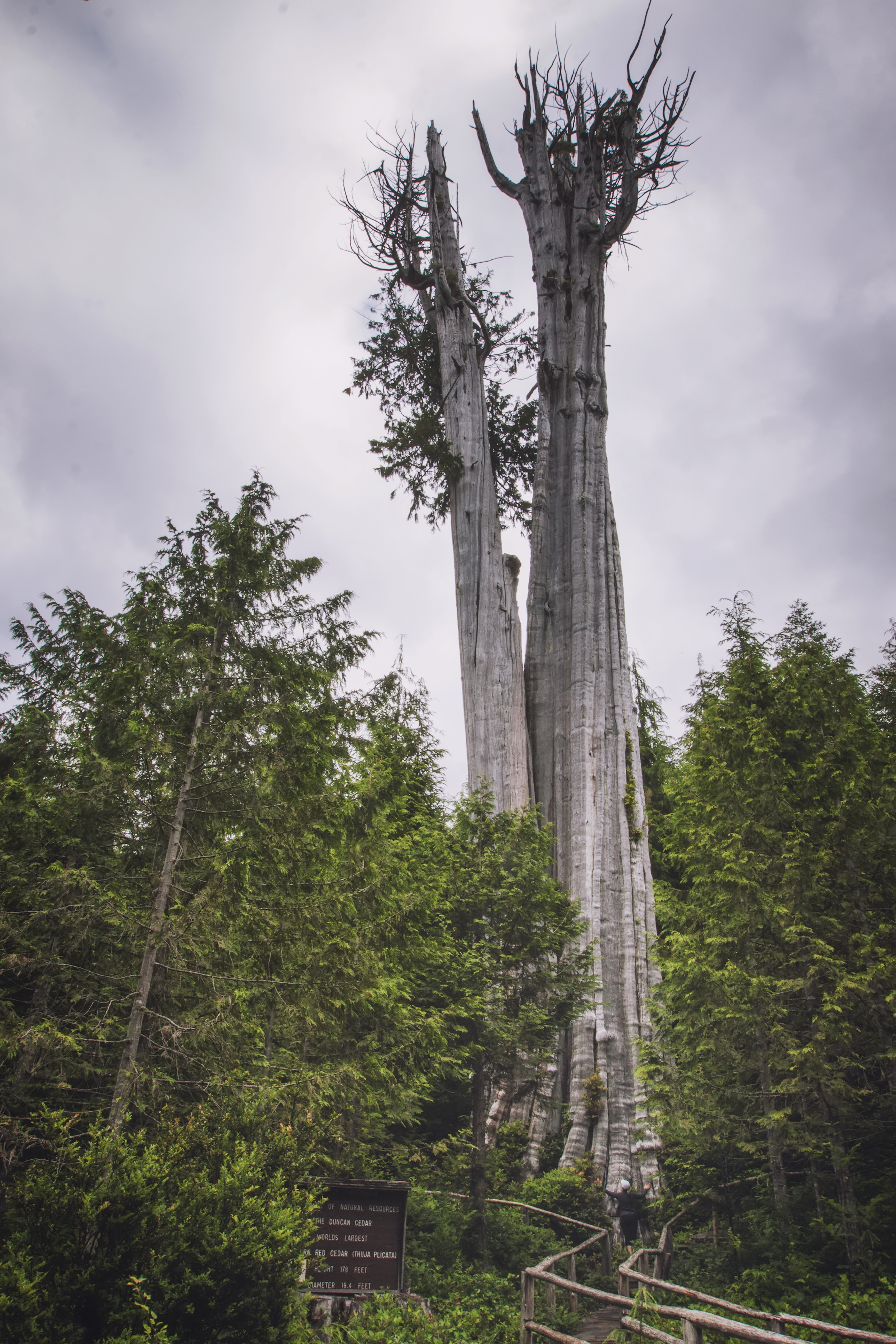
Duncan Cedar
Two loggers named Wiley and Ed Duncan were cutting a state timber sale in 1975 when they came across something that stopped them cold. Rising from the temperate rainforest near Nolan Creek on Washington's Olympic Peninsula, a Western redcedar of staggering proportions stood in the path of the harvest. At 19.4 feet in diameter and 178 feet tall, the tree was so large that felling it would have been less an act of logging than one of demolition. The Duncans reported what they had found, and the Forks Lions Club lobbied the state to pull the tree from the sale. They succeeded. The cedar was spared, renamed in honor of the two men who chose to speak up rather than cut it down, and today it stands as the largest known Western redcedar on Earth.
Last One Standing
The Duncan Cedar's surroundings tell a story the tree itself cannot. It rises from a patch of second-growth forest that sprouted after commercial logging interests clearcut the original old-growth rainforest in this area during the mid-20th century. The young trees pressing in around its base are decades old; the cedar at their center is estimated at more than a thousand years. It germinated sometime around the turn of the first millennium, long before the logging roads that now provide its only access were carved into the hillside. The contrast is stark and a little eerie - a single ancient survivor towering above a forest that barely reaches its lower branches. Everything that once stood beside it, the old-growth canopy that sheltered it through centuries of storms and drought, is gone. The Duncan Cedar endures not because the forest was preserved, but because two loggers and a civic club decided this one tree was worth saving.
A Millennium of Patience
Western redcedars are among the longest-lived tree species in North America, and the Duncan Cedar has used that longevity fully. At over 1,000 years old, it has outlasted the rise and fall of medieval kingdoms, the European arrival on this coast, and the industrial transformation of the Pacific Northwest timber industry that consumed the forest around it. Most of the tree is now dead. Only a single strip of bark on one of its trunks carries sap and sustains life - a thread of living tissue connecting root to crown through nearly twenty feet of diameter. According to University of Washington Forestry Professor Robert Van Pelt, the tree could persist for many more centuries in this diminished state, unless wind, fire, or human intervention finishes what time has started. That narrow margin between life and death is typical of ancient cedars, which often survive as fragments of their former selves, their dead wood resisting decay for generations.
The Measure of Giants
After the Quinault Big Cedar died in 2016, the Duncan Cedar became the largest known Western redcedar in the United States by volume. It is also the largest tree of any species in Washington state, and among the largest trees on Earth outside of California's remaining old-growth redwood forests. Its only rival for the title of world's largest Western redcedar is the Cheewhat Giant on Canada's Vancouver Island. These superlatives, measured in board feet and cubic meters, capture something about the tree's physical presence but not its effect on visitors. Standing at its base requires tilting your head back until your neck aches before you find the crown. The trunk is wider than many living rooms. The bark, deeply furrowed and fibrous, looks less like the surface of a tree than the texture of a canyon wall. Numbers describe the Duncan Cedar. They do not prepare you for it.
Four Miles of Gravel
Reaching the Duncan Cedar requires commitment. Located in Jefferson County approximately 15 miles south of Forks, the tree sits on land managed by the Washington State Department of Natural Resources, accessible only by traveling about four miles on unpaved logging roads off US Route 101. There are no visitor centers, no paved trails, no gift shops. The approach passes through the same second-growth forest that frames the tree itself - a working landscape of timber harvests and replanting cycles that makes the cedar's survival feel even more improbable. The roads can be rough, and signage is minimal. But the difficulty of access has also served as a kind of protection, keeping visitor numbers low enough that the tree's root zone has not been compacted into hardpan by foot traffic. The Duncan Cedar does not make itself easy to find. What it offers in return is the rare experience of standing before something genuinely ancient, in a setting that makes no effort to package the encounter.
From the Air
Located at 47.72N, 124.32W in Jefferson County, Washington, approximately 15 miles south of Forks on the Olympic Peninsula. The tree is not visible from altitude - it sits beneath forest canopy on Department of Natural Resources land, accessible by logging roads off US-101. Look for the patchwork of clearcuts and second-growth forest that characterizes the managed timberlands between Forks and the Quinault area. The Hoh River valley lies to the north, and the Pacific coast is roughly 10 miles west. Nearest airports include Quillayute Airport (KUIL) near Forks, about 15 miles north, and William R. Fairchild International (KCLM) in Port Angeles, approximately 65 miles northeast. The surrounding terrain is low, rolling hills covered in dense conifer forest.