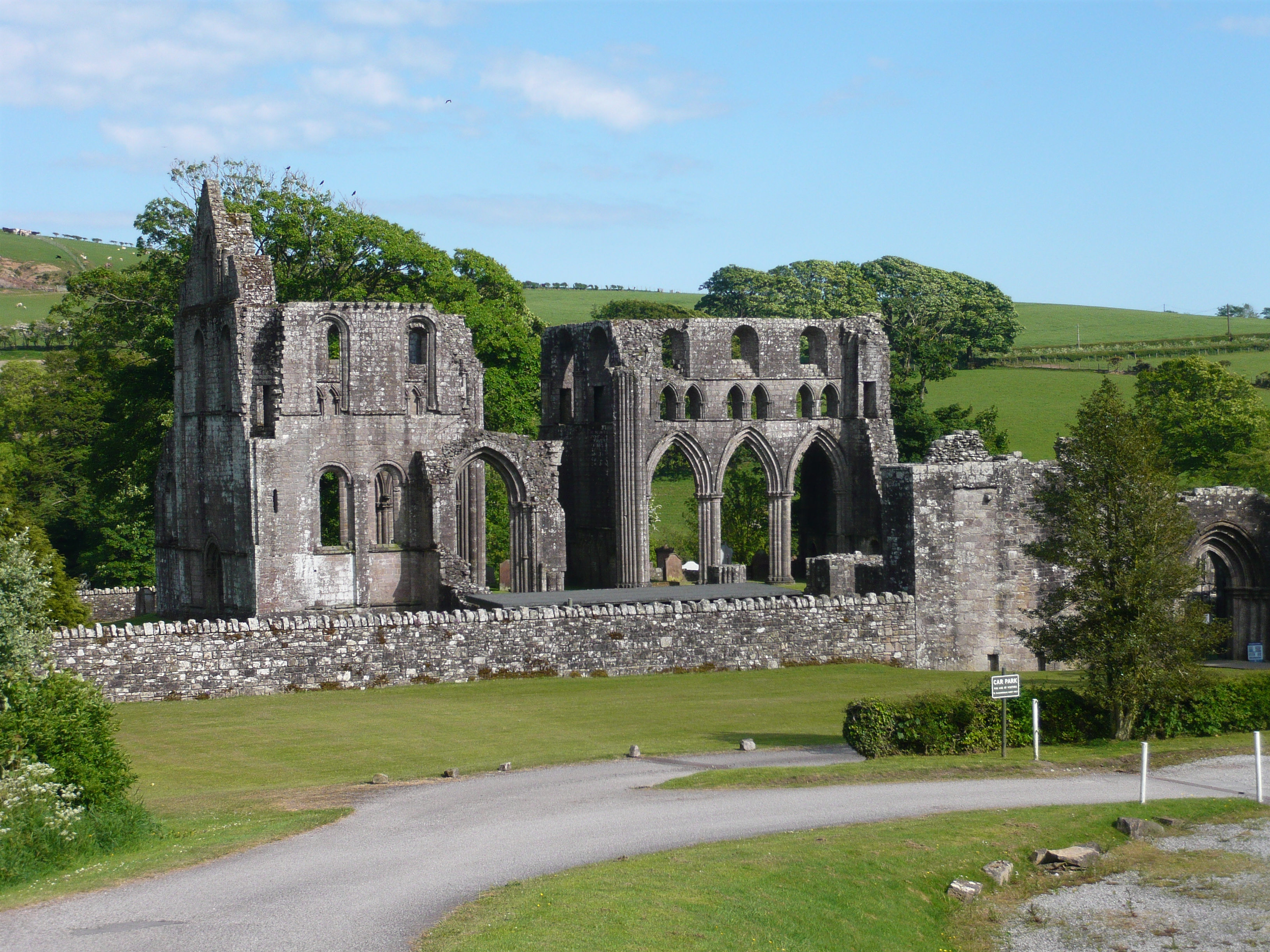
Dundrennan Abbey
On a night in May 1568, Mary, Queen of Scots, rode into the ruins of a Cistercian abbey in Galloway. She had just lost the Battle of Langside, her army scattered, her claim to the Scottish throne in tatters. Dundrennan Abbey, founded four centuries earlier in this quiet corner of southwest Scotland, would be her last stop on home soil. From the nearby inlet of Port Mary, she crossed the Solway Firth to Workington in England, believing she would find refuge with her cousin Elizabeth I. Instead, she found nineteen years of imprisonment, followed by the executioner's block. The abbey that sheltered Scotland's most tragic queen still stands in dignified ruin, its grey sandstone transepts among the finest Romanesque architecture to survive in the country.
A Kingdom's Ambitions in Stone
Dundrennan was established in 1142 by Fergus of Galloway and King David I of Scotland, who populated it with monks from Rievaulx Abbey in Yorkshire. The foundation was part of a larger political strategy. Fergus was simultaneously resurrecting the Bishopric of Whithorn, an ancient see that had disappeared with Northumbrian power after the Danes sacked York in 867. By founding a Cistercian house and re-establishing the bishopric, Fergus secured the independence of the Galwegian church from both the Bishop of Man in the west and Glasgow and Durham in the east. Dundrennan was not merely a place of contemplation -- it was a statement of territorial and ecclesiastical sovereignty.
Grey Stone, Hard Weathering
The abbey is built from exceptionally hard grey sandstone, which is why the original architectural details -- mouldings, arches, column capitals -- survive with remarkable clarity after nearly nine centuries. The transepts, the main surviving portions, display the austere aesthetic that defined Cistercian building: clean lines, restrained ornament, the beauty of proportion rather than decoration. Archaeologists excavating during the 1990s uncovered the building sequence across five periods, from roughly 1170 to 1600, revealing a warming house, a novice's day room, a great drain, and a latrine block. Alan of Galloway, one of the most powerful lords of medieval Scotland, is buried within the abbey grounds.
From Queen's Refuge to Cattle Pen
After the Scottish Reformation of 1560, the abbey's lands passed to the Crown in 1587. The site's decline was not dramatic but mundane -- the buildings were given over to housing livestock, and centuries of hooves and weather did what armies had not. The transition from sacred space to agricultural utility was common across Scotland's dissolved monasteries, but at Dundrennan the quality of the stone meant the fabric endured better than most. Today, Historic Environment Scotland maintains the ruins as a scheduled monument, open to visitors who can walk through the transepts and trace the outlines of the cloister.
Port Mary and the Solway Crossing
The inlet from which Mary departed Scotland still bears her name. Port Mary lies just south of the abbey, on the coast of the Solway Firth -- that broad, grey arm of sea that separates Scotland from England. Mary crossed to Workington on 16 May 1568, landing in Cumberland and placing herself in the power of a monarch who would never let her go. Dundrennan Abbey, where she spent her final night of freedom, sits in the green, rolling countryside near Kirkcudbright, a landscape of stone walls, grazing sheep, and quiet roads. The abbey's position -- sheltered, inland, but close to the coast -- made it a natural stopping point for a fugitive queen. Whether Mary looked back at the grey transepts as she rode toward the sea, no one recorded.
From the Air
Dundrennan Abbey is at 54.81N, 3.95W in Dumfries and Galloway, southwest Scotland, near the village of Dundrennan and roughly 5 miles southeast of Kirkcudbright. The ruins sit in a rural valley setting. The Solway Firth coastline, from which Mary crossed to England, is visible a short distance south. Nearest airports: Carlisle (EGNC, 45nm east) and Glasgow Prestwick (EGPK, 55nm north). The Solway Firth is a major visual landmark from altitude.