Dunedin Botanic Garden
The garden was born in the wrong place. When Dunedin established New Zealand's first botanical garden in 1863, it occupied a site along the Water of Leith where the University of Otago now stands. Five years later, the river flooded catastrophically, and in 1869 the garden was moved to higher ground -- a site that climbs from the river plain at 25 metres up a spur of Signal Hill to 85 metres. The old location left only a ghost: a faint place name, Tanna Hill, a corruption of 'Botanic,' still occasionally used for the small rise near the university registry. The new site, though, turned out to be a gift. Where the first garden had been flat and flood-prone, its replacement straddles two dramatically different landscapes, and that vertical range gives it a character no level garden could match.
Two Gardens in One
The Dunedin Botanic Garden splits into upper and lower sections connected by Lovelock Avenue, a winding road named for Jack Lovelock, the Dunedin-born runner who won Olympic gold in the 1,500 metres at Berlin in 1936. The lower garden occupies the valley floor along Lindsay Creek, a tributary of the Leith, and its character is formal and sociable: a heated Edwardian glasshouse called the Winter Garden, rose beds, herb borders, a duck pond, a children's playground, and a Japanese garden commemorating Dunedin's sister-city relationship with Otaru. A cafe sits beside the pond. Students from the nearby University of Otago drift through between lectures, and families settle on the lawns on sunny afternoons. The upper garden is a different world -- native bush walks, a rhododendron dell, a geographic plant collection, and a small aviary, all threaded through remnant forest on the hillside.
Statues, Fountains, and Heritage
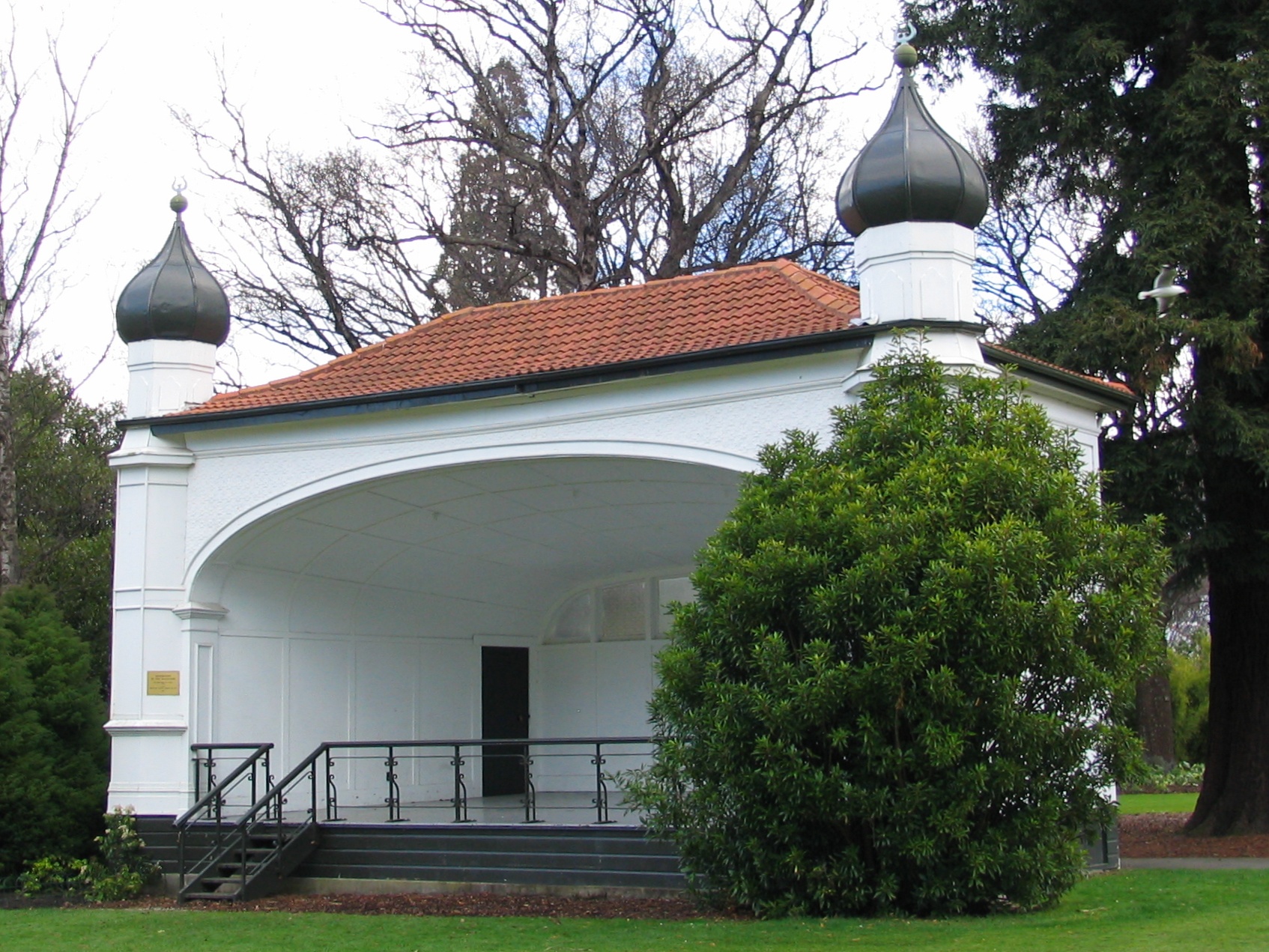
The lower garden collects sculpture the way old parks do -- gradually, through gifts and civic occasions. The most striking piece is the Wolf Harris fountain, an ornate Victorian structure erected in 1890 and listed as a Heritage New Zealand Category II Historic Place since 1982. Nearby, a pair of bronze statues by sculptor Cecil Thomas depict Peter Pan and the Darling children from J.M. Barrie's story, installed in 1965. A near-replica of the Peter Pan figure stands in Whanganui, beside Rotokawau Virginia Lake. At the northern entrance, a more contemporary work uses stylised Maori koru -- spiralling fern-shoot forms -- rendered as tall pillars. The garden's sound shell, a bandstand built in 1914, carries its own heritage listing. These layers of ornament give the lower garden a depth that pure horticulture cannot: the sense of a place that has been loved, argued over, and added to for more than a century and a half.
Fire Beneath the Flowers
Walk the geological trail in the upper garden and you learn that the ground beneath Dunedin is anything but peaceful. The city sits on the remains of the Dunedin Volcano, a complex that was active roughly 13 to 10 million years ago. The trail passes through exposures of different eruptive phases, laid bare along the slopes and the banks of the Water of Leith below. Volcanic basalt, tuff, and lava flows -- the raw materials of the landscape -- are labelled and explained as you climb. It is a startling counterpoint to the cultivated beauty of the rhododendrons and native plantings that grow from this ancient violence. The garden, it turns out, is not just sitting on a hillside. It is growing on the side of a dead volcano, and the trail makes sure you do not forget it.
A Garden of International Standing
David Tannock, the garden's long-serving superintendent in the early twentieth century, oversaw a major expansion that established much of the upper garden's character. His legacy endures in the plantings, the layout, and the ambition of the collection. In July 2010, the New Zealand Gardens Trust recognised that ambition formally, awarding the Dunedin Botanic Garden the rank of 'Garden of International Significance' -- one of only six gardens in the country to receive the honour. The only other South Island garden with that ranking is also in Dunedin, at Larnach Castle on the Otago Peninsula. The garden forms part of Dunedin's Town Belt, a green belt established in the city's earliest planning to encircle the inner city with open space. Within that belt, this particular patch has been cultivated, flooded out, replanted, sculpted, and cherished for over 160 years. It is the oldest botanical garden in New Zealand, and it wears its years well.
From the Air
Located at 45.86°S, 170.52°E at the northern end of central Dunedin, on the lower slopes of Signal Hill. The garden is visible from the air as a distinctive green expanse between the University of Otago campus to the south and residential North East Valley to the north. The upper and lower sections are separated by the winding line of Lovelock Avenue. Best viewed at 1,500-2,500 feet. The Water of Leith and George Street provide useful orientation. Nearest airport: NZDN (Dunedin International), approximately 25 km to the southwest.