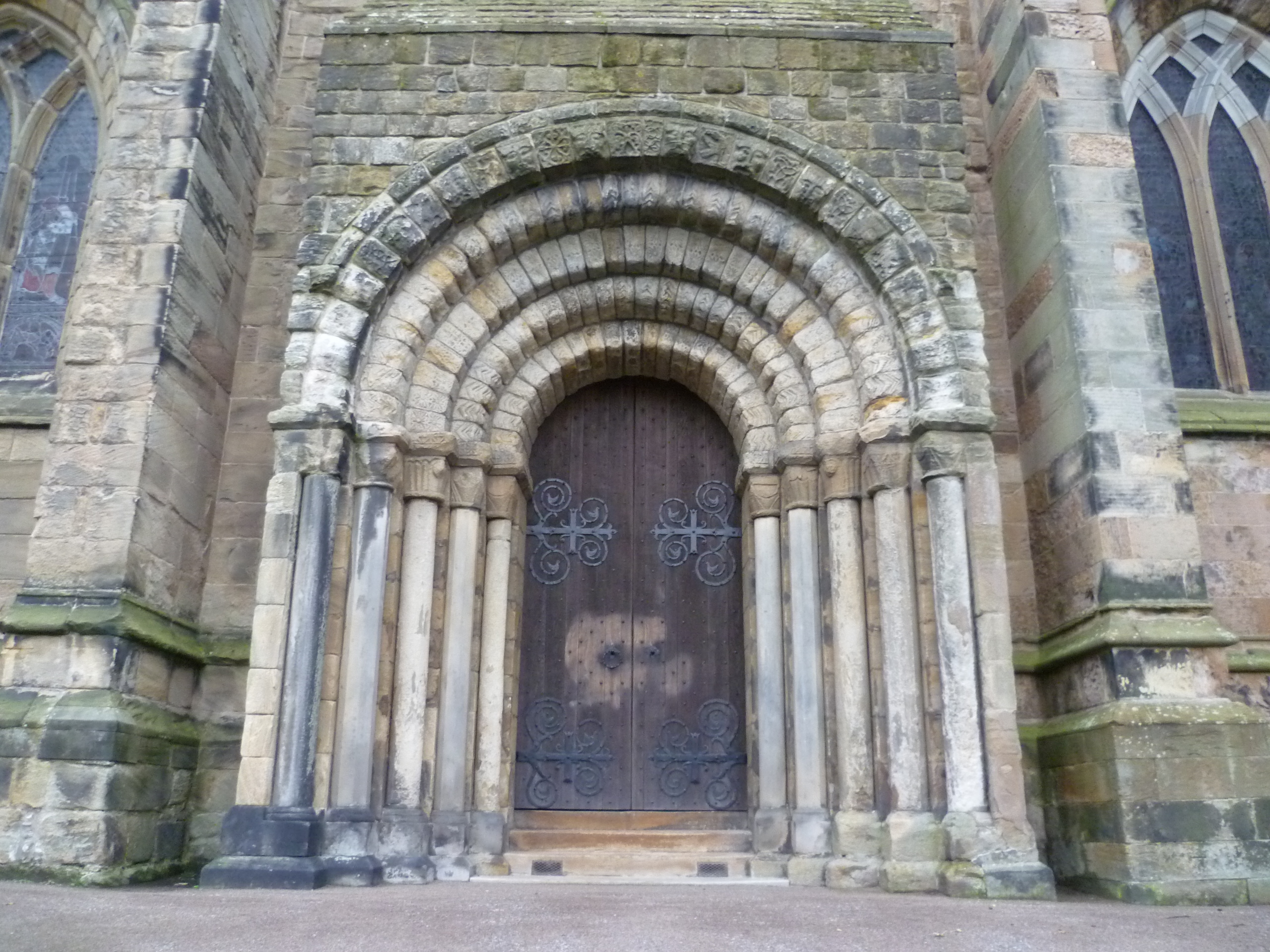
Dunfermline Abbey
They found the skeleton in 1818, wrapped in lead and cloth of gold beneath the pulpit of Dunfermline Abbey. When they opened the ribcage, the sternum had been sawn through. This was not damage from burial or decay -- it was deliberate. Robert the Bruce, King of Scots, had requested on his deathbed in 1329 that his heart be carried to the Holy Land. The heart went to Melrose Abbey. The bones stayed here, in the church that holds more of Scotland's royal dead than any place in the kingdom except Iona.
The Romanesque Survivor
Dunfermline Abbey was founded in 1128 by King David I, but the monastic community predates him, reaching back to the reign of his father, Malcolm III, and his mother, St. Margaret. The Benedictine priory they established became one of Scotland's great abbeys, and its 12th-century nave remains one of the finest examples of Romanesque architecture in the country. The massive columns, carved with chevron and spiral patterns, have the weight and permanence of something built to outlast argument. Alexander I added the flanking towers to the western entrance, and a beautiful doorway in the west front survives intact. When masons were cutting a site for a Boer War memorial in 1903, they uncovered another rich Romanesque doorway hidden in the south wall, and the memorial was moved to preserve it.
A Kingdom's Necropolis
The list of burials reads like a compressed history of medieval Scotland. Saint Margaret herself was interred here in 1093, and in 1250, following her canonization, her remains were exhumed and placed in a golden reliquary. Malcolm III lies beside her. Their sons Edgar, Alexander I, and David I are buried here. So is Malcolm IV. Alexander III rests alongside his wife Margaret of England and their sons. The abbey was not only a burial ground but a living center of royal power: Edward I of England held court here during the winter of 1303, and when he left the following year, he burned most of the buildings behind him. Dunfermline was also the birthplace, in 1600, of Charles I -- the last British monarch born in Scotland.
Sacked, Collapsed, and Rebuilt
The Reformation hit Dunfermline hard. Protestant reformers stripped the abbey in September 1559 and sacked it again in March 1560. By 1563, the choir and feretory chapel were roofless, and the nave walls were so badly damaged that entering the building was considered dangerous. Over the following centuries, pieces continued to fall: parts of the east end collapsed in 1672, part of the central tower fell in 1716, the east gable tumbled in 1726, and the tower's final collapse came in 1753. Through it all, the nave survived and served as the parish church. In 1821, a new church in the Perpendicular style was built on the site of the ancient chancel, and the old nave became its vestibule -- the medieval entrance hall to a modern place of worship.
What Endures
Today the abbey is two buildings fused together: the Romanesque nave, with its columns that have stood for nine centuries, and the 19th-century parish church that occupies the footprint of the medieval choir. The south wall of the monastic refectory still stands with its fine window. Next door, the ruins of Dunfermline Palace -- once part of the same complex -- connect via the old gatehouse. Queen Victoria ordered the restoration of Margaret and Malcolm's tomb within the ruined Lady Chapel, enclosing it to protect what remained. The tower of the parish church spells out its allegiance in stone letters around its parapet: KING ROBERT THE BRUCE. His bones lie below, reinterred in 1819 with a monumental brass inserted into the floor in 1891 to mark the royal vault. The heart went to Melrose. The rest stayed in Dunfermline, where it belongs.
From the Air
Dunfermline Abbey is at 56.070N, 3.464W in the center of Dunfermline, Fife, on the north shore of the Firth of Forth. The abbey complex and adjacent palace ruins are visible from altitude. Nearest airports: Edinburgh (EGPH) approximately 14 nm southeast across the Forth; Fife Airport (EGPJ) approximately 20 nm northeast. Best viewed at 2,000-3,000 ft.