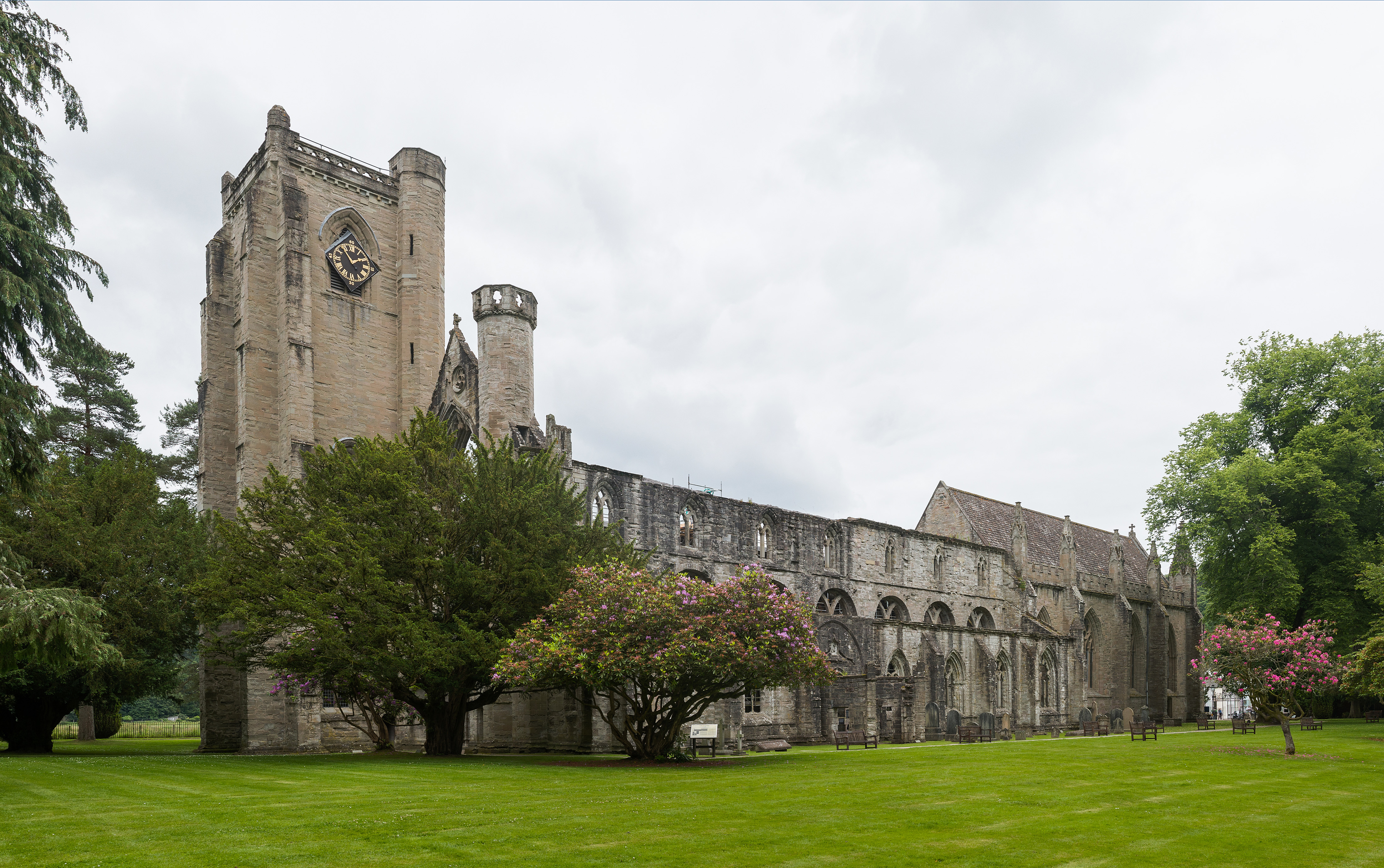
Dunkeld Cathedral
There is a streak of reddish stone visible in the eastern gable of Dunkeld Cathedral, irregular against the surrounding grey sandstone. It is all that remains of the Culdee monastery that stood here before the cathedral was begun in 1260 -- a few recycled stones from an older, simpler faith, embedded in the wall of the grander building that replaced it. The cathedral took 241 years to complete, was partly destroyed in a single night of battle, and has spent the centuries since as something unusual in Scottish ecclesiastical architecture: a building that is simultaneously a ruin and a functioning church.
Columba's Bones
Long before the cathedral, Dunkeld was sacred ground. The original monastery dated from the sixth or early seventh century, founded after an expedition by Saint Columba to the land of Alba. It began as a collection of wattle huts on the banks of the Tay, a foothold of Celtic Christianity in the Pictish heartland. Columba's relics -- reportedly including his bones -- were brought to Dunkeld for safekeeping, and for centuries the monastery drew pilgrims seeking the saint's intercession. The Culdees, those enigmatic 'Companions of God' who practiced an austere form of Celtic worship, maintained the site through the early medieval period. When the decision came to build a proper cathedral in the mid-thirteenth century, the masons incorporated stones from the Culdee buildings into their foundations, layering one era's devotion literally on top of another's.
Two Centuries of Stone
Construction began in 1260 and did not finish until 1501. The result is a building that wears its history in its architecture: Gothic and Norman elements intermingled throughout, the accumulation of generations of builders working in different styles across different centuries. The church, once it stood complete, was 195 feet long, a substantial building for a small Highland-edge town. It served as the seat of the Bishop of Dunkeld, and its chapter house held a small but significant collection of medieval relics. Kings visited. Edward I of England came during the Wars of Independence. David Stewart, Duke of Rothesay -- the heir to the Scottish throne who died under mysterious circumstances while imprisoned at Falkland Palace in 1402 -- was buried within its walls.
Fire, Battle, and Reformation
The cathedral survived the Wars of Independence, but the sixteenth century brought destruction from within Scotland itself. The Reformation reached Dunkeld as it reached many Scottish religious houses: with violence. Saint Columba's relics were reportedly removed to Ireland during this period, though persistent local belief holds that undiscovered Columban relics remain buried somewhere within the cathedral grounds. Then came the night of 21 August 1689, when Cameronian soldiers turned the cathedral into a fortress during the Battle of Dunkeld, fighting Jacobite Highlanders for sixteen hours through the streets and houses of the town. Musket ball holes still pit the east gable -- damage from a single night that the subsequent three centuries have left untouched.
Half Ruin, Half Parish Church
Today Dunkeld Cathedral exists in a state that is rare and oddly moving. The nave stands open to the sky, its roofless arches framing views of the River Tay and the wooded hills beyond -- a picturesque ruin of the kind that drew Romantic painters. But the choir, at the eastern end, is fully roofed and in regular use as the town's Church of Scotland parish church, with services every Sunday. The building is not formally a cathedral in the modern sense -- the Church of Scotland has neither cathedrals nor bishops -- but it has continued to carry the name. The small Chapter House Museum holds relics from monastic and medieval times. Among the burials within the walls lie figures spanning centuries: bishops, earls, and Charles Edward Stuart, Count Roehenstart, a grandson of Bonnie Prince Charlie who died in 1854. The cathedral is a Crown property, managed by Historic Environment Scotland and designated as a scheduled monument. It stands where it has stood for more than seven hundred years, on the north bank of the Tay, carrying in its stones the traces of Culdee monks, medieval masons, Reformation iconoclasts, and Jacobite musket balls -- each layer inseparable from the whole.
From the Air
Dunkeld Cathedral sits on the north bank of the River Tay at approximately 56.57N, 3.59W. The cathedral and its surrounding grounds are clearly visible from the air, with the roofless nave and intact choir creating a distinctive half-ruin profile. Perth/Scone airfield (EGPT) is approximately 15 nm south-southeast. Best viewed at 1,500-2,500 ft AGL. The A9 corridor and River Tay valley provide navigational context.