Dunkirk Evacuation
On 26 May 1940, the Archbishop of Canterbury led a national day of prayer in Westminster Abbey "for our soldiers in dire peril in France." In synagogues and churches across Britain, the same prayers were said. The country did not yet know that nearly 400,000 British, French and Belgian troops were already pinned against the sea at Dunkirk, that the dock installations were burning, or that Vice Admiral Bertram Ramsay - working from a chamber cut into the chalk beneath Dover Castle - had just been authorised to begin Operation Dynamo. By the time the prayer was ending, the first 28,000 men had already crossed the Channel. The next eight days would decide whether the rest had any future at all.
How the Trap Was Sprung
The Manstein Plan was meant to be impossible. Erich von Manstein, Chief of Staff of Army Group A, proposed that German panzers attack through the heavily wooded Ardennes - terrain that French commander Philippe Pétain had declared "impenetrable" - then race for the English Channel and cut the Allied armies in half. Hitler approved a version of the plan in February 1940. On 10 May, German Army Group B drove into Belgium and the Netherlands while Army Group A's three panzer corps slipped through the Ardennes and turned northwest. On 20 May, German tanks reached the coast at Abbeville. The British Expeditionary Force, the Belgian Army, and three French armies were trapped along a sliver of coastline. General Lord Gort, commanding the BEF, had already seen what was coming. On 19 May, he met French General Gaston Billotte and learned the French had no reserves between the Germans and the sea. He began planning a withdrawal to Dunkirk - the closest port, fronted by the longest sand beach in Europe.
Three Days of Silence
On 24 May, with German armour within striking distance of the pocket, Rundstedt's halt order froze the panzers in place. The official reasons were practical: half the tanks were out of service, the marshes around Dunkirk looked poor for armour, and Göring had promised the Luftwaffe could finish the job alone. Hitler endorsed the order. For nearly three days the German armour stood still while the Allies dug in. Guderian later called it one of the great German mistakes of the war; Manstein agreed; Rundstedt himself called it "one of the great turning points." Inside the pocket, the trapped armies used the lull to build a defensive perimeter along a chain of canals from Nieuwpoort to Gravelines and to start moving toward the beaches. Eight kilometres of pale sand lay between them and a sea they could not yet cross.
The Mole and the Little Ships
The Dunkirk docks were rubble. Captain William Tennant, the senior naval officer ashore, made a decision that probably saved the operation: he routed troops onto the East Mole, a stone-and-concrete breakwater nearly a mile long that had never been designed for embarkation. Almost 200,000 men would file down its narrow walkway and onto the decks of Royal Navy destroyers. James Campbell Clouston, the Canadian pier master on the mole, organised the queues under bombing and shellfire until he was killed when his motor launch was sunk on 2 June. From the beaches at Bray-Dunes, Malo-les-Bains and De Panne, soldiers waded out shoulder-deep and waited for hours to be ferried to the bigger ships. The shallow water demanded smaller boats. Admiralty agents combed the Thames for anything that could float - lifeboats, fishing smacks, motor cruisers, Thames sailing barges, pleasure yachts. Some were requisitioned without their owners' knowledge. Hundreds were crewed by their civilian skippers. The Little Ships of Dunkirk arrived from 28 May and shuttled men out to deeper water under repeated air attack.
Cost and Conscience
When Operation Dynamo ended on the morning of 4 June, 338,226 Allied soldiers had been evacuated - among them 139,997 French, Polish and Belgian troops. The cost on the Allied side was high: six British and three French destroyers sunk, more than 200 vessels lost, 16,000 French soldiers and 1,000 British soldiers dead during the evacuation itself, and around a thousand civilians killed in Dunkirk by Luftwaffe bombing in a single day. The BEF lost 68,000 men across the whole French campaign and abandoned almost every tank it had brought to France. Behind, on the beach of Malo-les-Bains and along the perimeter, some 35,000 to 40,000 French soldiers stayed in their positions until the morning of 4 June and were taken prisoner. Most were men of the French First Army and the 12th Motorised Infantry Division - the rearguard whose stand had kept the perimeter alive long enough for everyone else to leave. The flag of the 150th Infantry Regiment was burned so it would not fall into German hands. Of every seven Allied soldiers who escaped through Dunkirk, one became a prisoner of war and was marched, often for twenty days, into camps in Germany; the majority spent the rest of the war as forced labour.
A Miracle the Country Could Not Quite Call a Victory
Churchill addressed the House of Commons on 4 June. He called the rescue a "miracle of deliverance," then refused to let the country indulge it. "We must be very careful," he warned, "not to assign to this deliverance the attributes of a victory. Wars are not won by evacuations." In France, where the British departure was felt as abandonment by some, the resentment was real and lasting; only about 3,000 of the French troops evacuated to England joined Charles de Gaulle's Free French. The men who had been lifted off the mole and the beaches mostly went straight back into the war. The men who had stayed behind to make their escape possible mostly did not come home until 1945, if they came home at all. Both groups belong on the same memorial. One of them is still being properly remembered.
From the Air
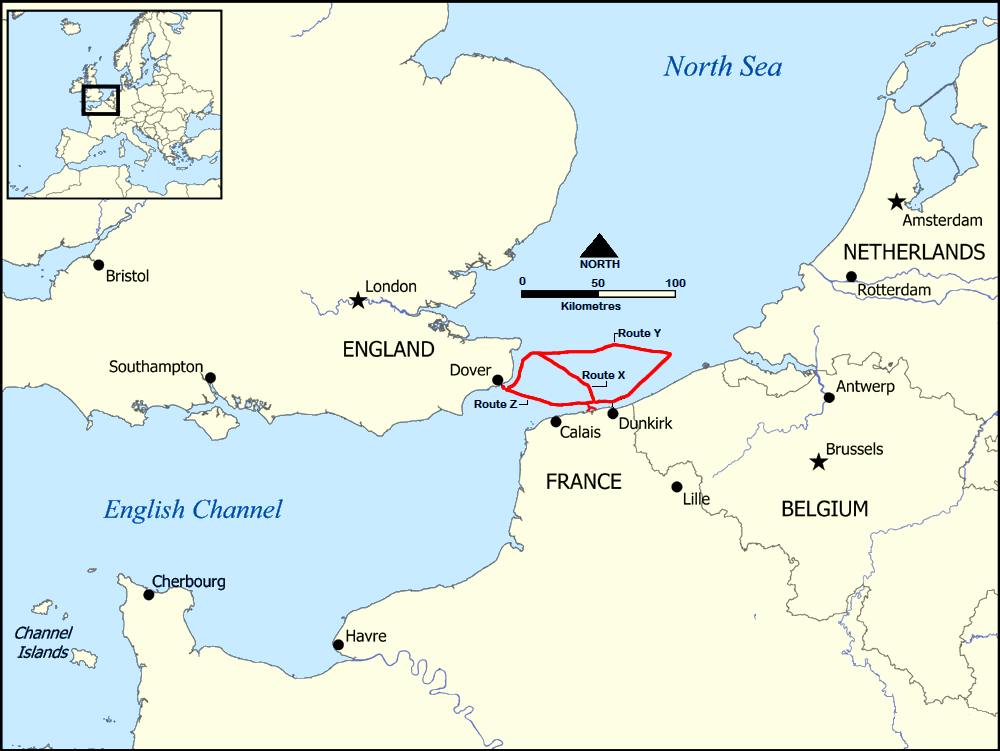
The evacuation perimeter ran along the canal line from Nieuwpoort (51.13°N, 2.75°E) through Veurne and Bergues to Gravelines (50.99°N, 2.13°E), with the embarkation beaches between Malo-les-Bains and De Panne and the East Mole at 51.03°N, 2.37°E. The Channel evacuation routes Z, X and Y arced north toward Dover (51.13°N, 1.31°E). Nearest airfields today: Calais-Dunkerque (LFAC) 30 km west; Lydd (EGMD) and Manston (EGMH) across the Channel in Kent; Ostend-Bruges (EBOS) 50 km northeast. The coastal stretch is best viewed at 2,500-4,000 ft on a clear day, when the East Mole and the line of war cemeteries inland are visible together.