Dunlawton Plantation and Sugar Mill
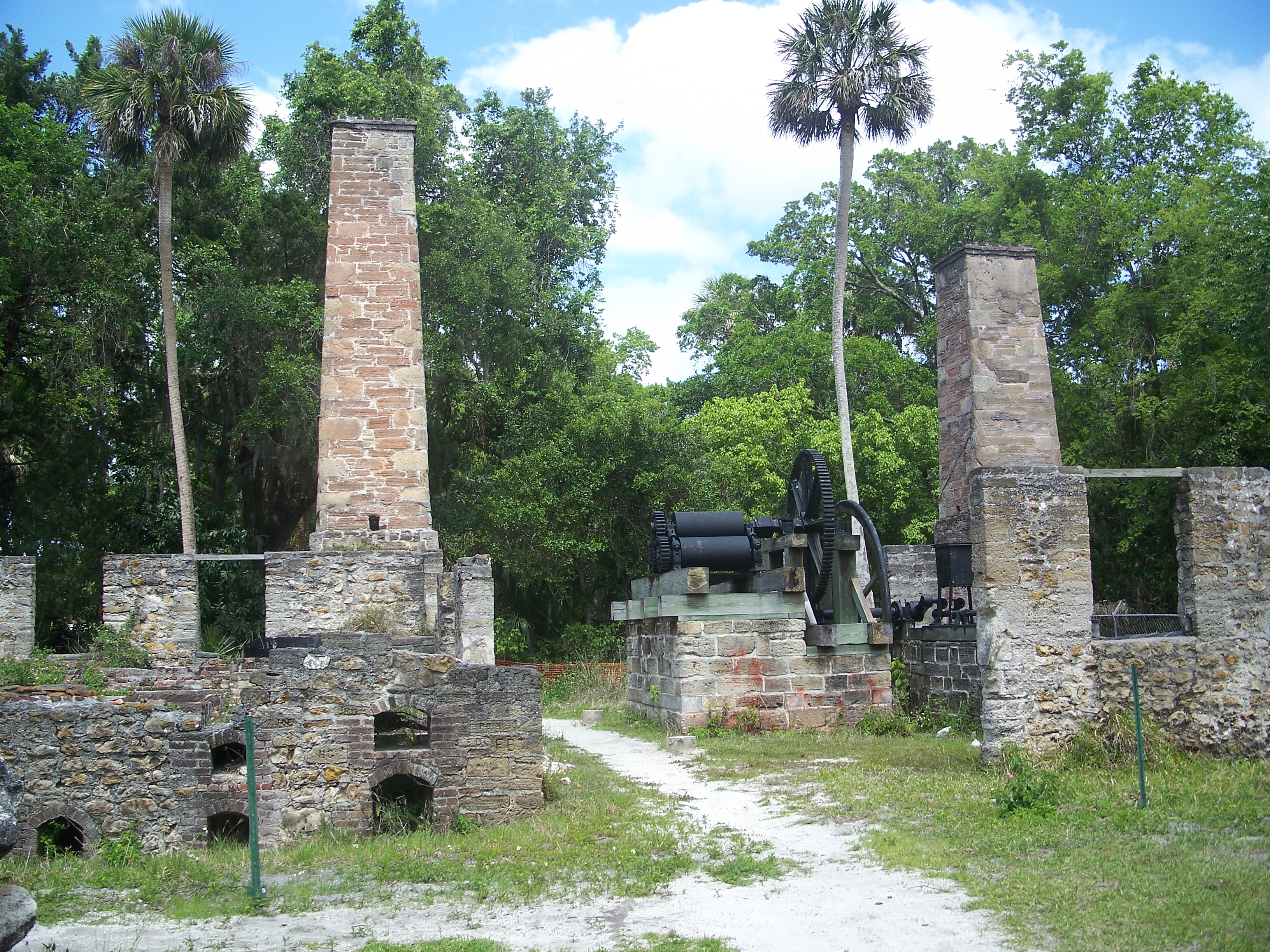
Concrete dinosaurs guard the ruins of a sugar mill in Port Orange, Florida. A triceratops, a stegosaurus, a tyrannosaurus rex, a dimetrodon, and a giant ground sloth stand among the crumbling coquina walls, remnants of two entirely different eras of Florida ambition -- a 19th-century plantation built on enslaved labor and a mid-20th-century tourist trap called Bongoland that lasted just four years. The site at 950 Old Sugar Mill Road has been a Spanish land grant, a sugarcane empire, a battlefield, a roadside attraction, and now a quiet botanical garden listed on the National Register of Historic Places since 1973.
From Bahamian Merchants to Sugar Kings
The plantation's story begins in August 1804, when Patrick Dean, a merchant from the Bahamas, and his uncle John Bunch, a planter from Nassau, received a Spanish Crown land grant for territory that had been part of the British Turnbull grant of 1777. Dean established a 995-acre indigo and sugarcane plantation in what is now Port Orange, worked by enslaved Africans. Dean was killed during the First Seminole War in 1818, and the property passed through family hands until John Bunch operated both his own and Dean's plantation as a single estate until 1830. The land eventually reached John B. Bunch McHardy, a British naval officer with no interest in farming, who sold it to land dealers Charles and Joseph Lawton for $3,000. In 1832, Sarah Anderson and her sons George and James purchased it for $4,500. They coined the name Dunlawton by combining her maiden name, Dunn, with the dealers' name, Lawton. The brothers operated the mill with slave labor, processing sugar, molasses, and rum until December 1835.
Christmas Eve in Flames
By late November 1835, tensions between white settlers and the Seminole people had reached a breaking point. Seminole leaders vehemently opposed the federal Indian removal policy, and Osceola's killing of Charley Emathla signaled open conflict was imminent. On December 17, General Joseph Hernandez ordered troops to defend the plantations along the Matanzas, Tomoka, and Mosquito Rivers. Major Benjamin A. Putnam led militia to Dunlawton, where the Anderson brothers were frantically building a stockade -- only to be drafted into the militia detachment before they could finish. On Christmas Eve 1835, the Seminoles struck the plantations south of St. Augustine. Over the following weeks, they burned or ransacked sixteen properties, including Dunlawton. When Putnam's troops returned on January 17, 1836, via Bulow Creek and the Halifax River, they found the Andersons' dwelling house and slave quarters burning and a large Seminole war party still in possession of the grounds. The militia exchanged heavy fire but could not retake the plantation.
Second Lives and Concrete Monsters
The plantation was eventually rebuilt and changed hands several times. With twenty-five enslaved laborers, it produced nearly 200 tons of sugar by 1851, but the collapse of the sugar market ended its agricultural life. John Marshall sold the property in 1871 to William Dougherty, whose son Charles -- Florida's first United States Congressman -- showed no interest in farming. The mill never operated again. Then, in the late 1940s, the ruins found an unlikely second act. A tourist attraction was built around the old walls and advertised to travelers heading south on U.S. Highway 1, complete with a miniature train that carried visitors past life-sized dinosaur statues fashioned by M.D. "Manny" Lawrence from chicken wire and concrete. The attraction ran from 1948 to 1952. In 1963, Saxton Lloyd landscaped the grounds, kept the dinosaurs, and donated the site to Volusia County.
Ruins Under the Oaks
Today the Dunlawton Sugar Mill Gardens offer a strange and peaceful convergence of history. Visitors walk under a canopy of live oak trees past interpretive signs explaining the coquina ruins, then turn a corner to find Lawrence's five surviving concrete dinosaurs still standing sentinel among the subtropical plantings. A gazebo sits among grasses, flowers, bushes, and native plants. According to a 1991 Orlando Sentinel article, a Seminole family once lived on the grounds for two years in a chickee, the traditional open-air shelter with a thatched roof -- a quiet reminder that the people who burned the plantation in 1835 never truly left this land. The gardens are free and open to the public, a place where Florida's layered past -- colonial ambition, enslaved labor, Indigenous resistance, roadside kitsch, and botanical beauty -- coexists in a few shaded acres along Old Sugar Mill Road.
From the Air
The Dunlawton Sugar Mill Gardens sit at approximately 29.14N, 81.01W in Port Orange, Florida, along the west bank of the Halifax River (Intracoastal Waterway). From the air, look for the dense oak canopy near Old Sugar Mill Road, just west of the Halifax River and south of the Port Orange Bridge. The site is small and best identified by its proximity to the river. Nearest airports: Daytona Beach International Airport (KDAB) approximately 10nm north, New Smyrna Beach Municipal Airport (KEVB) approximately 8nm south, Spruce Creek Fly-In (7FL6) approximately 3nm southwest.