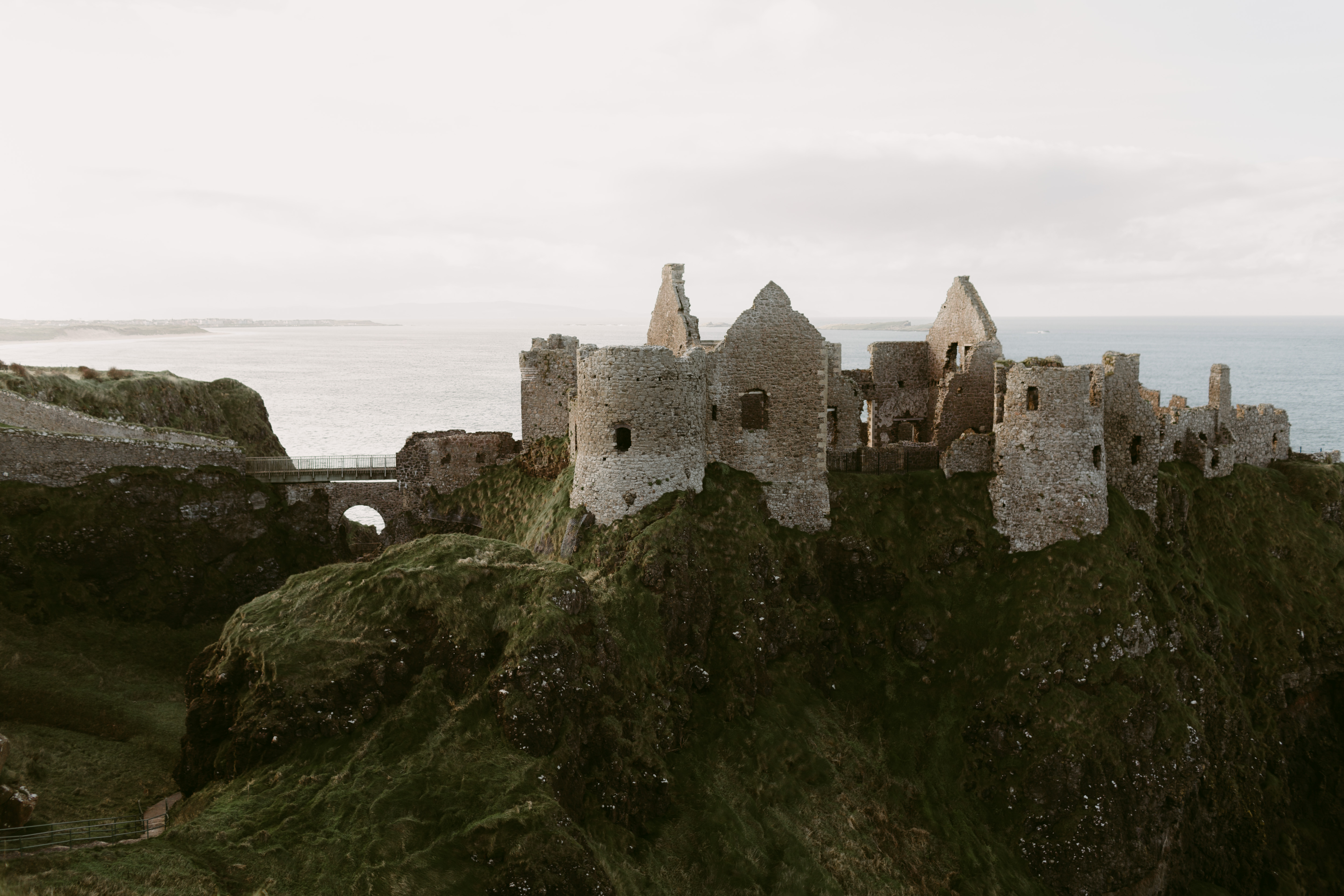
Dunluce Castle
The story that everyone remembers about Dunluce Castle is the kitchen. According to tradition, part of the castle -- including the kitchen and several servants -- fell into the sea during a storm while dinner was being prepared. The Duchess of Buckingham, wife of the Earl of Antrim, reportedly declared that she would not spend another night in a place where the ground could simply vanish beneath her. Whether every detail is true hardly matters. Stand on what remains of Dunluce, perched on a basalt outcropping between Portballintrae and Portrush on the Antrim coast, with the North Atlantic battering the rocks eighty feet below, and the story feels not just plausible but inevitable.
Lords of the Route
The first castle at Dunluce was built in the thirteenth century by Richard de Burgh, the 2nd Earl of Ulster. By 1513, it had passed to the McQuillan family, the Lords of Route, who added the two large drum towers -- about nine metres in diameter -- that still define the castle's eastern profile. The McQuillans held the castle for generations until they were displaced in the mid- to late-sixteenth century by the MacDonnells, a Scottish clan who had crossed from the Hebrides and were steadily absorbing the Antrim Glens. In 1584, Sorley Boy MacDonnell seized Dunluce after the death of the sixth MacDonald chief, taking the castle for himself and redesigning it in the Scottish style. He swore allegiance to Queen Elizabeth I, and his son Randal was made the 1st Earl of Antrim by King James I.
Spoils of the Armada
In 1588, the Girona, a galleass of the Spanish Armada, was wrecked in a storm on the rocks near Dunluce. The MacDonnells salvaged what they could from the wreck. Cannons from the Girona were installed in the castle's gatehouses -- Spanish artillery repurposed as Irish coastal defense. The rest of the cargo was sold, and the proceeds funded the castle's restoration. It was the kind of pragmatic windfall that defined life on this coast: whatever the sea delivered, you used. The Girona's guns gave Dunluce a firepower it had never possessed, turning a feudal stronghold into something approaching a fortified position. Centuries later, divers recovered extraordinary treasures from the wreck site -- gold and jewels now held at the Ulster Museum in Belfast.
The Lost Town
In 2011, archaeologists made a discovery that reshaped understanding of Dunluce. Major excavations adjacent to the castle uncovered significant remains of a lost town, built around 1608 by Randall MacDonnell, the first Earl of Antrim. The town predated the official Plantation of Ulster and represented an early attempt at creating a planned settlement on the Antrim coast. It was razed during the Irish uprising of 1641 and had been largely forgotten for nearly four centuries, its streets and structures buried under turf. The discovery revealed that Dunluce had been far more than a castle -- it was the center of a community, a small urban settlement that existed and vanished within a single generation.
From Ruin to Imagination
The MacDonnells abandoned Dunluce after the Battle of the Boyne in 1690, impoverished by backing the wrong side. The castle deteriorated steadily, its stones scavenged for nearby buildings. What the sea and weather did not claim, the locals repurposed. But ruins have their own kind of power. C. S. Lewis, who grew up in Belfast and knew this coastline intimately, is thought to have drawn on Dunluce as inspiration for Cair Paravel, the castle by the sea in his Chronicles of Narnia. Led Zeppelin featured the castle on the inner gatefold of Houses of the Holy in 1973. Irish composer Edward Norman Hay wrote an orchestral tone poem titled "Dunluce" in 1921. The castle's ruin is part of its appeal -- not a preserved monument but a place where the walls end abruptly at the cliff edge, where rooms open onto sky, and where the kitchen that fell into the Atlantic serves as a permanent reminder that nothing built on the edge of things is ever truly secure.
From the Air
Located at 55.21N, 6.58W on the north Antrim coast, Northern Ireland, between Portballintrae and Portrush. The castle ruins are dramatically visible from the air -- a stone structure perched on a detached basalt headland connected to the mainland by a narrow bridge. The Giant's Causeway is approximately 3 km east along the coast. Nearest airports are City of Derry (EGAE) to the west and Belfast International (EGAA) to the southeast. The Antrim coast road offers spectacular aerial views.