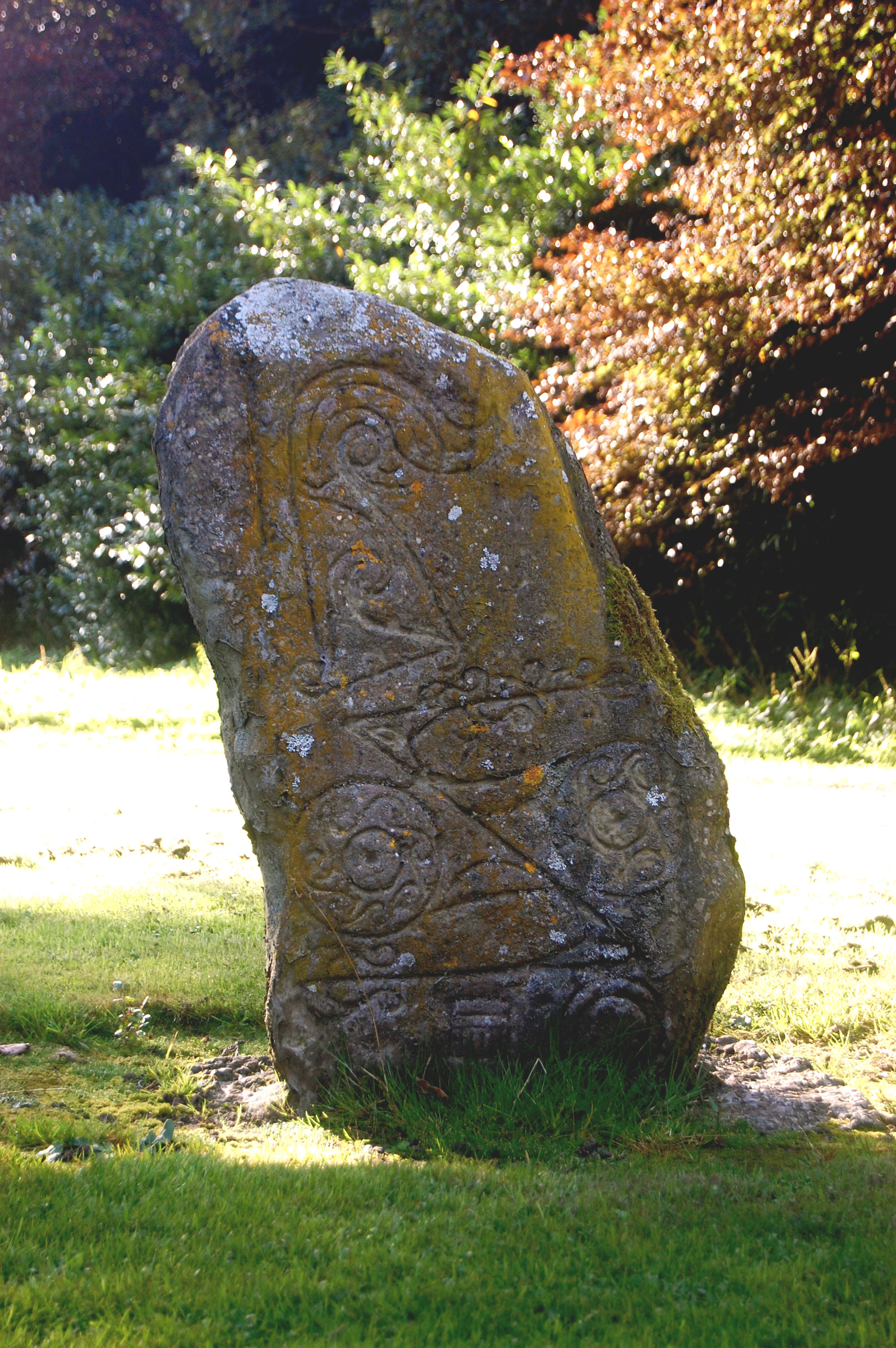
Dunnichen Stone
Three symbols are incised on its weathered sandstone face: a Pictish flower, a double disc and Z-rod, and a mirror and comb. Two of these motifs appear on Pictish stones across Scotland. The third -- the flower -- is exceptionally rare. The Dunnichen Stone, discovered in 1811 on the southeast slope of Dunnichen Hill in Angus, dates to roughly the 7th century AD and belongs to a culture that mastered the art of monumental carving but left no written language to explain what any of it meant.
Found on a Battlefield
Dunnichen is no ordinary hillside. In AD 685, the Battle of Dunnichen (also called Nechtansmere) was fought in the area below Dunnichen Hill, a clash between the Picts and the Northumbrians that halted the northward expansion of the Anglian kingdom and secured Pictish independence for centuries. Whether the stone has any direct connection to the battle remains unknown, but its location on the slopes overlooking Dunnichen Moss -- a wetland that may once have been a lake -- places it in a landscape of exceptional historical importance. The exact findspot is uncertain. Andrew Jervise, a 19th-century antiquarian, recorded that it was discovered in a field called the Chashel or Castle Park, a site later destroyed by quarrying.
A Stone on the Move
The Dunnichen Stone has been a nomad. After its discovery, it was initially set up at an unidentified "Kirkton Church" in either Dunnichen or nearby Letham, then moved to the garden of Dunnichen House. In 1967 it was relocated to St Vigeans Museum, then in 1972 to Dundee Museum, now the McManus Galleries. It currently resides on long-term loan at the Meffan Institute in Forfar, the county town of Angus. A fibreglass replica stands at the church in Dunnichen, marking the stone's approximate origin while the original occupies a climate-controlled gallery miles away. Each move has been an act of preservation, but each has also separated the stone further from the landscape that gave it meaning.
Reading the Symbols
The stone stands 1.5 metres high, 0.7 metres wide, and 0.3 metres thick -- a modest slab of rough sandstone that bears its carvings on one face. The double disc and Z-rod is one of the most common Pictish symbols, appearing on dozens of stones across Scotland, though its meaning remains debated. The mirror and comb, often interpreted as a female association or a symbol of status, appears alongside the double disc elsewhere, including on the Aberlemno Serpent Stone a few miles to the northeast. But the Pictish flower is the rarity. This botanical motif appears on very few stones, making the Dunnichen Stone an outlier in a tradition that favoured animals, geometric shapes, and abstract symbols. Together, the three carvings form a statement in a language we can see but cannot hear -- a message carved with deliberate precision by someone who expected it to be understood.
From the Air
Located at 56.64N, 2.89W, near the village of Dunnichen in Angus. Dunnichen Hill is a low eminence amid agricultural fields. The stone itself is housed at the Meffan Institute in Forfar, 3nm to the northwest. Nearest airports: Dundee (EGPN) 12nm south, RAF Leuchars (EGQL) 20nm south.