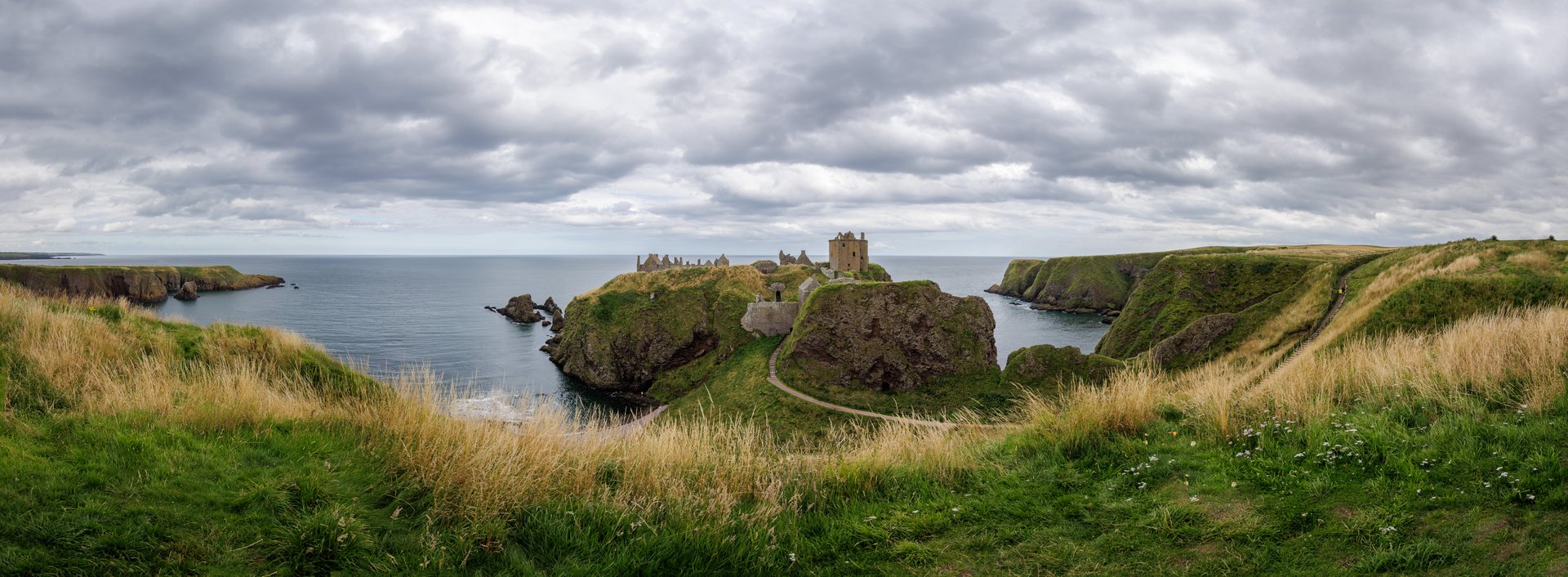
Dunnottar Castle
On a winter night in 1652, with English soldiers camped on every landward approach, two women carried out one of the most audacious acts of defiance in Scottish history. Elizabeth Douglas, wife of the castle's governor, and Christian Fletcher, wife of the local minister, smuggled the Honours of Scotland -- the crown, sword, and sceptre of the Scottish kings -- out of Dunnottar Castle and buried them beneath the floor of Kinneff Parish Church, where they would remain hidden for eight years. Cromwell's troops eventually starved the garrison into surrender but never found what they had come for. The Scottish crown jewels survived because of a fortress so formidable that it bought two women the time they needed.
A Fortress Built by the Sea
Dunnottar Castle occupies a rocky headland on the northeast coast of Scotland, two miles south of Stonehaven in Aberdeenshire. The site is surrounded on three sides by cliffs that plunge 160 feet to the North Sea, and a narrow strip of land provides the only approach from the mainland. A steep path climbs to a gatehouse fitted with a portcullis, passing Benholm's Lodging, a five-storey building carved directly into the rock face. A second, secret approach winds up from a marine cave on the northern cliffs, through which a small boat could be landed in calm weather. The strategic location allowed the castle's owners to control the coastal passage between the sea cliffs and the hills of the Mounth, the only practical route into northeastern Scotland. The Chronicle of the Kings of Alba records that King Donald II was killed here during a Viking attack in 900, and the English king Athelstan raided as far north as Dunnottar in 934. James V of Scotland, recognizing the fortress's value, exempted the Earl Marischal's men from military service on the grounds that Dunnottar was one of the 'principall strenthis of our realme.'
The Keiths and Their Kingdom
The castle passed to the Keith family around 1359, when William Keith, Marischal of Scotland, married Margaret Fraser, a niece of Robert the Bruce. The Keiths held Dunnottar for more than three centuries, transforming it from a stark medieval tower into something approaching a palace. The 5th Earl Marischal, George Keith -- who also founded Marischal College in Aberdeen -- began a sweeping reconstruction in the 1580s, building luxurious ranges around a quadrangle on the northeastern cliffs. Seven identical lodgings lined the west range. Above them ran a 120-foot gallery that displayed, among other treasures, a Roman tablet taken from the Antonine Wall. The east range housed apartments for the countess, while the earl's own quarters included a room known as the King's Bedroom, where Charles II himself once slept. Mary, Queen of Scots visited in 1562 and again in 1564 -- the second time after sending a messenger ahead to ensure the Earl Marischal had enough provisions on hand.
Jewels, Prisoners, and Exile
The castle's greatest hour came during Cromwell's invasion. After Charles II was crowned at Scone in January 1651, the Honours of Scotland could not be safely returned to Edinburgh with English forces occupying the Lowlands. The regalia was smuggled to Dunnottar hidden in sacks of wool, carried by a woman named Katherine Drummond. When Cromwell's troops laid siege in November 1651, the castle held firm. During the blockade, Anne Lindsay, a kinswoman of the governor's wife, walked straight through the English lines with the king's papers sewn into her clothing. Then came the crown jewels themselves, spirited away by Douglas and Fletcher before the garrison finally capitulated. But Dunnottar also witnessed darker chapters. In 1685, during the suppression of the Covenanters, 167 Presbyterian prisoners were crammed into a cellar beneath the King's Bedroom. Five died in captivity. Those who refused to swear allegiance were transported to Perth Amboy, New Jersey, where many perished on the voyage. The cellar is still known as the Whigs' Vault.
Ruin and Resurrection
The Jacobite Rising of 1715 sealed Dunnottar's fate. George Keith, the 10th Earl Marischal, led cavalry at the Battle of Sheriffmuir and, when the rebellion collapsed, fled to the Continent, eventually becoming Frederick the Great's ambassador to France. His titles and estates, including Dunnottar, were declared forfeit to the Crown. In 1720, the York Buildings Company purchased the seized property and dismantled much of the castle for its stone and timber. For two centuries, the ruins brooded above the North Sea, picturesque and neglected. Restoration came in 1919, when Weetman Pearson, 1st Viscount Cowdray, bought the estate and his wife began a careful programme of repairs. Today, visitors descend the steep cliff path to enter through the same gatehouse that once withstood English armies, walking among roofless palace rooms where earls entertained monarchs and where, in a cellar beneath flagstones, the oldest crown jewels in Britain were hidden from the most powerful military force of their age. Over 135,000 people make the journey each year.
From the Air
Located at 56.95N, 2.20W on a dramatic rocky headland on the Aberdeenshire coast, 2 miles south of Stonehaven. The castle ruins are clearly visible from the air, spread across a 3.5-acre clifftop plateau surrounded on three sides by North Sea cliffs dropping 160 feet. The narrow land bridge approach is distinctive from above. Nearest airport: Aberdeen (EGPD), approximately 15 nm to the north. Best viewed at 1,500-2,500 ft AGL.