Dunstaffnage Castle
To retain the title of Hereditary Captain of Dunstaffnage, the incumbent must spend three nights a year in the castle. No other responsibilities or privileges attach to the post -- it is, as the sources note, a sinecure without military significance. Yet the requirement endures, a thread connecting the present to a castle that has stood on its promontory near Oban since the thirteenth century, guarding the entrance to Loch Etive and the sea lanes of Argyll. Dunstaffnage is one of Scotland's oldest stone castles, a fortress that has housed MacDougall lords, Bruce kings, Campbell earls, Jacobite prisoners, and at least one ghost.
The Headland of the Staves
The castle sits on a platform of conglomerate rock on a promontory three miles north-northeast of Oban, surrounded on three sides by the sea. The prefix dun means 'fort' in Gaelic; the rest of the name derives from the Norse stafa nes -- headland of the staves. Before the stone castle was built, the site may have been a stronghold of the Dal Riatan kingdom as early as the seventh century. The sixteenth-century chronicler John Monipennie recorded that the Stone of Destiny was kept here after being brought from Ireland and before being moved to Scone Palace in 843 -- though historians consider Iona and Dunadd more likely candidates. The castle belongs to a local group of Scotland's earliest stone fortifications, alongside Castle Sween and Castle Tioram.
MacDougalls, Bruce, and the Fall of Argyll
Duncan MacDougall, Lord of Lorn and grandson of Somerled, Lord of the Isles, made Dunstaffnage his seat in the second quarter of the thirteenth century. He was also the founder of nearby Ardchattan Priory. His son Ewen expanded the MacDougall influence, styling himself 'King of the Isles.' But the MacDougalls backed the wrong side in the Wars of Scottish Independence, supporting the Balliol claim against Robert Bruce. After Bruce defeated them at the Battle of the Pass of Brander in August 1308, he besieged Dunstaffnage and took it. Rather than destroying the castle as he did elsewhere, Bruce appointed a constable and provisioned it, recognizing its strategic value for controlling the seaways of western Scotland. The MacDougall lands were given to his ally Angus Og Macdonald, Lord of the Isles.
Campbells, Jacobites, and a Wedding Stabbing
Dunstaffnage passed through a series of royal keepers before James III granted it to Colin Campbell, 1st Earl of Argyll, in 1470. The Campbells appointed hereditary Captains to oversee the castle and used it as a base for government expeditions against the MacDonald Lords of the Isles. One of the more dramatic episodes occurred in 1463, when the keeper John Stewart of Lorn was stabbed by supporters of his rival Alan MacDougall on his way to his own marriage at Dunstaffnage Chapel -- though he survived long enough to make his vows. During the Jacobite risings of 1715 and 1745, government troops occupied the castle. Flora MacDonald, who helped Bonnie Prince Charlie escape disguised as her maid, was briefly imprisoned here while en route to London.
Ghost, Chapel, and Captain
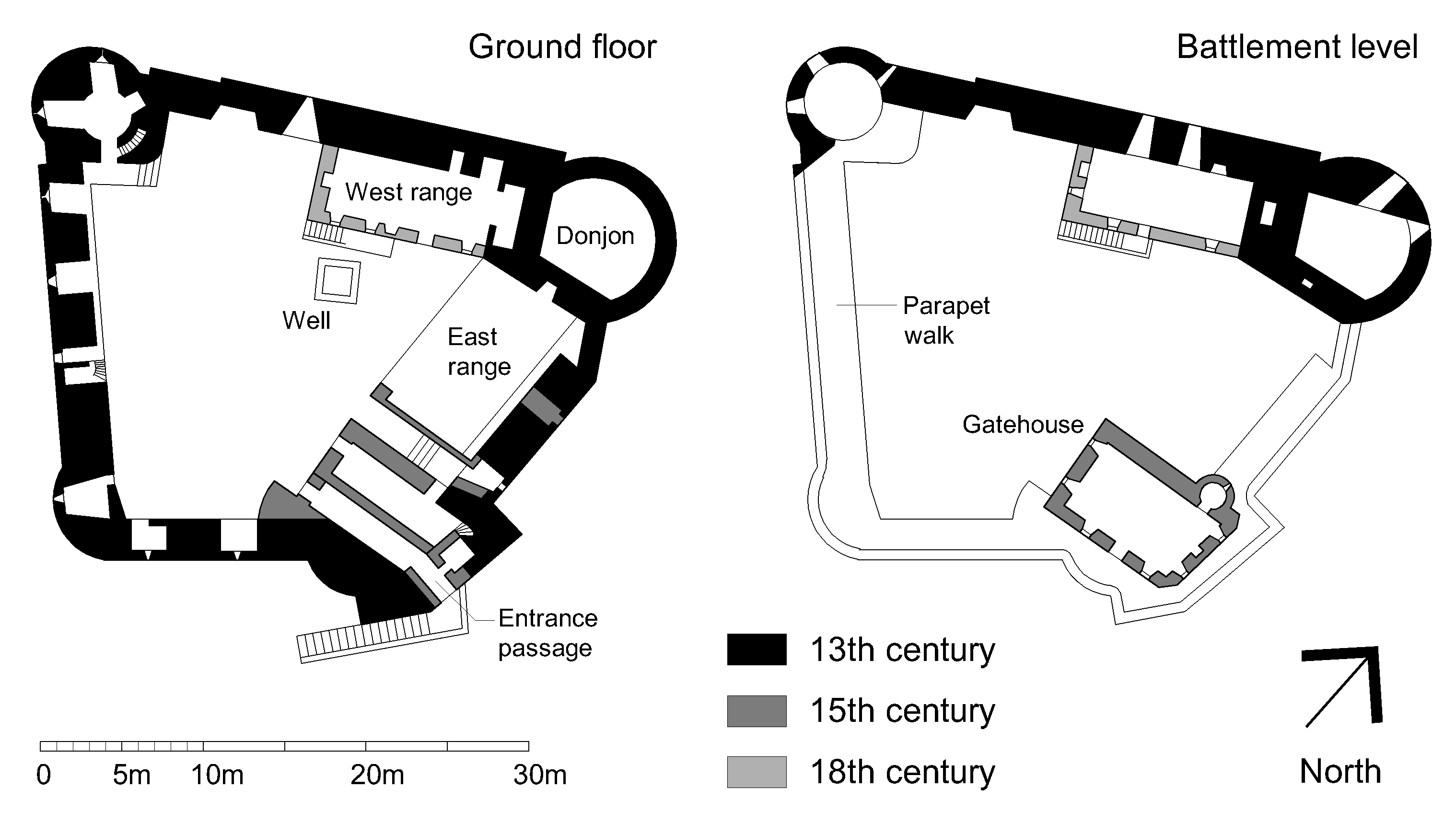
A ghost known as the 'Ell-maid of Dunstaffnage' is said to haunt the castle, a gruagach whose appearances are associated with events in the lives of the hereditary keepers. Southwest of the castle, a ruined chapel built by Duncan MacDougall in the thirteenth century features stonework of outstanding quality -- dog-tooth carving on lancet windows with fine wide-splayed arches. The chapel was already ruinous by 1740, when a burial aisle was added for the Campbells of Dunstaffnage. An accidental fire gutted the gatehouse in 1810, and the Captains moved out to Dunstaffnage House two kilometres away. Restoration work began in 1903, though a 1912 court case was needed to confirm the hereditary Captain's right of residence. The castle passed into state care in 1958 and is now maintained by Historic Environment Scotland, open to the public -- though the gatehouse remains the private property of the Captain, who continues to sleep within the walls three nights each year.
From the Air
Located at 56.45N, 5.44W on a promontory at the southwest entrance to Loch Etive, approximately 3 miles north-northeast of Oban. The castle is visible from the air on its rocky headland, surrounded by sea on three sides. Nearest airport is Oban Airport (no ICAO code); nearest major airports are Glasgow (EGPF) and Inverness (EGPE). Best viewed at 1,500-3,000 feet. Dunstaffnage Marina is adjacent.