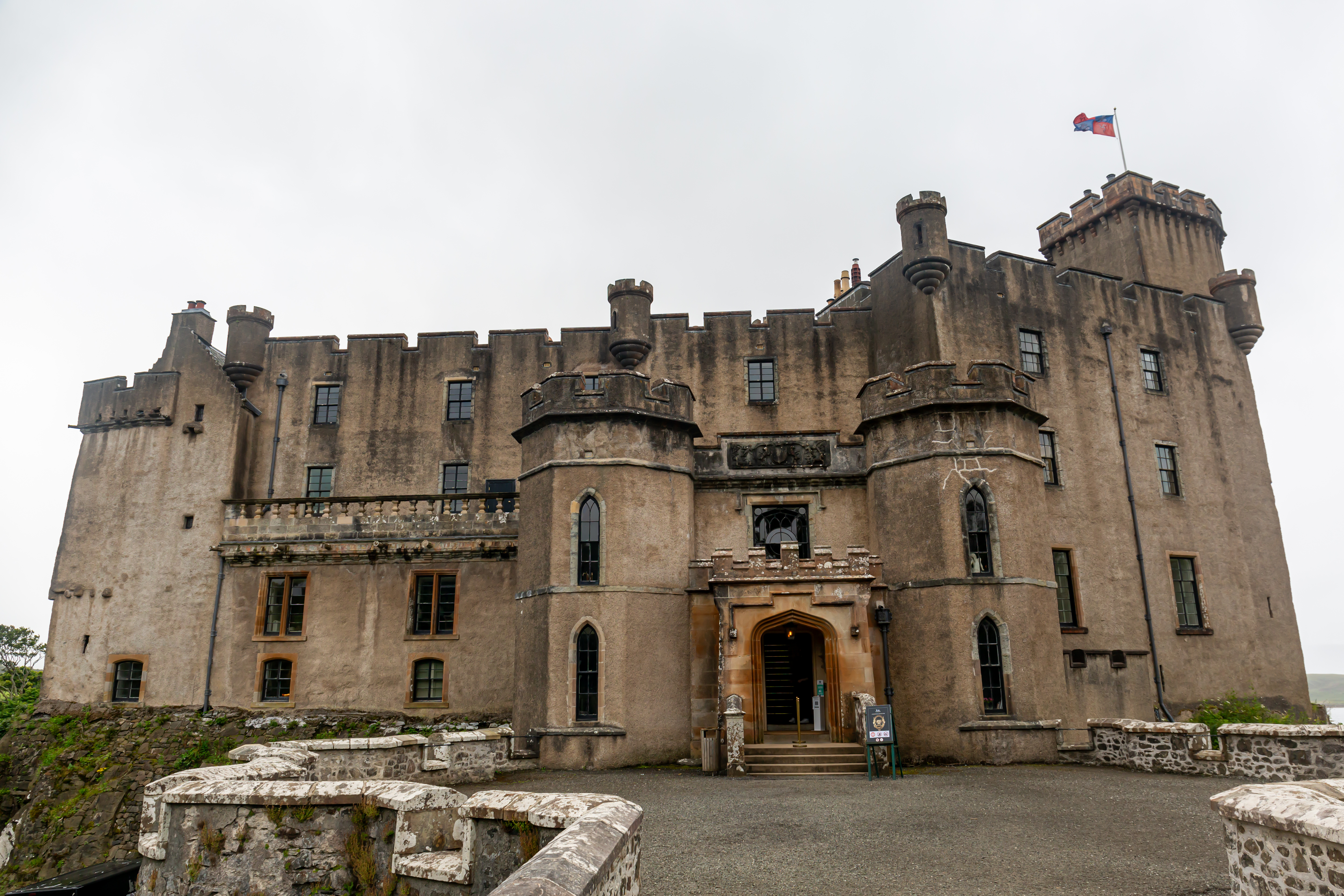
Dunvegan Castle
A piece of silk no larger than a tablecloth has protected Clan MacLeod for eight centuries -- or so the clan believes. The Fairy Flag of Dunvegan hangs in a glass case inside the castle, its fabric so ancient and fragile that conservators have debated whether it dates to the 4th century. Scientific analysis suggests Syrian or Rhodian silk. Clan tradition insists it was a gift from a fairy who married a MacLeod chief and left it as a parting blessing when she returned to her own world. Whatever its origin, the flag was unfurled at the Battle of Glendale and the Battle of the Spoiling Dyke, and the MacLeods credit it with turning certain defeat into victory both times. Dunvegan Castle, perched on a rock fifty feet above the eastern shore of Loch Dunvegan on the Isle of Skye, has been the seat of Clan MacLeod since the 13th century. It is the oldest continuously inhabited castle in Scotland.
Rock Above the Loch
Dunvegan Castle occupies the summit of an elevated rock projecting onto the eastern shore of a north-facing inlet on Loch Dunvegan, a sea loch on Skye's western coast. On the landward side, a partly natural ditch roughly eighteen feet deep separates the castle from the surrounding terrain. The promontory was first enclosed by a curtain wall in the 13th century, and a four-storey tower house was added in the late 14th century, similar in style to contemporary structures at Kisimul Castle on Barra and Caisteal Maol on the mainland. For centuries, the only entrance to the castle was by sea through a gate in the sea wall -- a defensive arrangement that meant visitors arrived by boat or not at all. The castle was developed piecemeal over the centuries, each generation of MacLeod chiefs adding or altering rooms, towers, and ranges. In the 19th century, the entire castle was remodelled in a mock-medieval style that gave it the romantic silhouette visible today.
The Flag, the Horn, and the Cup
Three heirlooms define Dunvegan. The Fairy Flag -- Am Bratach Sith -- is the most famous. One legend says a fairy bride gave it to her MacLeod husband when they parted at the Fairy Bridge near Dunvegan. Another version tells of a fairy who wrapped an unattended MacLeod baby in a silk shawl while a lullaby filled the tower room. The flag is said to possess the power to save the clan from destruction if unfurled in battle, but only three times -- and tradition holds it has already been used twice. During the Second World War, young MacLeod pilots reportedly carried photographs of the flag as talismans. The second heirloom is Sir Rory Mor's Drinking Horn, a massive ox horn that each new MacLeod chief must drain of claret -- roughly a bottle and a half -- in a single draught to prove his fitness to lead the clan. The third is the Dunvegan Cup, a medieval ceremonial vessel of Irish origin. Together, these three objects anchor eight centuries of MacLeod identity to a single fortress on a sea loch in Skye.
Eight Hundred Years on the Rock
Dunvegan's longevity is remarkable even by Scottish standards. Other clan seats were abandoned, burned, forfeited, or sold. Dunvegan was none of these. The MacLeod chiefs have held it through the Wars of Scottish Independence, the Reformation, the Civil Wars, the Jacobite risings, the Clearances, and two World Wars. The castle's gardens, developed from the 18th century onward, include formal plantings that benefit from the warming influence of the North Atlantic Drift. Seal-spotting boat trips depart from the castle's jetty into Loch Dunvegan, where colonies of common and grey seals haul out on the rocky islets. The castle and its grounds draw tens of thousands of visitors each year, making Dunvegan one of the most visited attractions on Skye. Yet its essence remains what it has been since the 13th century: a clan chief's home on a rock above a sea loch, guarding a scrap of ancient silk that may or may not have come from another world.
From the Air
Dunvegan Castle sits at 57.449N, 6.590W on the eastern shore of Loch Dunvegan on the Isle of Skye. The castle is visible on its rocky promontory at the head of an inlet. The village of Dunvegan lies approximately 1 mile to the south. Nearest airfield is Broadford Airstrip on Skye (no ICAO code), approximately 20 nm southeast, or Plockton on the mainland. Oban Airport (EGEO) lies approximately 65 nm south. The Waternish peninsula extends to the north, and the MacLeod's Tables (flat-topped mountains) are prominent to the southwest.