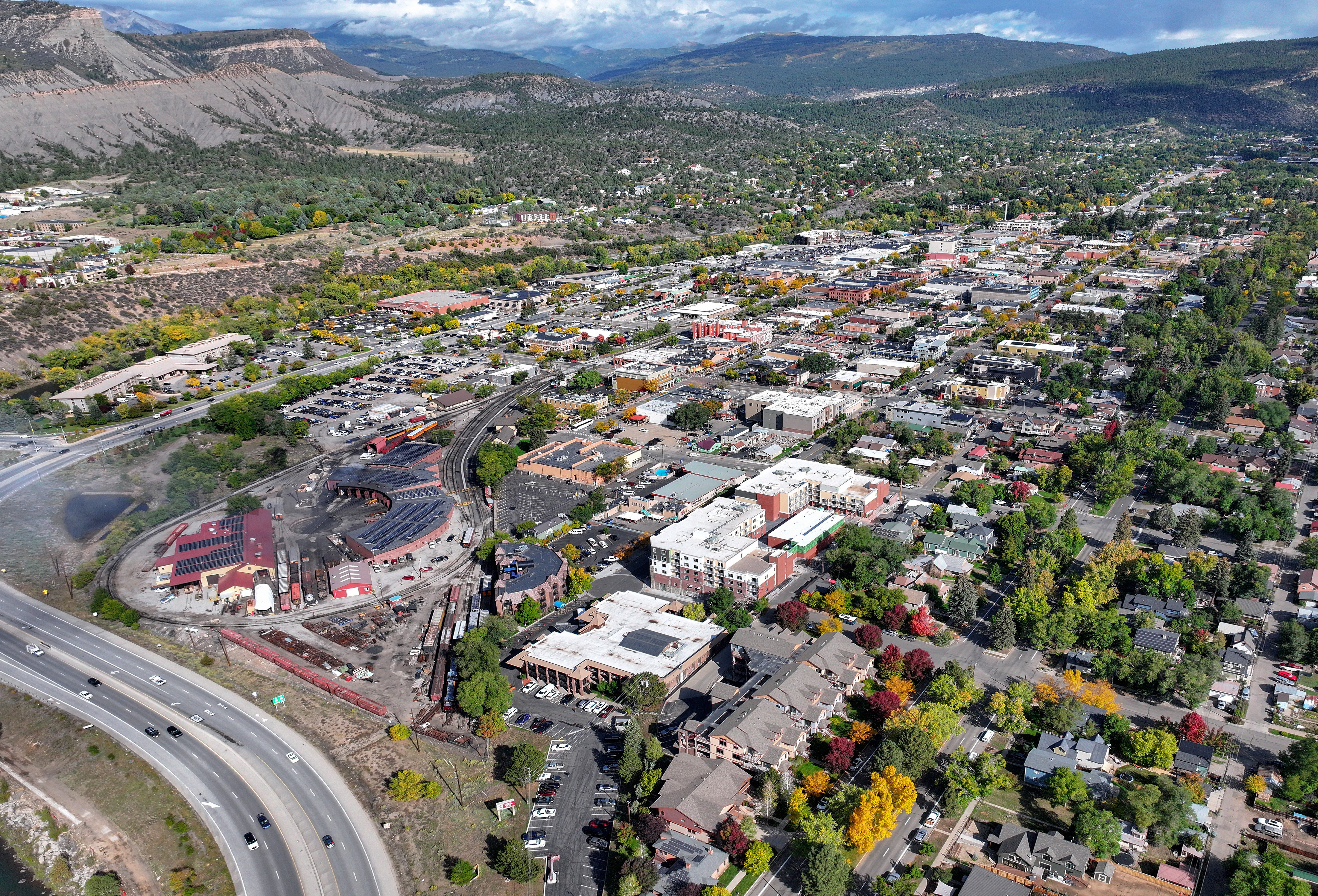
Durango, Colorado
When the Denver and Rio Grande Railway came pushing westward toward the San Juan mining district in 1880, the existing settlement of Animas City refused the railroad's demands. The railroad's response was decisive and ruthless: it would build its own town two miles south. General William J. Palmer, president of the railroad, along with investors William A. Bell and John A. Porter formed the Durango Trust, surveyed a townsite along the Animas River in September 1880, and began selling lots at $50 to $100 apiece. Buyers snapped up more than $15,000 in parcels in the first two days. By year's end, Durango had 2,000 residents -- six times the population of the town that rejected the railroad. Colorado's former territorial Governor A.C. Hunt chose the name, inspired by the similarity of the landscape to Durango, Mexico.
Iron Rails to Silver Mines
The railroad arrived in Durango on August 5, 1881, celebrated with a parade, a free barbecue, races, and the governor's personal attendance. Construction on the narrow gauge line to Silverton began that fall, pushing through the Animas River gorge and climbing 2,800 feet over 45 miles of some of the most dramatic terrain in North America. By July 1882, tracks reached Silverton, and trains began hauling both passengers and freight. Over its lifetime, the route is estimated to have transported more than $300 million in precious metals from the San Juan Mountains. The line was designated a National Historic Landmark and recognized by the American Society of Civil Engineers as a National Historic Civil Engineering Landmark in 1968. In 1981, the Denver and Rio Grande Western Railroad sold the line, and the Durango and Silverton Narrow Gauge Railroad was born, continuing daily operations using historic steam locomotives.
Main Avenue and the Victorian Heart
Durango's Main Avenue is a Nationally Registered Historic District that cuts through the downtown core, lined with galleries, boutiques, restaurants, and bars housed in Victorian-era buildings. At the avenue's south end stand two landmark hotels: the General Palmer and the Strater, a Victorian hotel that now hosts the annual Durango Ragtime and Early Jazz Festival. The Strater sits near the Durango and Silverton Narrow Gauge Railroad depot, grounding visitors in the town's railroad origins the moment they step onto the platform. Since 1983, Durango has hosted Snowdown, an annual midwinter festival with a unique theme each year, complete with a Parade of Lights and five days of competitions and costumes. The Iron Horse Bicycle Classic, founded in 1972, draws cyclists from around the world to race the narrow gauge train on its journey to Silverton.
Hollywood's Mountain Backlot
The Denver and Rio Grande Western Railroad began advertising the La Plata County area to Hollywood in the mid-1930s, and Durango has been appearing on screen ever since. The 1950 film A Ticket to Tomahawk, shot along the Silverton Branch, featured one of Marilyn Monroe's first onscreen appearances. James Stewart filmed both The Naked Spur in 1953 and Night Passage in 1957 in and around Durango. James Cagney starred in Run for Cover, filmed in the Hermosa Valley north of town in 1955. Perhaps most famously, parts of the 1969 classic Butch Cassidy and the Sundance Kid were filmed along the Animas River and on the narrow gauge railroad. The filming continued through the decades with City Slickers in 1991 and Cliffhanger in 1993. The town's combination of Victorian architecture, dramatic mountain scenery, and working steam railroad made it an irresistible stand-in for the Old West.
Pedal Power Capital
Durango has produced an extraordinary concentration of world-class cyclists. The town's notable residents read like a who's who of American cycling: Ned Overend, Bob Roll, Greg Herbold, Missy Giove, Todd Wells, Howard Grotts, Christopher Blevins, Quinn Simmons, Riley Amos, and Sepp Kuss have all called Durango home. The mountain terrain, high altitude training conditions, and year-round outdoor culture created a natural incubator for endurance athletes. Fort Lewis College, a public four-year liberal arts college, sits on a mesa overlooking downtown, adding a youthful energy to the town. NASA astronaut Stuart Roosa and Baseball Hall of Fame pitcher Steve Carlton also count Durango among their connections, but it is the cycling community that has become the town's most distinctive athletic legacy.
Gateway to the San Juan Skyway
Durango sits at the crossroads of U.S. Highway 160 -- the Old Spanish Trail running east-west -- and U.S. Highway 550 running north-south. North of town, Highway 550 becomes the Million Dollar Highway, one of the most spectacular and nerve-wracking drives in Colorado, climbing through Red Mountain Pass toward Silverton and Ouray as part of the San Juan Skyway scenic byway. Durango-La Plata County Airport provides year-round regional service connecting to Dallas-Fort Worth, Phoenix, and Denver. As the economic hub of southwestern Colorado and the Four Corners region, Durango serves as the natural base camp for exploring the San Juan Mountains -- the same role it has played since the railroad first punched through in 1881, carrying prospectors north toward the silver veins of Silverton.
From the Air
Durango sits at approximately 37.28N, 107.88W at about 6,512 feet elevation in the Animas River valley. The town is visible as the largest urban area in southwestern Colorado. Durango-La Plata County Airport (KDRO) is located southeast of town near Ignacio, with year-round commercial service. Fort Lewis College is visible on the mesa overlooking downtown from the west. The narrow gauge railroad track is visible along the Animas River heading north toward Silverton. US-550 (Million Dollar Highway) heads north toward Red Mountain Pass. The San Juan Mountains rise dramatically to the north and east. US-160 runs east-west through town.