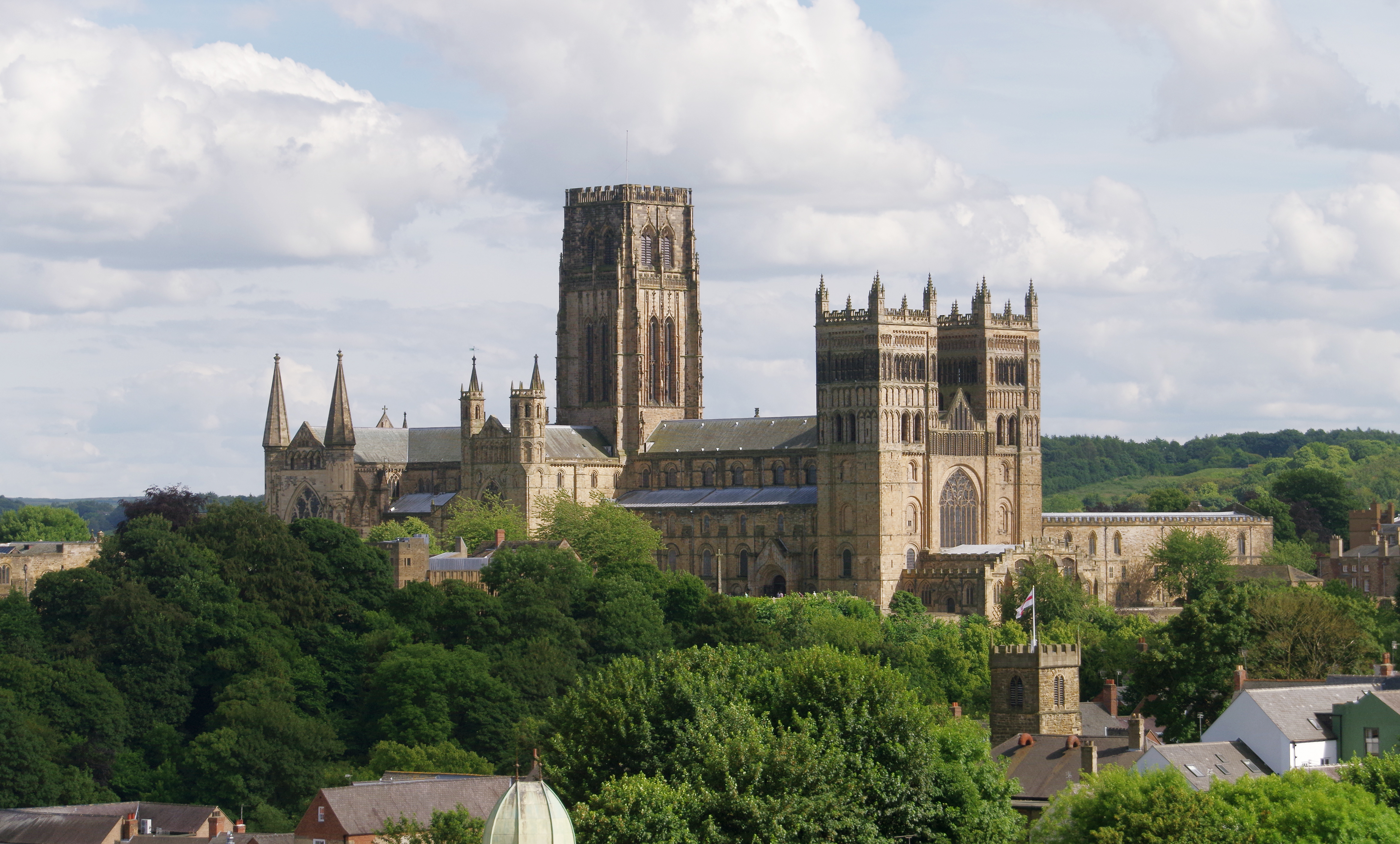
Durham Cathedral
According to legend, the monks knew they had found the right place when the coffin refused to move. They had been carrying Saint Cuthbert's remains for over a century, fleeing Viking raids from Lindisfarne in 875, resettling at Chester-le-Street, then fleeing again in 995. Following two milkmaids searching for a dun-colored cow, they arrived at a rocky peninsula formed by a loop in the River Wear. There, Cuthbert's coffin became immovable. The pragmatic explanation involves a highly defensible position and the political protection of the Earl of Northumbria. But the monks liked their version better, and so Durham Cathedral was born.
Stone Upon Stone
The present cathedral was begun on 11 August 1093, when Bishop William de St-Calais and Prior Turgot laid the foundation stone. William had already ejected the secular canons who controlled the shrine and replaced them with Benedictine monks from Wearmouth and Jarrow. His purpose was singular: to build a structure worthy of housing the bodies of Saint Cuthbert and the Venerable Bede. The choir was completed by 1096, and the bulk of the building was finished by 1133. What emerged was one of the supreme achievements of Romanesque architecture. The nave ceiling is the earliest surviving example of a pointed rib vault, a structural innovation that would eventually evolve into Gothic architecture. The massive incised pillars, alternating between round and compound, march down the nave with a rhythm that feels both ancient and modern. King Canute had been among the earliest pilgrims to the shrine. The flow of pilgrim money, combined with the defensible peninsula and the power of the prince-bishops, transformed a monastic encampment into a city.
Additions and Layers
Each century added something to the cathedral. In the 1170s, Bishop Hugh de Puiset attempted to build a Lady Chapel at the east end, but subsidence cracked the walls and forced him to add the Galilee Chapel at the west end instead. This five-aisled porch now holds the tomb of the Venerable Bede. The western towers rose around 1200. In the 1230s, the east end was expanded in the Early English Gothic style, creating the Chapel of the Nine Altars. The Perpendicular Gothic central tower was rebuilt in two stages in the 15th century after lightning destroyed the original. The medieval bishop's throne, claimed to be the highest in Christendom, still stands in the cathedral. The Neville Screen, an elaborate stone reredos behind the high altar, dates from the 1370s. Prior Castell's Clock, with its elaborate mechanism, has been keeping time since the early 16th century. Bishop Cosin added the ornate choir stalls and a towering font cover in the 17th century. Each addition speaks in the architectural language of its era, yet the whole holds together with remarkable coherence.
Prison and Sanctuary
Durham Cathedral has witnessed more than worship. During the Wars of the Three Kingdoms in the 1640s, the cathedral was used to hold 3,000 Scottish prisoners of war captured at the Battle of Dunbar. Seventeen hundred of them died inside the building, from cold, disease, and starvation. The prisoners burned anything combustible for warmth, including medieval woodwork and choir stalls, though they reportedly spared a clock bearing a Scottish thistle. The scale of suffering within those walls is difficult to comprehend. Archaeological work has uncovered mass graves in the cathedral grounds. These were real people who endured unimaginable conditions within a building designed to glorify God. Their story is a necessary counterpoint to the architectural splendor.
The World Recognizes Durham
In 1986, UNESCO designated Durham Castle and Cathedral as a World Heritage Site, recognizing the cathedral as the largest and most perfect example of Norman architecture in England. In 2001, BBC Radio 4 listeners voted it Britain's favorite building. The cathedral library, housed in the former monks' refectory, holds collections dating back to the 6th century, including fragments of Bede's own writings. Nearly 400,000 visitors walked through its doors in 2024. From the air, the cathedral dominates Durham's wooded peninsula, its three towers rising above the River Wear in a composition that has barely changed in 900 years. The coffin that could not be moved anchored a building that refuses to be forgotten.
From the Air
Located at 54.77N, 1.58W on a dramatic wooded peninsula formed by a loop in the River Wear. The cathedral's three towers are unmistakable from the air, rising above the surrounding medieval city. Durham Castle sits adjacent to the north. Nearest airports: EGNV (Teesside International) approximately 20 miles south; EGNT (Newcastle) approximately 15 miles north. The A1(M) motorway runs north-south to the west of the city.