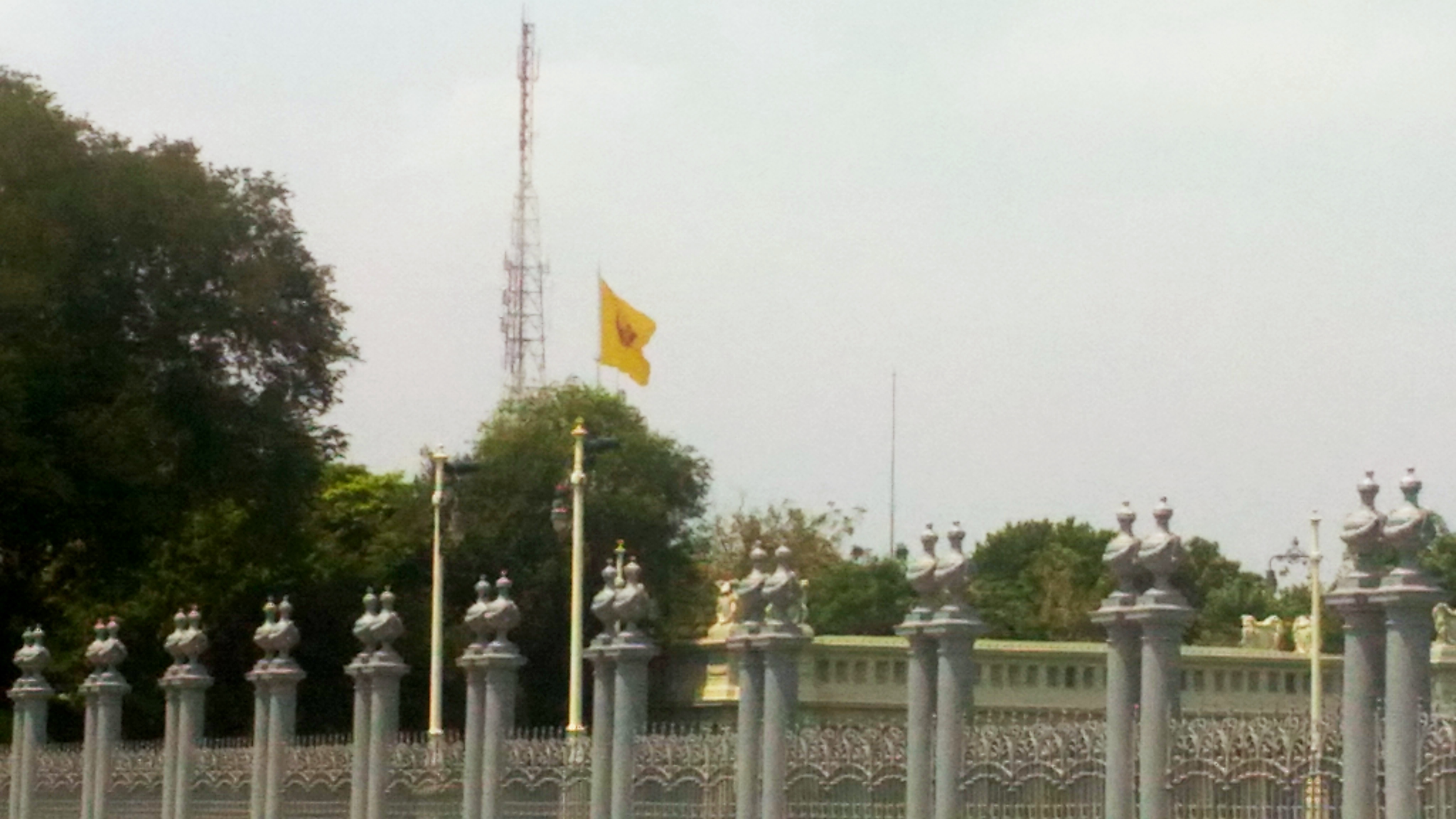
Dusit Palace
King Chulalongkorn could not breathe. By the 1890s, the Grand Palace that had housed every Chakri monarch since 1782 had grown so dense with buildings that air barely moved through its Inner Court. Epidemics swept the crowded compound with grim regularity, and the summer heat, trapped between closely packed walls, left the king physically ill after prolonged stays. He took to escaping on long walks through the countryside north of Bangkok. On one of those walks, passing through farmlands and orchards between the Padung Krung Kasem and Samsen canals, he saw the space he needed -- and began buying it with his own money from the Privy Purse.
A Celestial Garden Takes Shape
Chulalongkorn's 1897 tour of Europe crystallized the vision. He had seen how monarchs in London, Paris, and Berlin lived in palaces set within vast gardens, and he returned to Bangkok determined to build something similar. The farmlands he had been acquiring became Suan Dusit -- the celestial garden. The first structure was a modest single-story wooden house where the king, his consorts, and children could escape the Grand Palace for short stays. But Chulalongkorn liked the garden so much that occasional visits became near-permanent residence. The name changed accordingly: from Suan Dusit (celestial garden) to Wang Dusit (celestial dwelling). His brother Prince Narisara Nuvadtivongs supervised the design alongside the German architect C. Sandreczki, and apart from the prince, every member of the planning team was European. Construction ran from 1897 to 1901, and the compound eventually covered more than 64,749 square meters.
Walls Made of Water
Unlike the Grand Palace, where thick masonry walls separated the outer, middle, and inner courts, Dusit Palace used canals and gardens as its boundaries. The effect was revolutionary for Thai royal architecture: openness replaced enclosure, and the breeze that the Grand Palace had strangled moved freely through the compound. Chulalongkorn allocated different residential halls and gardens to his consorts and children, connecting them through gates named after motifs on blue and white Chinese porcelain ware that the king selected personally. Gates received names inspired by human or animal figures; pathways took their names from floral patterns. The system was both aesthetic and practical -- a royal address book rendered in porcelain and landscape.
Teak, Marble, and a Mansion Rebuilt
The jewel of the early compound was the Vimanmek Mansion, built entirely of golden teak in 1900. It was not originally constructed at Dusit Palace at all -- the mansion first rose on Ko Sichang in Chonburi Province, a coastal retreat. When Chulalongkorn decided he wanted it closer, he ordered the entire building dismantled, shipped to Bangkok, and reassembled within the palace grounds in 1901. The compound grew steadily after that. The Abhisek Dusit Throne Hall went up in 1904 as a banqueting space and now houses the Thai Handicrafts Museum. The Amphorn Sathan Residential Hall followed in 1906 and remains the current residence of King Vajiralongkorn. The monumental Ananta Samakhom Throne Hall, completed in 1915 (its foundation stone laid in 1908), served as Parliament from 1932 to 1974 before being returned to the crown. The Chitralada Royal Villa, added in 1913, became King Bhumibol Adulyadej's primary home from 1957 until his death in 2016.
Five Reigns Under the Trees
Dusit Palace has sheltered five monarchs across more than a century. Chulalongkorn made it his primary residence, followed by Vajiravudh (Rama VI) and Prajadhipok (Rama VII). After the upheavals of the 1932 revolution and decades of political change, Bhumibol Adulyadej (Rama IX) settled into the Chitralada Royal Villa, making it the quiet center of Thai royal life for nearly sixty years. When Vajiralongkorn (Rama X) assumed the throne, he continued living at the Amphorn Sathan Residential Hall, the home he had already occupied. In 2019, the National Assembly moved to its new building, the Sappaya-Sapasathan, and the old parliament structure was demolished. The cleared land merged back into the palace compound -- the celestial garden still expanding, still absorbing the city around it. Today, several buildings within the precinct house museums and exhibitions, though only a few are open to the public.
From the Air
Located at 13.774N, 100.512E in Bangkok's Dusit district, north of Rattanakosin Island. The compound's green lawns and scattered buildings are distinguishable from surrounding urban density at 2,000-3,000 feet. The Ananta Samakhom Throne Hall's white dome is a useful reference point. Look for the Royal Plaza and equestrian statue of King Chulalongkorn to the south of the complex. Nearest airports: Don Mueang (VTBD) approximately 15 nm north; Suvarnabhumi (VTBS) approximately 17 nm east-southeast.