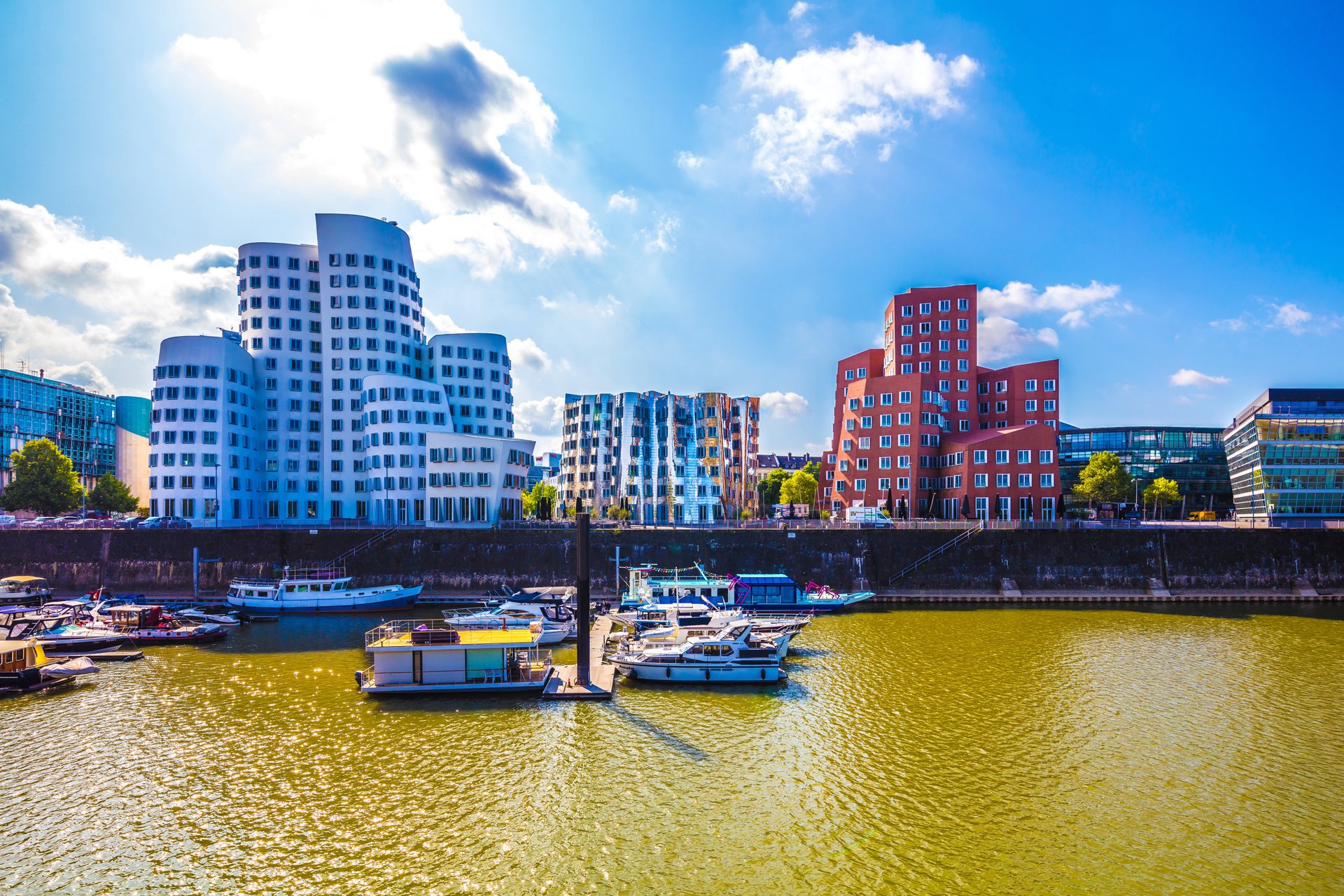
Dusseldorf
On the Immermannstrasse, sushi restaurants share the sidewalk with German bakeries and a Japanese supermarket called OK Trading anchors a block where you can buy fresh sashimi, manga, and rice cookers without crossing the street. This is Little Tokyo, the heart of the largest Japanese community in Germany - approximately 8,000 Japanese residents in greater Dusseldorf, drawn here over six decades by the headquarters of corporations like Mitsubishi and Toshiba and ITOCHU. A few kilometers away, in a low building on Mintropstrasse, four men who called themselves Kraftwerk built the album Autobahn in 1974 and changed what electronic music could be. The same city. The same year. The cartwheelers spinning in bronze on the storm drains. The bar district locals call the longest bar in the world. Dusseldorf does not quite fit any single description of a German city.
From Fishing Village to Court City
The first mention of Dusseldorf dates from sometime between 1135 and 1159; in 1162 it appeared in records as Thusseldorp - the village on the Dussel. For its first century it was a small farming and fishing settlement on the Rhine. Then, in 1288, after the Counts of Berg won the Battle of Worringen and broke the Archbishop of Cologne's regional power, Dusseldorf received city rights. Through the late Middle Ages and the Renaissance it grew under the Dukes of Berg, then the United Duchies of Julich-Cleves-Berg. Elector Jan Wellem made it his court residence at the end of the seventeenth century and his wife Anna Maria Luisa de' Medici brought Italian taste to the Rhine. They built the world's first independent picture gallery here. When Elector Charles Theodore inherited Bavaria and moved his court to Munich in 1777, he took the entire art collection with him - now the foundation of Munich's Alte Pinakothek. Dusseldorf got it back eventually, in different form. The city today is one of Germany's primary art centers.
Heine and the Black-Silk Lady
Heinrich Heine was born here in 1797, in a modest house on Bolkerstrasse in the Altstadt. He grew up watching the old castle decay across the Burgplatz - the same castle that would burn finally in 1872 - and remembered the legend of a black-silk lady without a head who haunted its empty halls. Heine became one of the great German poets of the nineteenth century, his lyrical clarity and ironic political eye still studied in classrooms today. The city named its university after him in 1989 - the Heinrich-Heine-Universitat in the southern part of the city, with about 36,000 students. The city also awards the Heinrich Heine Prize every two years to individuals who, through their intellectual work in the spirit of the human rights for which Heine advocated, promote social and political progress. Past laureates include Vaclav Havel and Amos Oz. Heine, who spent his last years in exile in Paris and died there, would have appreciated the irony of being honored most thoroughly by the city he could only return to as a name on a building.
The Longest Bar
The Altstadt - the old town - covers half a square kilometer of cobbled streets along the Rhine, and Dusseldorfers like to claim it contains over 260 bars and pubs. Many serve Altbier, the dark, copper-colored top-fermented beer that took its name in the nineteenth century to distinguish itself from the new pale lagers sweeping Germany. Five brewpubs still produce Alt on site, including Schumacher, which opened in 1838 and pioneered the modern Alt style by lagering the beer longer than tradition required. The standard pour is a 0.25-liter glass, replaced automatically by the waiter unless you set a coaster on top to signal you've had enough. Each brewery except one produces a secret seasonal version - Sticke at one brewery, Stike (no c) at another, Latzenbier at Schumacher, Weihnachtsbier at Fuchschen for Christmas Eve. A few blocks east, the Konigsallee - the Ko - runs as a wide canal-lined avenue past Cartier and Prada and Chanel storefronts, with some of Germany's highest retail rents.
Wir sind die Roboter
We are the robots, Kraftwerk announced in 1978, in songs that sounded like factories thinking. The band formed in Dusseldorf in 1970, founded by Ralf Hutter and Florian Schneider, and built an electronic music vocabulary that subsequent decades of pop, hip-hop, and techno would borrow from continuously. Their studio Kling Klang sat near the Hauptbahnhof for decades. They were not alone here. Neu! formed in 1971 after Klaus Dinger and Michael Rother split from Kraftwerk, and invented the motorik beat that would echo through ambient music and post-punk. La Dusseldorf, Die Krupps, Die Toten Hosen, D.A.F. - the city produced a strand of music whose influence reached well beyond any reasonable expectation for a town of 650,000 on the Rhine. Today Dusseldorf is also home to Joseph Beuys's legacy at the Kunstakademie, to the Dusseldorf School of Photography that gave the world Andreas Gursky and Thomas Struth, and to the K20/K21 art museums whose Picassos and Klees and Beuys installations make it possible to spend an entire day walking from one Düsseldorf masterpiece to the next.
Carnival, Cartwheels, and Mostertpottche
Carnival here begins, like everywhere in the Rhineland, on November 11 at 11:11 a.m., reaches its climax on Rosenmontag with a long parade through the streets, and ends on Ash Wednesday. The Dusseldorf rivalry with neighboring Cologne plays out fiercely at carnival, in football, in ice hockey, and most pointedly in beer - they drink Kolsch in Cologne and Alt here, and bringing one into a bar in the other city remains a quietly dangerous move. The city's oldest symbol is the cartwheeler, the Dusseldorfer Radschlager, the cartwheel-doing child whose origin is uncertain but whose image appears on souvenirs, fountains, storm drains, and the door knocker of the Lambertus church. A cartwheeler competition has been held annually since 1971. Local cuisine includes Himmel und Ad - black pudding with apple-mashed potato - and Rheinischer Sauerbraten, plus the famous Dusseldorf mustard, served in a brown ceramic Mostertpottche so distinctive that Vincent van Gogh painted one in a still life in 1884.
From the Air
Dusseldorf sits at 51.23 degrees north, 6.78 degrees east, on the right bank of the Rhine in the center of the Rhine-Ruhr metropolitan region. The dominant visual feature is the river itself, bending north past the Altstadt with the Schlossturm visible on the riverbank. The Rheinturm telecommunications tower (240 m, Germany's tenth-tallest structure) stands south of the Altstadt and is visible from far away. Eight bridges span the Rhine within the city. Dusseldorf Airport (ICAO EDDL) is 7 km north of downtown. Cologne-Bonn (EDDK) lies 50 km south. North Rhine-Westphalia has Germany's densest motorway network - the A3, A44, A46, A52, A57, A59, and A524 all serve the city.