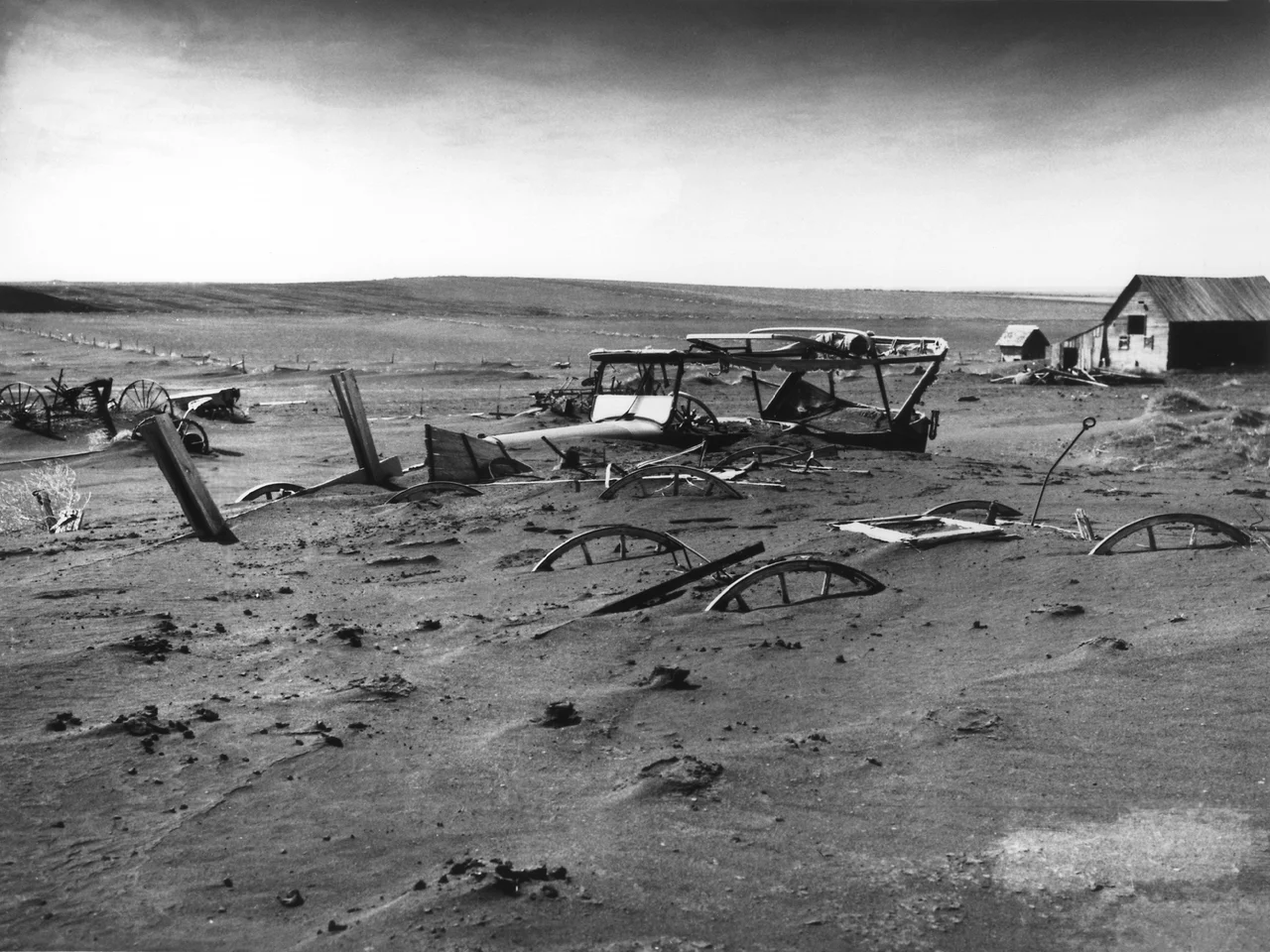

Dust Bowl Region
In the 1930s, the Southern Great Plains experienced an environmental catastrophe without precedent in American history. Drought, combined with decades of aggressive plowing that had stripped the land of its native grasses, exposed loose topsoil to winds that carried it away in massive dust storms. 'Black blizzards' rolled across the plains, burying farms, drifting against houses like snow, and turning noon to midnight. On April 14, 1935 - 'Black Sunday' - the worst storm blackened skies from Canada to Texas. An estimated 300 million tons of topsoil blew away that day. The Dust Bowl, as a reporter named it, displaced 2.5 million people, devastated agriculture across five states, and forced a fundamental reconsideration of how Americans used their land. The Okies who fled to California became symbols of Depression-era suffering, immortalized by John Steinbeck in 'The Grapes of Wrath.'
The Causes
The Dust Bowl resulted from a collision of climate and agriculture. The Southern Plains had always been dry, sustained by deep-rooted native grasses that held the soil in place. In the early twentieth century, high wheat prices and new technology encouraged farmers to plow millions of acres, replacing grass with shallow-rooted crops. When drought arrived in 1931, the exposed soil had nothing to anchor it. Wind lifted the dirt and carried it in clouds that blocked the sun. The dust drifted into dunes; it buried tractors and fences; it sifted through doors and windows, coating everything inside. People and animals died of 'dust pneumonia.' The most affected area - the Oklahoma and Texas panhandles, southwestern Kansas, southeastern Colorado, and northeastern New Mexico - became known as the 'Dust Bowl.'
Black Sunday
April 14, 1935, began unusually clear after days of dust storms. People emerged to clean up. Some went to church. Then, around 5 PM, the sky to the north turned black. A massive cold front was dragging dust from four states in a single rolling wall. When it hit, day became night instantly. Visibility dropped to zero. Cars crashed. People caught outside suffocated. The storm lasted hours, depositing dust across the eastern United States and out to ships in the Atlantic. An Associated Press reporter, covering the storm, used the phrase 'dust bowl' in his dispatch. The name stuck.
The Exodus
By the mid-1930s, many Dust Bowl farmers had lost everything. Banks foreclosed on mortgages; the government bought out others. An estimated 2.5 million people left the Plains states during the 1930s. Many headed to California, drawn by rumors of jobs in agriculture. They traveled Route 66 in overloaded cars, seeking work as migrant laborers. Californians called them 'Okies' regardless of their origin - a term that combined economic desperation with ethnic prejudice. They were unwanted, exploited, and abused. John Steinbeck documented their suffering in 'The Grapes of Wrath' (1939), which won the Pulitzer Prize and shaped how America remembered the crisis.
The Response
The Dust Bowl forced fundamental changes in American land use. The Soil Conservation Service, created in 1935, promoted techniques to prevent erosion: contour plowing, cover crops, windbreaks. The government planted 200 million trees in shelterbelts across the Plains. Farmers were paid to take land out of production, allowing it to recover. These programs worked - combined with the return of rainfall in the late 1930s, the Dust Bowl gradually ended. But the underlying vulnerability remains. Periodic droughts still threaten the Plains. The Ogallala Aquifer, which irrigates much of the region today, is being depleted faster than it recharges. The Dust Bowl may have been a warning, not an anomaly.
Visiting Dust Bowl Sites
The Dust Bowl affected a huge region; no single site captures the entire story. The Dust Bowl era is interpreted at multiple locations. The Panhandle-Plains Historical Museum in Canyon, Texas, has extensive Dust Bowl exhibits. Boise City, Oklahoma - struck by five dust storms in a single day during Black Sunday - has a small memorial. The Oklahoma Route 66 Museum in Clinton tells the migration story. The National Steinbeck Center in Salinas, California, explores 'The Grapes of Wrath' and its context. The landscape itself has recovered - green fields where dust once drifted - though periodic droughts reveal how fragile the recovery remains. Amarillo, Texas, is the largest city in the region (Rick Husband Amarillo International Airport, AMA). The experience is one of understanding place through history rather than visible remains.
From the Air
The Dust Bowl affected approximately 100 million acres across the Southern Great Plains, centered on the Oklahoma and Texas panhandles and adjacent areas of Kansas, Colorado, and New Mexico (approximately 37°N, 102°W). From altitude, the region appears as flat farmland - green where irrigation reaches, brown where it doesn't. The contrast between irrigated and dryland farming is visible. The wind that carried away the topsoil still blows; only the grass and farming practices have changed.
Nearby Stories
- Boise: The Idaho Capital Where California Refugees Landed 34 km away
- First Battle of Adobe Walls 102 km away
- Bent's Fort 110 km away
- Capulin Volcano 119 km away
- Fort Mann 139 km away
- Bent's Old Fort National Historic Site 143 km away
- Boot Hill Cemetery, Dodge City 163 km away
- Fort Union National Monument 231 km away