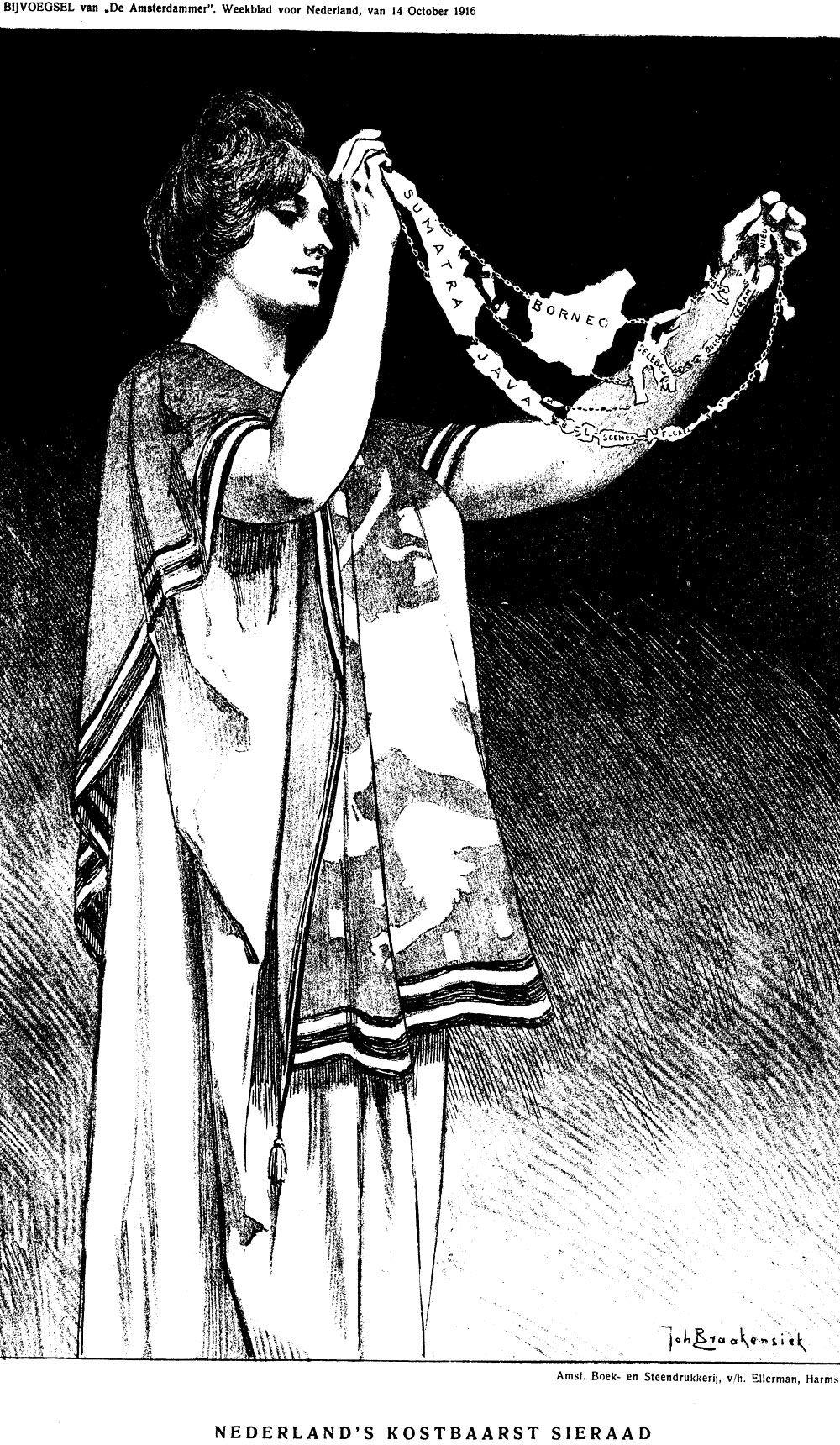
Three Centuries of Spice and Subjugation
The nutmeg that flavored a Dutch merchant's dinner in 1650 was worth more than gold by weight, and people were dying for it. On the tiny Banda Islands in the eastern reaches of the Indonesian archipelago, the Dutch East India Company had solved its supply problem with ruthless efficiency: deport or kill the local population, replace them with enslaved laborers, and guard the groves with armed garrisons. It was a business model that would define three and a half centuries of colonial rule across thousands of islands - a project so vast and so violent that its consequences still shape Indonesia today.
The Company That Became a Country
The Dutch East India Company, or VOC, arrived in the Indonesian archipelago in 1595, chasing the spice trade that had enriched Portuguese and Spanish merchants for decades. By 1602, the Dutch government had consolidated its competing trading ventures into a single corporation with extraordinary powers: the VOC could wage war, negotiate treaties, establish colonies, and mint its own coins. Its capital was established at Batavia - modern Jakarta - which became the hub of a commercial network stretching from Japan to South Africa. The VOC built its fortune on monopolies in nutmeg, cloves, cinnamon, and pepper, then expanded into coffee, tea, sugar, rubber, and opium. When the company went bankrupt in 1800, the Dutch government simply took over, transforming a corporate enterprise into a state colony that would endure until 1949.
The Human Cost of Profit
Beneath the ledger books lay an architecture of coercion that touched millions of lives. The VOC expanded upon existing indigenous slavery, with an estimated one million enslaved people active at the system's peak in the 17th and 18th centuries. Enslaved people worked as domestic servants, plantation laborers, and concubines, and punishments for resistance included whipping, mutilation, and execution by burning. When slavery was formally abolished in 1860, it was mostly limited to Java - on more distant islands, where enforcement would have been expensive and politically disruptive, enslavement persisted well into the 20th century. The Cultivation System, introduced in 1830, compelled Javanese farmers to devote their best land to export crops like coffee and sugar. Over a million farmers worked under this system, and the mortality rate on Java would have been 10 to 20 percent higher if it had not been abolished in 1870. After abolition, the coolie system took its place - over 500,000 indentured laborers were shipped to plantations on Sumatra and Java, where death rates reached 25 percent in some locations.
Conquest by Increments
Dutch control over the archipelago was never total, and it was never uncontested. From the late 16th century to the declaration of independence in 1945, indigenous resistance flared across the islands. The Padri War consumed Sumatra from 1821 to 1838. The Java War, led by Prince Diponegoro, raged from 1825 to 1830. The Aceh War, beginning with a Dutch invasion in 1873, dragged on for nearly four decades of guerrilla resistance before an Acehnese surrender in 1912. Bali was subjugated by military conquest in 1906 and 1908, and the remaining independent kingdoms in Maluku, Kalimantan, and Nusa Tenggara were brought under control between 1901 and 1910. Each conquest carried its own toll - hundreds of thousands dead over the course of the 19th century alone. The Dutch maintained order through what they called a "strategy of awe," which in practice meant slow, violent occupation or campaigns of destruction.
The End of the Colonial Dream
Japan's invasion in January 1942 dismantled the colonial state in weeks. The Royal Dutch East Indies Army surrendered on Java by March 8, and the Japanese interned all Dutch citizens while training and arming young Indonesians - an ironic foundation for the independence movement that followed. Four million Indonesians died under Japanese occupation, according to a United Nations report. When Japan surrendered on August 15, 1945, nationalist leaders Sukarno and Mohammad Hatta declared independence the very next day. The Netherlands deployed 220,000 troops to reclaim their colony, fighting a four-and-a-half-year war that included summary executions of villagers and the mass murder of 364 Indonesians at Galoeng Galoeng. International pressure, including an American threat to terminate Marshall Plan aid, forced the Dutch to recognize Indonesian sovereignty in December 1949. Their last possession, Western New Guinea, was surrendered in 1962.
What Remained
The colonial legacy runs deeper than politics. The Dutch legal system was adopted by independent Indonesia. The University of Indonesia and the Bandung Institute of Technology, both founded under colonial rule, became the country's most prestigious institutions. Rijsttafel, the elaborate rice table the Dutch invented to show off their colony's abundance, is now standard fare in restaurants across the Netherlands. Nearly 300,000 Dutch citizens - most of them Indo-Europeans born in the islands - repatriated to a country many had never seen, bringing Indonesian cuisine, language, and culture into Dutch daily life. Today, almost every town in the Netherlands has a toko or an Indonesian restaurant. The colony's influence flows in both directions: roughly one-fifth of contemporary Indonesian vocabulary traces to Dutch. The relationship between colonizer and colonized, between exploitation and exchange, remains as tangled as the spice routes that started it all.
From the Air
Centered at approximately 5.00S, 120.00E, reflecting the vast extent of the Dutch East Indies across the Indonesian archipelago. Key colonial centers included Batavia/Jakarta (WIII), Surabaya (WARR), and Semarang (WARS) on Java. The Banda Islands, site of the nutmeg monopoly, lie in the Banda Sea east of Sulawesi. The Aceh region is visible at the northern tip of Sumatra. From cruising altitude, the scale of the archipelago - over 17,000 islands stretching 5,000 km from Sabang to Merauke - conveys the ambition of the colonial project.