Dutch Empire
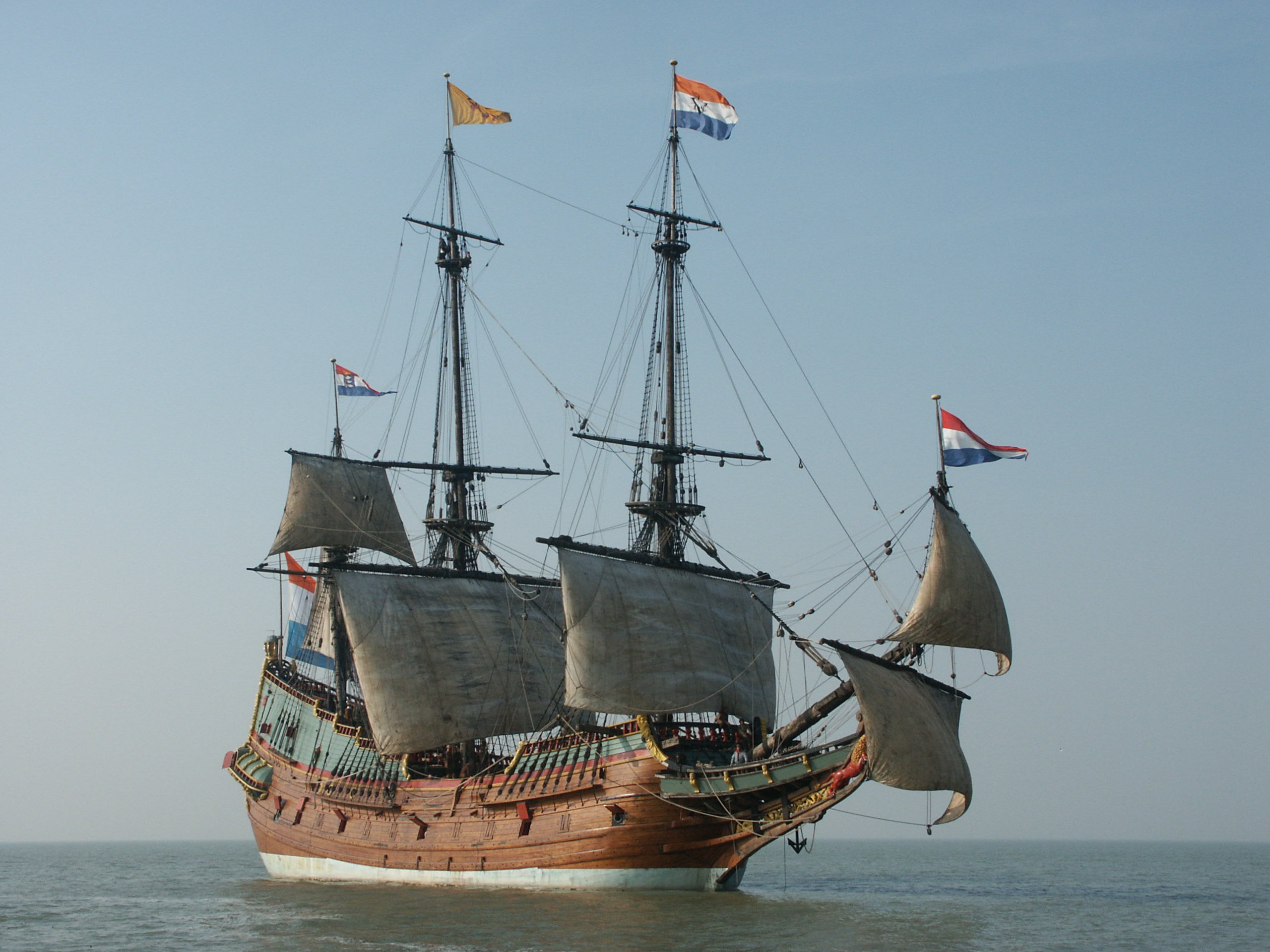
The Dutch did not so much conquer their empire as incorporate it. The United East India Company - the VOC, founded 1602 - was the first joint-stock corporation in history, traded on the world's first stock exchange, and at its peak was worth more than most national governments. Its directors were known as the Heeren Zeventien, the Gentlemen Seventeen, and they ran from a townhouse on Amsterdam's Oude Hoogstraat what was effectively a private military state with its own armies, its own coinage, its own treaties, and its own gallows. The empire it built reached from Manhattan to Nagasaki, from the Cape of Good Hope to the Banda Islands. It was administered like a balance sheet. The cost of the balance sheet, paid by people who never appeared on it, is the part of the story that the Netherlands is still learning to tell.
The Banda Massacre
In 1621, the VOC's governor-general Jan Pieterszoon Coen sailed to the Banda Islands - ten small volcanic specks in what is now Indonesia, the only place on Earth where nutmeg then grew. The Bandanese had refused to honour a treaty granting the Dutch a monopoly on the spice. Coen's response was systematic. Over the course of a few weeks, his soldiers and Japanese mercenaries killed or starved roughly fifteen thousand people - most of the islands' population. The survivors were enslaved and shipped to Batavia. The islands were repopulated with Dutch planters and enslaved Africans and Asians to work the nutmeg groves. Coen wrote home unapologetically; the directors in Amsterdam approved his bookkeeping. Banda nutmeg made fortunes for two centuries afterward. The Bandanese, as a people, did not survive their own islands. Coen's statue still stands in Hoorn, the city of his birth, and what to do with it is the kind of question the Netherlands has only recently begun to ask out loud.
The Atlantic Triangle
On the other side of the world, the Dutch West India Company - WIC, the slightly less successful sibling of the VOC - ran a different kind of operation. It built forts along the West African coast at Elmina, Axim, and a string of trading posts in modern Ghana, Senegal, Gambia, and Angola. It bought enslaved people from local rulers, packed them into ships, and sold them in the Caribbean and on the South American mainland. Conservative scholarly estimates put the number of Africans the Dutch transported into slavery at around 600,000 over the life of the trade. The destinations were the sugar plantations of Suriname, the salt and trading hubs of Curacao, the gold and ivory factories at the coast. The slogan along the way was 'gold, ivory, and slaves' - the third category, of course, being human beings who were ripped from families, branded, chained in ship holds across the Middle Passage, and sold to a life of forced labour from which most never returned. In 1863 the Netherlands finally abolished slavery in its colonies. The enslaved were forced to work for another ten years of so-called apprenticeship before being legally free. The descendants of those people are large communities today in Suriname, the Dutch Caribbean, and the Netherlands itself.
New Netherland and the Trade
On the east coast of North America, the Dutch built a smaller colony called New Netherland - the area that became New York, New Jersey, Delaware, and parts of Connecticut. They founded New Amsterdam on the southern tip of Manhattan in 1624, after their first settlement on the Hudson kept flooding. The land was taken from the Lenape and other Algonquian peoples through what the Dutch called a purchase but what was almost certainly understood by the sellers as a hunting-rights agreement; the colonists then expanded relentlessly. In 1664, with four English frigates in the harbour, the colony surrendered without a fight. The settlers had been begging the Netherlands for help against attacks they had provoked themselves, and the WIC had concluded the colony was not worth defending. In the treaty that followed, the Dutch kept Suriname and the English kept Manhattan. It is one of the most consequential real-estate trades in history. Place names along the Hudson - Harlem, Brooklyn, the Bronx, Yonkers - are corrupted Dutch. So is much of the language of commerce: cookie, coleslaw, boss, dollar.
The Cape and What Came After
In 1652, the VOC sent Jan van Riebeeck to set up a refreshment station at the Cape of Good Hope - a stop where ships rounding Africa could take on fresh water and vegetables on the long journey to Batavia. It was supposed to be small. It became a colony. The Dutch settlers - later called Boers - pushed inland, fought the Khoikhoi and the San for grazing land, imported enslaved people from Madagascar and West Africa, and built a settler society that the British took over in 1795 and again, permanently, in 1806. The Dutch sold the colony away in 1814. The settler society they left behind continued to expand, ultimately producing the political system that became apartheid in 1948. The Dutch connection to South Africa stayed warm well into the 1960s, with significant Dutch emigration to the country after the Second World War. The Afrikaans language is a Dutch creole. The history is shared, including the parts that nobody now wants to claim.
Indonesia, and the Long Goodbye
The biggest piece of the empire was always Indonesia - the Dutch East Indies, run from Batavia (now Jakarta), built on spices first and on sugar, coffee, and rubber after that. The colony ran for more than three centuries and at its height generated wealth that paid for canals, museums, and a national mythology back in the Netherlands. In 1945, two days after Japan surrendered at the end of the Second World War, Indonesia declared independence. The Dutch refused to recognise it and fought a four-year war to hold the colony, conducting what they called police actions and what historians now call a war that killed perhaps 100,000 Indonesians. The Netherlands lost. Indonesia became independent in 1949. The Dutch held New Guinea for another fourteen years and then handed it to Indonesia in 1963. Suriname became independent in 1975. The Caribbean islands - Aruba, Curacao, Sint Maarten, Bonaire, Sint Eustatius, Saba - remain inside the Kingdom in different constitutional arrangements. The empire is gone. The diaspora it created is, today, one of the most visible parts of Dutch society. The rijsttafel on the menu at any Indonesian restaurant in Amsterdam is a colonial dish that came back. So did its cooks. So did their grandchildren.
From the Air
The Dutch Empire was administered from the Netherlands itself; the coordinates here (52.70 N, 5.25 E) mark the West Frisian coast where many VOC ships were built, fitted, and crewed - Hoorn, Enkhuizen, and the harbour towns of the old Zuiderzee. From the air, Amsterdam (EHAM), Rotterdam (EHRD), and the long line of the IJsselmeer are visible. The major surviving VOC buildings - the East India House on Oude Hoogstraat in Amsterdam, the Westfries Museum in Hoorn, the West-Indisch Huis on the Herenmarkt - are all within an hour of each other. The empire is no longer on the map. Its archives, ledgers, and consequences are.