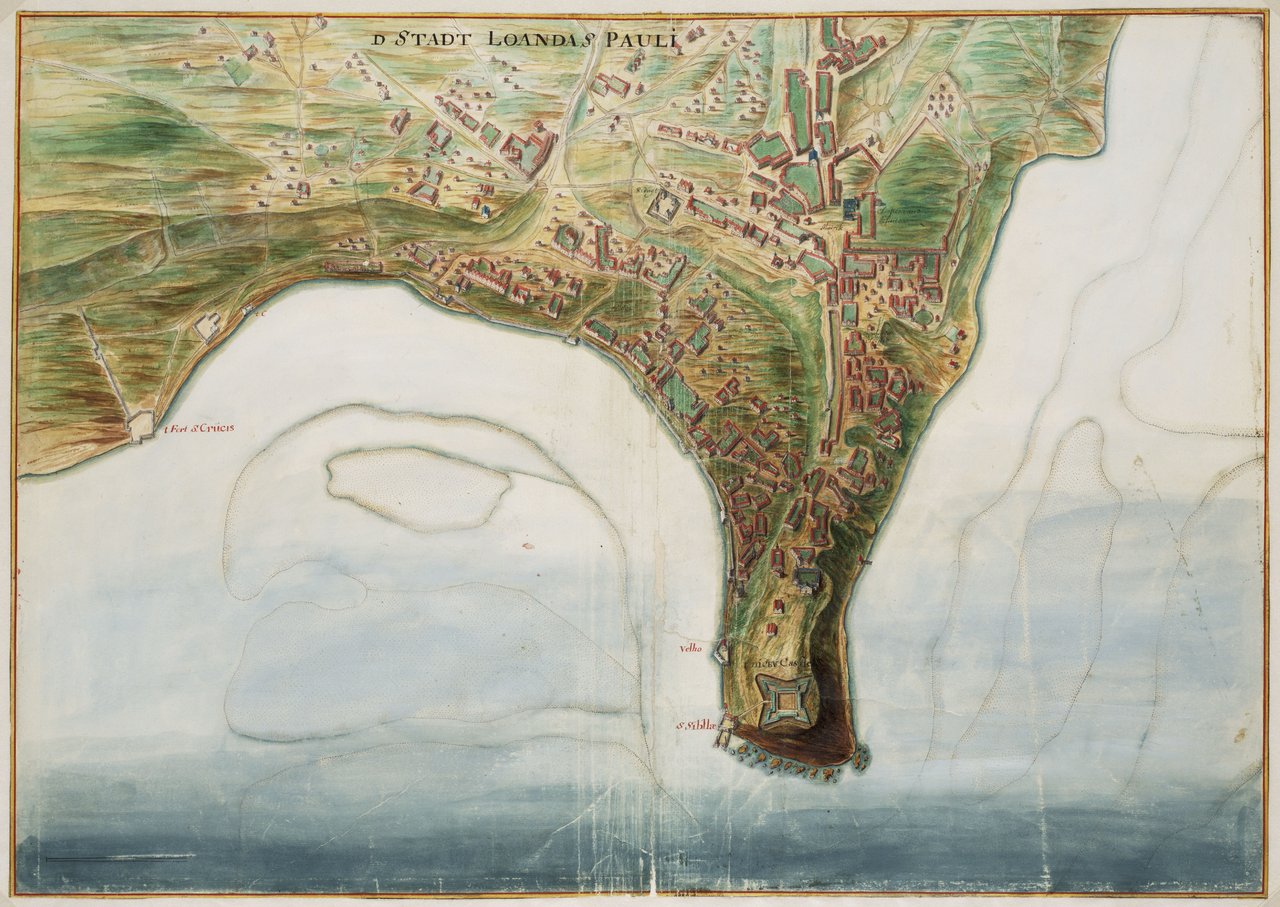
Dutch Loango-Angola
Two thousand one hundred and forty-five Dutch troops splashed ashore near Luanda on 25 August 1641, and eight hundred Portuguese -- soldiers and civilians alike -- abandoned the city without a fight. The conquest looked easy, almost bloodless. It was anything but. Over the next seven years, the Dutch would discover that holding a colonial capital and controlling a colony were very different things. Their brief, turbulent rule of Angola would entangle three European empires, two African kingdoms, and a queen whose military and diplomatic cunning outmatched them all.
The Groot Desseyn
The Dutch seizure of Luanda was not impulsive -- it was the culmination of a plan decades in the making. The Dutch West India Company, founded in 1621, had conceived the Groot Desseyn: a grand strategy to strip Portugal's Atlantic empire and redirect its wealth to Amsterdam. The first attempt came in 1624, when the legendary privateer Piet Hein tried to take Luanda but found the Portuguese had reinforced the city after an earlier Dutch probe by Filips van Zuylen. Four years later, Hein captured the Spanish treasure fleet at Matanzas Bay, filling the company's coffers and reigniting the plan. By 1630, the Dutch had seized Recife and Olinda, the heartland of Brazil's sugar plantations. But sugar without labor was worthless. Portugal controlled the slave trade from Angola, and the Dutch needed to break that monopoly. Luanda was the key.
Queen Nzinga's Gambit
When Admiral Cornelis Jol's fleet took Luanda, the Dutch immediately signed a treaty with Queen Nzinga of the Ndongo Kingdom. Nzinga was no passive ally -- she had been fighting the Portuguese for years, and she saw the Dutch as a weapon she could wield against her enemies. She attacked the Portuguese stronghold at Fort Massangano but failed to take it. The Portuguese, driven from Luanda but far from defeated, regrouped along the Bengo River and at Massangano, receiving reinforcements from Brazil. The Kingdom of Kongo also entered the alliance: King Pedro II had first proposed a joint attack on the Portuguese as early as 1622, and in 1643, the Count of Sonho sent his cousin Dom Miguel de Castro on a diplomatic mission to the Dutch Republic, traveling through Brazil and arriving in The Hague for an audience with Stadtholder Frederick Henry. African rulers were not spectators in this European conflict -- they were active strategists, pursuing their own interests through shifting alliances.
Lawyers, Merchants, and Mutinous Troops
The Dutch governed their new colony with characteristic commercial pragmatism -- and characteristic dysfunction. Two lawyers from Leiden University, Pieter Moorthamer and Cornelis Nieulant, were installed as civil administrators on 29 August 1641. When the West India Company decided to make Loango-Angola a separate commandment rather than place it under the administration of Dutch Brazil, they appointed a triumvirate including the experienced merchant Hans Mols, who had previously served as commandant of Cape Verde and chief factor at Elmina. But the arrangement quickly unraveled. By the time Mols arrived in April 1643, Moorthamer had left for Brazil. Nieulant died two months later. Mols found himself alone, commanding troops who openly disobeyed his orders. Directors came and went -- Heynderick van Redinckhoven arrived in 1644, then spent years begging to be recalled. The colony's administration was a revolving door of reluctant bureaucrats presiding over a venture that generated far less profit than Amsterdam had expected.
The Battle That Broke the Stalemate
The Dutch were not interested in conquering Angola's interior -- a fact that frustrated both Queen Nzinga and King Garcia II of Kongo, who had pressed them to drive the Portuguese out entirely. But by 1646, Dutch authorities realized they could not monopolize the slave trade just by holding the coastline while the Portuguese held Massangano and received supply ships from Brazil. In 1647, after Nzinga's forces had been defeated by the Portuguese, the Dutch finally agreed to reinforce her army. At the Battle of Kombi, the combined Dutch and Ndongo forces crushed a Portuguese army, then laid siege to Ambaca, Massangano, and Muxima. It was the high-water mark of Dutch Angola. The following year, Salvador Correia de Sa led a Portuguese fleet from Rio de Janeiro and recaptured Luanda in August 1648. Seven years of Dutch rule ended as abruptly as they had begun.
Profits After Empire
The loss of Luanda did not end Dutch involvement in the region. From about 1670 onward, the Dutch West India Company acquired enslaved people from the Loango coast -- north of the Congo River, beyond Portuguese control -- on a regular basis. Dutch free traders continued this commerce until well after 1730. The brief colonial episode had always been less about territory than about securing labor for the sugar plantations of Brazil. When the colony was lost, the trade simply moved to different shores. Today, the physical traces of Dutch Luanda have all but vanished. The Portuguese rebuilt, and centuries of subsequent history have layered over the seven years of Dutch occupation. What endures is the story of how the slave trade drew European empires into alliances with African kingdoms, and how those alliances served everyone's interests except those of the people being sold.
From the Air
Located at 8.00S, 13.00E, centered on Luanda, Angola's capital city on the Atlantic coast. The bay of Luanda and the Ilha de Luanda sandspit are visible from altitude. The Bengo River to the north and the route to Massangano inland are key geographic features of this colonial conflict. Nearest major airport: Quatro de Fevereiro International Airport, Luanda (FNLU). Best viewed at 5,000-10,000 feet to appreciate the coastal geography that made Luanda strategically valuable.