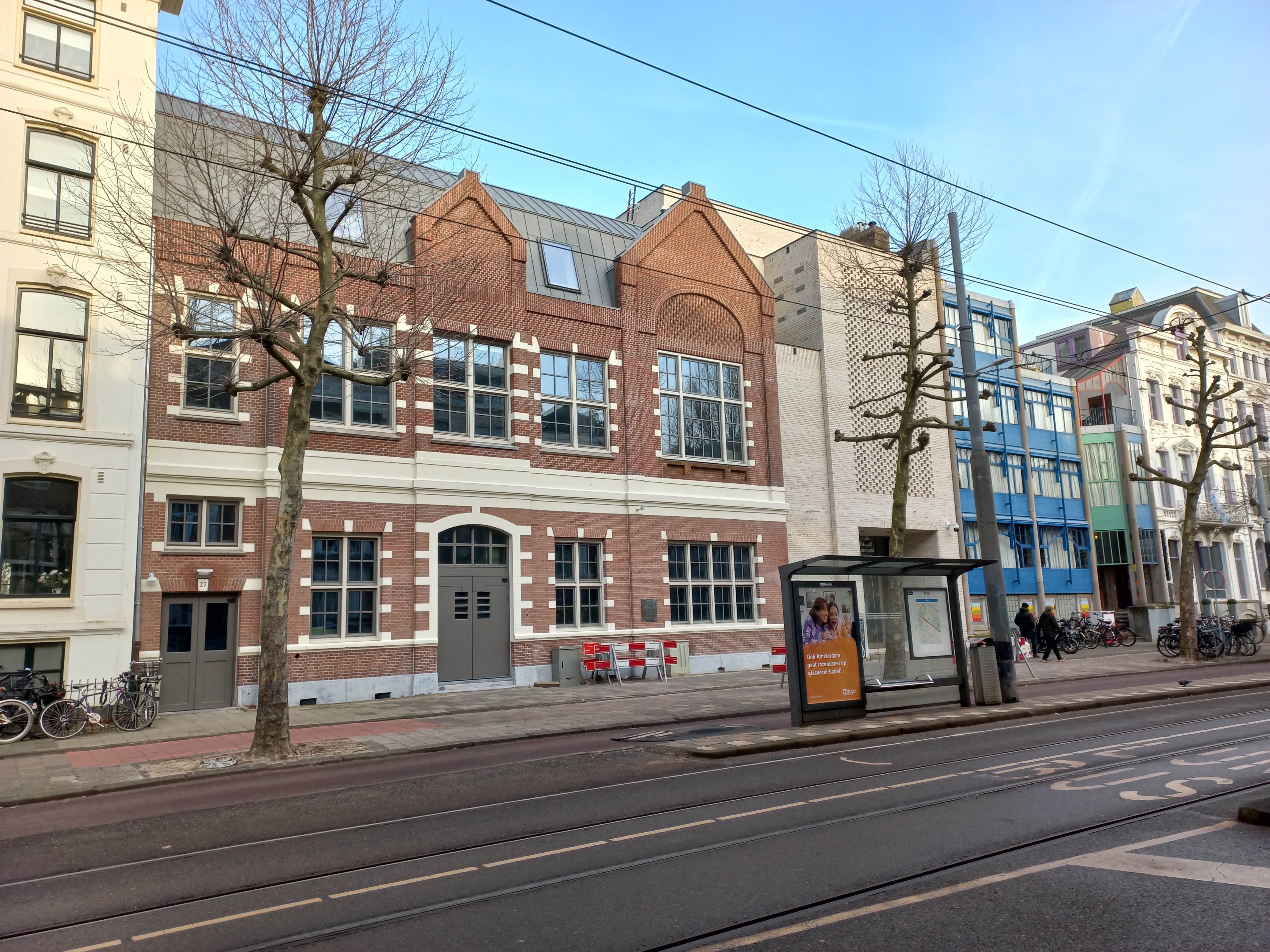
Dutch National Holocaust Museum
It took the Netherlands almost eighty years to build it. On 10 March 2024, King Willem-Alexander stood before the doors of a converted teacher-training college in Amsterdam's Jewish Cultural Quarter and opened the first official Holocaust museum in his country's history. Inside, the walls are covered - wall after wall after wall, the king's own words - with the hundreds of ordinances by which Dutch Jewish citizens were stripped of their lives. The museum tells the story through individual people: men, women, and children who had been Dutch citizens with equal rights since the eighteenth century, and whose rights were taken from them one regulation at a time. Three-quarters of the Netherlands' Jewish population - 102,000 people - did not survive what those regulations led to. This building exists so the country can finally say that out loud.
Wall After Wall After Wall
The museum's central exhibit is not artifacts. It is paperwork. A floor-to-ceiling display lists every law that progressively unmade Jewish life in the occupied Netherlands between 1940 and 1945. The king read some of them aloud at the opening, and the cadence of the list is its own kind of indictment. Mandatory termination of employment. Forced registration. Banishment from public life. No bicycle. No telephone. No savings. No home. No freedom of movement. No life. Each line was a sentence served by a real person. A teacher fired. A grandmother told to surrender her savings book. A child whose bicycle was taken away. The ordinances arrived one by one, often without public protest, because each next step seemed like only a small step further than the one before. The walls of this museum are a careful record of how civilization gives itself permission to disappear its neighbors. Read them all and you understand what Willem-Alexander meant when he said, quoting the historian who first put it this way: "Sobibor began in the Vondelpark with a sign that read 'Forbidden for Jews.'"
The Creche Across the Street
The museum stands beside what was once the Hollandsche Schouwburg, the Dutch Theatre. From 1942 the occupiers used it as a deportation hub - a holding pen where Jewish families from Amsterdam were assembled before being sent east to camps. Across the road stood the kindergarten, the childcare creche where Jewish children were separated from their parents to wait. And it was at that creche that a network of resistance workers, teachers, and ordinary Dutch civilians made a decision that has become one of the few clear sources of light from this part of Dutch history. They smuggled children out. Babies were hidden in laundry baskets, schoolbags, even bicycle panniers. Director Henriette Pimentel, her young assistant Walter Suskind, and a wider network of helpers worked with the Amsterdam University students and the Dutch underground to slip more than 600 Jewish children past the guards and into hiding places across the Netherlands. Pimentel did not survive Auschwitz. Suskind died in the death marches of early 1945, at an unknown location in central Europe. Most of the children they saved did survive, and lived because adults they would mostly never remember decided that the children were not deportable - whatever the laws said.
How Amsterdam's Jews Lived, and Did Not
The Jewish community in the Netherlands had been part of Dutch life for centuries. Sephardic Jews fled here from Iberian persecution in the sixteenth and seventeenth centuries; Ashkenazi Jews followed soon after. Since 1796 - the era of the Batavian Republic - Dutch Jews had been formal citizens with equal rights. Amsterdam was the heart of that community, and it was Amsterdam where the killing was most efficient. Scholars who have studied the Dutch numbers - the highest death rate among Western European Jews - point to several factors: the population's concentration in one city, the singular focus of Nazi policies, the cooperation of Dutch municipal authorities in registration and rounding-up, and the tragic structural position of the Jewish Council, which was forced to administer the very ordinances aimed at its own community. The figure is 102,000 - the largest fraction of a national Jewish population lost in any country in Western Europe. Behind that statistic are families: people who had names, jobs, addresses, dinner tables, plans for next week.
The Country Looks at Itself
For decades after the war, the Netherlands struggled to look directly at what had happened. The country told itself a story of resistance, and there had indeed been resistance - the creche workers, the people who hid Anne Frank's family, the strikers of February 1941 who walked out in protest of the first deportations. But there had also been cooperation, indifference, and a postwar silence that left survivors largely on their own. The opening of this museum is a reckoning that should have happened sooner. Even the opening itself revealed how unhealed the wounds are. About a thousand protestors gathered near the site to object to the attendance of the Israeli president, Isaac Herzog, in the context of the ongoing war in Gaza. The day was complicated. History does not arrive in clean ceremonies. But the building is open now, and as the king put it: there is no excuse for ignorance, no place for relativism, no room for ifs and buts. Knowledge of the Holocaust is not optional.
From the Air
Located at 52.367 N, 4.911 E in the historic Jewish Cultural Quarter of central Amsterdam. Geohash u173z. The museum stands across from the Hollandsche Schouwburg memorial and is part of a complex that includes the Portuguese Synagogue (Esnoga), the Joods Historisch Museum, and the National Holocaust Names Memorial - all walkable within a few blocks. Schiphol Airport (EHAM) lies 14 km southwest. The neighborhood is identifiable from above by the green space of the Plantage and the proximity to Artis Zoo. The museum is best experienced on the ground; from the air, the entire Jewish Cultural Quarter is a quiet cluster of red-tiled roofs east of the central canal belt.