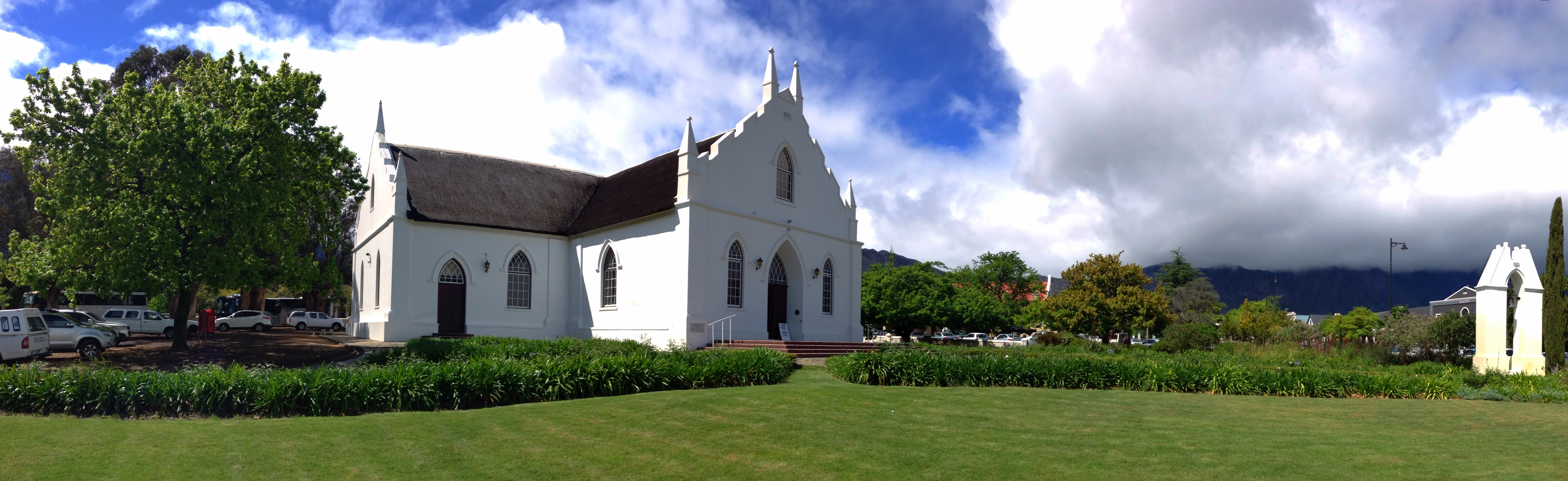
Dutch Reformed Church, Franschhoek
The church sits on the main road through Franschhoek, which is the only thing about its position that could be called understated. Behind it, mountains close in tight on the valley. Before it, the road runs through a town whose very name -- French Corner, in Dutch -- records a story of flight, refuge, and reinvention. The French Huguenots who arrived in 1688 had fled religious persecution in Europe, crossing an ocean to start over at the southern tip of Africa. They brought with them the knowledge of viniculture, and they planted the vines that would eventually make this valley one of the most celebrated wine regions in the world. The Dutch Reformed Church they built in 1847 stands as the architectural centre of that history, a whitewashed presence anchoring a town that has never quite forgotten where its people came from.
Refuge in the Valley of Elephants
When the Huguenots first arrived in this narrow valley, hemmed in by mountains on three sides, they found it full of elephants. They called it Oliphantshoek -- Elephant's Corner -- before the name Franschhoek took hold. The valley's isolation was part of its appeal: it offered distance from the colonial authorities in Cape Town and fertile soil for the European grape varieties the settlers knew how to cultivate. The church that eventually rose on the main road was a statement of permanence, a signal that these refugees intended to stay. Built in 1847 under the ministry of Reverend Pieter Nicolaas Ham, the first of a long line of ministers who would serve the congregation for over 150 years, the church represented not just faith but community -- the social nucleus around which Franschhoek organized itself.
From Dutch to Afrikaans
The church's records trace a linguistic transformation that mirrors the broader evolution of South African identity. For its first 80 years, services were conducted in Dutch, the language of the Cape Colony's European settlers. In 1929, the congregation switched to Afrikaans, the language that had been developing at the Cape for two centuries from a creole of Dutch, Malay, Portuguese, Khoisan, and other influences. The first church council minutes in Afrikaans date from December 1929. By 1933, Afrikaans Bibles had replaced Dutch ones, and by 1937, the congregation sang from an Afrikaans psalter. These dates mark something larger than a change in hymn books: they trace the moment when a colonial community began to define itself as something distinct from its European origins. In 1923, a new organ was purchased at a cost of 1,200 pounds, a significant investment that signalled the congregation's commitment to the building as a permanent home.
Earthquake, Restoration, and Memory
In 1967 and 1968, the church underwent extensive restoration at a cost of R60,000, a substantial sum that reflected both the building's deteriorating condition and the community's determination to preserve it. The timing proved fortunate. In 1969, an earthquake struck the region, but the recently restored structure suffered only minor damage -- a near miss that would have been catastrophic a year earlier. The building was declared a National Monument in 1972, during the ministry of Reverend Gys Muller, who served the congregation for two decades. A sound system was installed in 1975, modernizing the worship experience while leaving the historic interior largely intact. The church bell, mounted externally on the building, still rings over a town that has changed dramatically since the Huguenots planted their first vines, but the building itself has remained recognizably the same structure that Reverend Ham's congregation built nearly two centuries ago.
A Church at the Centre of Wine Country
Today the Dutch Reformed Church sits at the heart of a town that has reinvented itself as one of South Africa's premier food and wine destinations. Franschhoek's main street is lined with restaurants, galleries, and boutiques, and the surrounding valley holds some of the country's oldest wine estates, including Boschendal, La Motte, and Grande Provence. The church grounds, with their cemetery on Dirkie Uys Street, offer a quiet counterpoint to the tourist bustle. Walking among the graves, many bearing French surnames that have been part of this valley for over three centuries, provides a reminder that beneath the tasting rooms and Michelin-style dining, Franschhoek began as a place of refuge for people who had lost everything. The wine industry they founded, now worth billions, grew from the knowledge they carried in their heads across an ocean. The church they built still stands on the main road, its whitewashed walls a persistent presence in a valley that has changed beyond anything its founders could have imagined.
From the Air
Located at 33.91S, 19.12E on the main road through Franschhoek, in a narrow valley surrounded by mountains on three sides. The white church building is visible from altitude against the vineyard-covered valley floor. The Franschhoek Pass approaches from the east. Cape Town International Airport (FACT) is approximately 75 km to the west. Recommended viewing altitude: 3,000-5,000 ft to appreciate the church's position within the mountain-hemmed valley.