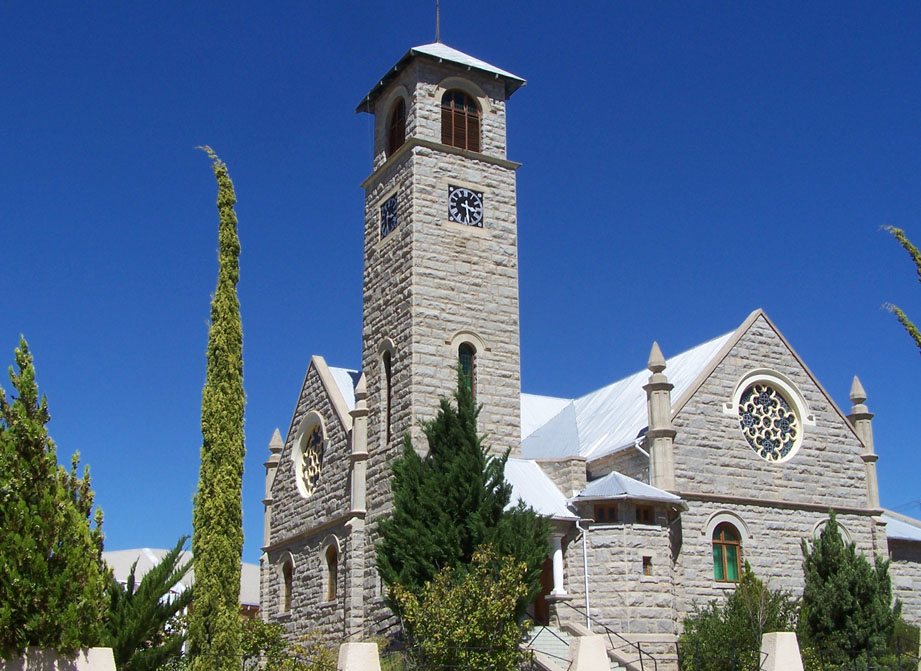
Dutch Reformed Church, Springbok
One of its ministers was expelled. Another resigned. A third served two separate stints decades apart. The ministerial history of the Dutch Reformed Church in Springbok, known locally as the Klipkerk, reads less like an ecclesiastical record and more like a saga of endurance in a place where nothing comes easily -- not water, not congregation members, and certainly not the kind of institutional stability that churches in gentler climates take for granted.
Born in a Place That No Longer Exists
The congregation was founded in 1850 in the settlement of Bowesdorp, south of present-day Springbok. Bowesdorp itself was named after the village doctor, a detail that speaks to how small and personal these frontier communities were. But the settlement could not sustain itself. Steep granite hills and chronic water shortages made life difficult enough that Bowesdorp was eventually abandoned, its population relocating along with the nearby settlement of Kamieskroon in 1923. Only ruins remained for decades, slowly dissolving back into the rocky landscape. The church, however, survived by transplanting itself to Springbok, the growing commercial center of Namaqualand. It was the 42nd congregation in the Dutch Reformed Church in South Africa, and it would become the mother church of all NGK congregations in the region.
The Frontier Church
The first cattle farmers began settling on the edges of what they called Little Namaqualand around 1750, drawn to the water-rich Kamiesberge mountains in an otherwise arid region. Little Namaqualand was distinguished from Great Namaqualand across the Orange River in what would become South West Africa. From about 1760, farms were steadily granted, and settlers pushed deeper into the landscape. The Klipkerk served these scattered frontier families, its reach extending across vast distances. At its widest, the congregation's ring -- its administrative district within the Dutch Reformed Church -- stretched all the way to Oranjemund, the diamond mining town on the Namibian coast, until that congregation was transferred to the NG Church in Namibia in 2013.
Daughters in Decline
The Springbok congregation became the mother church of Namaqualand's Dutch Reformed presence, spawning daughter congregations as mining towns grew and populations shifted. But the mining economy proved as fickle as the region's rainfall. When copper and other mineral operations declined in towns like Nababeep and Aggeneys, so did their congregations. Membership dropped so sharply that these churches could no longer support their own pastors. Rather than close, they entered agreements with the mother congregation, and the ministers of Namaqualand took responsibility for serving the daughter churches as well. It is a pattern familiar across rural South Africa -- communities built on extractive industries that bloom and fade, leaving the institutions behind to manage with less.
Stone and Persistence
The Klipkerk -- the name means "stone church" -- is built from the same granite that defines Springbok's landscape. The town sits nestled in a valley surrounded by hills, and the church occupies a position near the central koppie that anchors the settlement. Its architecture is plain, the product of a community that valued durability over decoration. The list of ministers who served here stretches from 1870 to the present, a continuous thread through more than 150 years of drought, war, mining booms, and the slow demographic shifts that have reshaped Namaqualand. Willem Siebert Edward Rorich was expelled in 1908. Willem Petrus Steenkamp resigned in 1926. Steyn McCarthy has served since 1977. Each tenure tells a piece of the larger story: a church that persists because the community it serves has no alternative.
From the Air
Located at 29.67S, 17.88E in the town of Springbok, the commercial center of Namaqualand. The church is near the central koppie (hill) that forms the town's core. Springbok sits in a valley surrounded by hills, easily identifiable from the air. Nearest airport is Springbok (SBU), 5km outside town. The N7 highway passes through, connecting Cape Town (562km south) to the Namibian border (100km north). The town is small enough that the church is visible among the clustered buildings around the central hill.