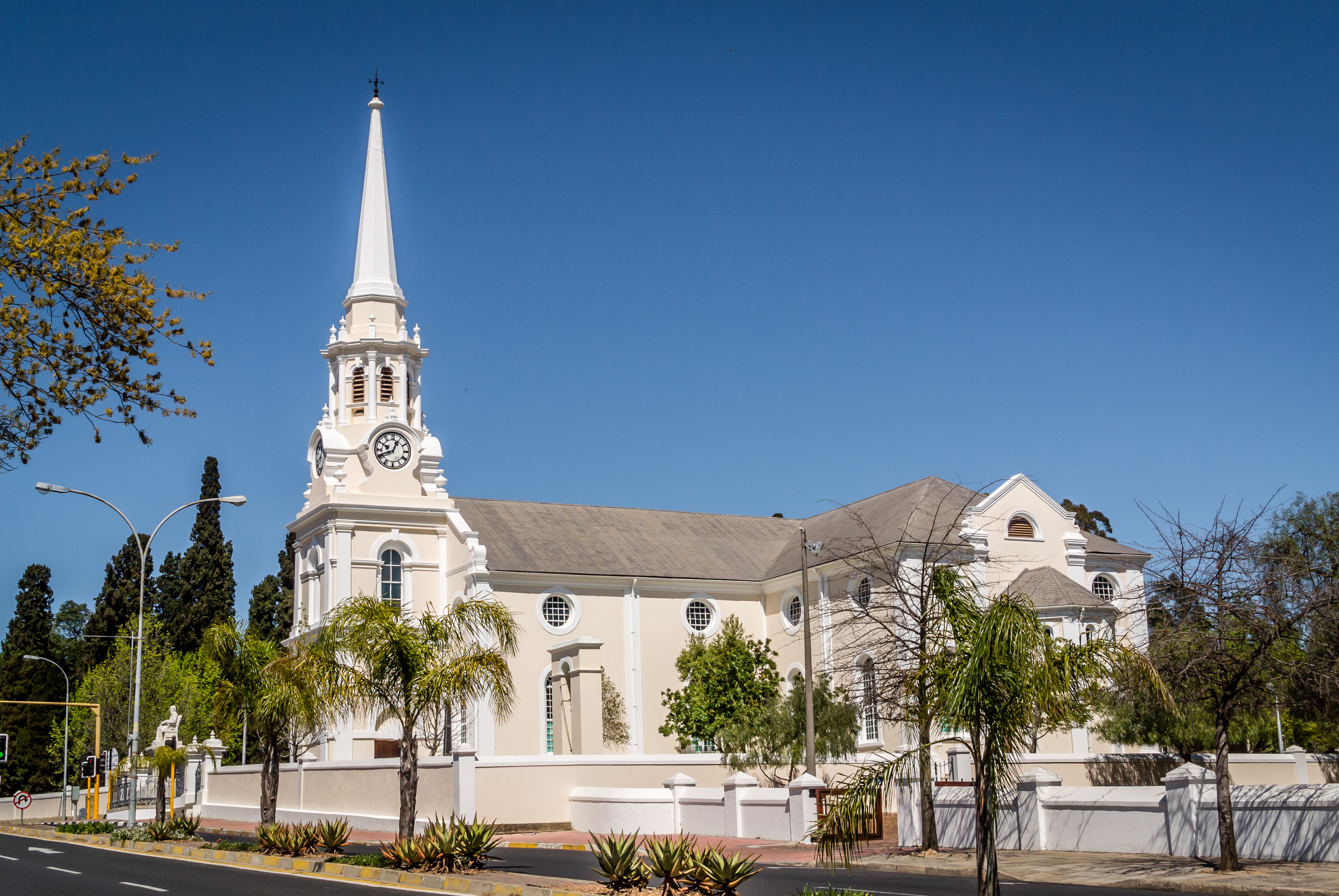
Dutch Reformed Church, Wellington
They wanted to name it Addeysdorp. For forty years, the descendants of Huguenot settlers in the Wagenmakers Valley had petitioned for their own congregation, separate from the mother church in Paarl, and when approval finally came in 1840, local sentiment favored naming the new town after Dr. John Addey, who had championed the cause most persistently. But Cape Governor Sir George Thomas Napier had other ideas. He suggested Wellington, after the hero of Waterloo, and the name stuck -- linking a quiet farming valley in the Western Cape to a distant British battlefield forever.
Forty Years of Patience
The Wagenmakers Valley was among the oldest settled areas in the Western Cape, home to families whose roots traced back to the Huguenot refugees of the late 1600s. Yet for decades, these farmers traveled to Paarl for church services, a journey that grew more burdensome as the community expanded. The congregation finally separated from Paarl in 1840, becoming the 26th in the Cape Church. Its founding coincided with the dedication of its first church building and the appointment of its first minister, Andries Francois du Toit, who would serve the congregation exclusively until his death in office in 1871. The original building has been continuously expanded -- wings added in 1861, galleries in 1874, a tower designed by architect Charles Freeman in 1891, and the roof raised in 1928 -- growing into the large house of worship that still dominates Church Street.
Murray's Wellington
Andrew Murray arrived in 1871, seven months after du Toit's death, and stayed for thirty-five years. Under his leadership, Wellington became something no one would have predicted for a small Boland town: a center of national influence in missionary work and education. Murray's vision produced a constellation of institutions. The Sendinginstituut trained missionaries for work across southern Africa and beyond. The Huguenot Seminary educated young women at a time when such opportunities were rare. Friedenheim provided a retreat and training center. American educators Anna Bliss and Abbie Park Ferguson came to Wellington at Murray's invitation and helped build these institutions from scratch, their presence connecting a rural Cape town to transatlantic educational networks.
The Missionaries Who Went Out
Wellington's significance lay not in what it accumulated but in what it sent forth. From these institutions flowed men and women who scattered across South Africa and into distant mission fields. The congregation's material contributions to church expansion were substantial, but the human capital it exported was extraordinary for a town of its size. Reverend J.C. Pauw, missionaries trained at the Sendinginstituut, teachers from the seminary -- Wellington functioned as a pump, drawing in young people for training and sending them out with purpose. When the Huguenot College returned to Dutch Reformed Church governance in 1950, it resumed training social and missionary workers, reaffirming the town's role as a launching pad for church service.
A Growing Town, A Persistent Church
Wellington has defied the trends that have thinned Dutch Reformed congregations across South Africa. The mother congregation and its two daughters -- Wellington North, founded in 1957, and Wellington East, established in 1973 -- together claimed 993 baptized and 3,738 professing members at the end of 2014. That makes Wellington one of the largest concentrations of NG Church members in any South African town, surpassing even cities like Welkom, East London, and Pietermaritzburg. The explanation is partly geographic: Wellington lies close enough to Cape Town to attract residents who commute to the city but prefer small-town living. Professing membership has actually grown by about 7 percent over thirty years, a striking contrast to the nearly 20-percent decline across the denomination as a whole. The church that took forty years to found has proven remarkably durable.
From the Air
Located at 33.64S, 19.00E in the town of Wellington, Western Cape, South Africa. Wellington sits in the Boland region at the foot of the Hawequa Mountains, surrounded by vineyards and fruit orchards. The town is approximately 75 km northeast of Cape Town along the N1. Cape Town International Airport (FACT) is the nearest major airport. The church building with its prominent tower is located on Church Street in the town center. Wellington is identifiable from altitude by its position where the Berg River valley narrows toward the Du Toitskloof mountains.