Duwisib Castle
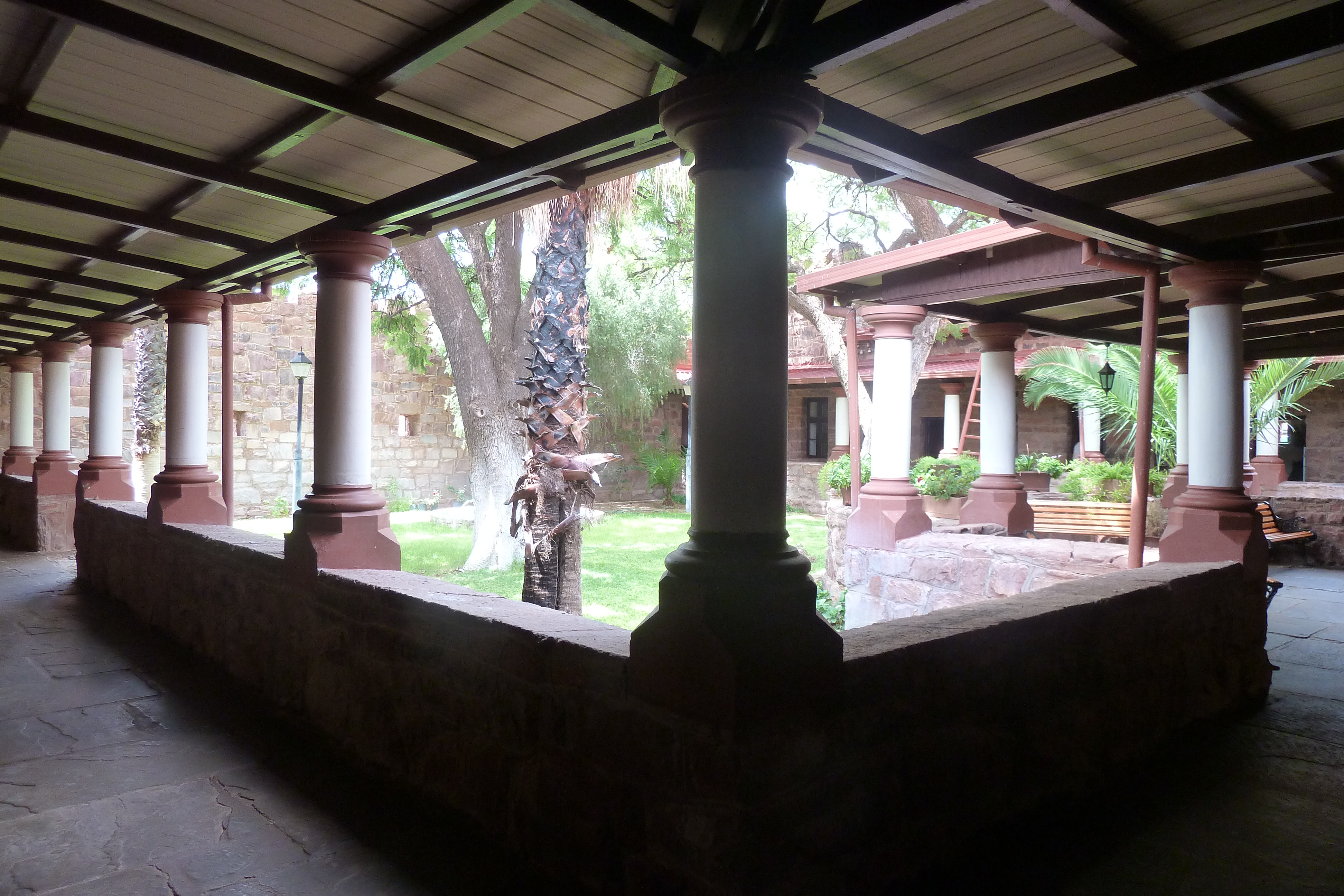
Seventy-two kilometers from the nearest town, in the semi-arid hills southwest of Maltahohe, a castle rises from the Namibian scrubland like a hallucination. It has 22 rooms, red sandstone walls, a courtyard inspired by Western monastery cloisters, and furnishings hauled 300 kilometers from the coast by wagons drawn by 24 oxen. Duwisib Castle was built in 1909 by a man who called himself a baron, married the stepdaughter of the American consul, and died at the Battle of the Somme before he could ever return to it. His wife never came back either. The castle has been waiting for them since 1914.
The Baron and the American
Hans Heinrich von Wolf was born in Dresden on September 11, 1873, the son of an officer in the Royal Saxon Army. He followed his father into the military and was posted to German South-West Africa as part of the Schutztruppe, the colonial protection force. After the German-Nama war, he returned to Europe and married Jayta Humphreys, the stepdaughter of the United States consul, on April 8, 1907. She was twenty-six. The couple decided to settle not in Germany but in the African colony, purchasing eight farms covering 20,000 hectares near Maltahohe. By 1910, they had added another 35,000 hectares and were running the property as a stud farm for English and Australian thoroughbred horses. What they needed, the Baron decided, was a castle worthy of the enterprise.
Building a Fortress in the Desert
The architect Wilhelm Sander -- who had also designed Windhoek's Heinitzburg, Schwerinsburg, and Sanderburg castles -- drew plans for a pseudo-medieval fortress modeled on the German forts already scattered across the colony. Red sandstone came from local quarries, but nearly everything else arrived from Europe: iron, wood, cement, and lamps shipped by sea to Luderitz, then dragged overland through the Namib by ox-drawn wagons. Italian bricklayers, Swedish and Irish carpenters, and other artisans converged on the site. While construction ground forward, the Von Wolfs lived in a hut alongside their coachman and Herero servant. Hans Heinrich planted the courtyard with palm trees. By mid-1909, the 22-room edifice was complete, furnished with a massive German oak cabinet, Turkish bamboo tables, and items purchased at a European castle auction. The inauguration drew dignitaries from across South-West Africa.
War Takes Everything
In 1914, the Von Wolfs sailed for Europe on what they expected to be a visit. The First World War broke out while they were at sea, and their ship was diverted to Rio de Janeiro. Jayta, who had kept her American citizenship, found passage to Europe on a Dutch vessel. Hans Heinrich, according to legend, had to disguise himself as a woman to make the crossing. On arrival, he rejoined the German army. Two weeks after enlisting, he was killed at the Battle of the Somme in 1916. Jayta could not bear to return to Namibia alone and never reclaimed the castle. She settled eventually in Zurich, where she married Erich Schlemmer, the consul general of Siam. The farm, entrusted to a friend named Count von Luttichau, went bankrupt after the war. It was sold for 7,500 pounds to a Swedish family named Murrman -- whose patriarch died shortly after arriving. His son was killed in the Second World War.
The Horses That Stayed
The Von Wolfs' thoroughbred stud farm did not survive its owners' departure, but something from it may have. Along the roadsides of the southern Namib, and in the restricted diamond areas near Luderitz, wild horses roam in herds that have fascinated visitors and scientists alike. The Namib Desert horses are one of the few feral horse populations on Earth living in a true desert environment. Whether they descend from the Von Wolfs' thoroughbreds is debated -- other origin theories point to German military horses abandoned during World War I, or stock from a South African cavalry camp at Garub. The connection has never been conclusively proven, but the romance of it persists: the Baron's horses, outlasting the Baron, outlasting the castle's every subsequent owner, running free across the desert he tried to tame.
A Castle That Endures
After the Murrman family, Duwisib passed through several more owners before the Namibian government acquired it in 1979. An extensive refurbishment in 1991 restored the interiors, and another renovation in 2014 opened a refurbished bedroom for overnight guests. Today the castle is managed by Namibia Wildlife Resorts. Visitors can tour the rooms, examine the European furnishings that survived a century in the desert, and sleep within walls that a Saxon artillery officer and an American consul's stepdaughter built together in one of the most improbable locations imaginable. The courtyard's palm trees are still there. So are the red sandstone walls, baked by a hundred Namibian summers. Everything around the castle has changed -- the colony became a country, the farms were subdivided and sold -- but the building stands exactly where its builders left it, waiting with a patience that its human occupants never had the chance to match.
From the Air
Located at 25.26S, 16.54E in the semi-arid hills of the Hardap Region, 72 km southwest of Maltahohe. The castle is a distinctive red sandstone structure visible from low altitude against the brown-grey scrubland. Nearest airports: Windhoek Hosea Kutako International (FYWH) approximately 300 km northeast, Luderitz (FYLZ) approximately 250 km southwest. The area is served by gravel roads; no paved airstrips nearby. Best viewed from 1,000-2,000 feet AGL where the castle's courtyard and fortress outline are clearly distinguishable.