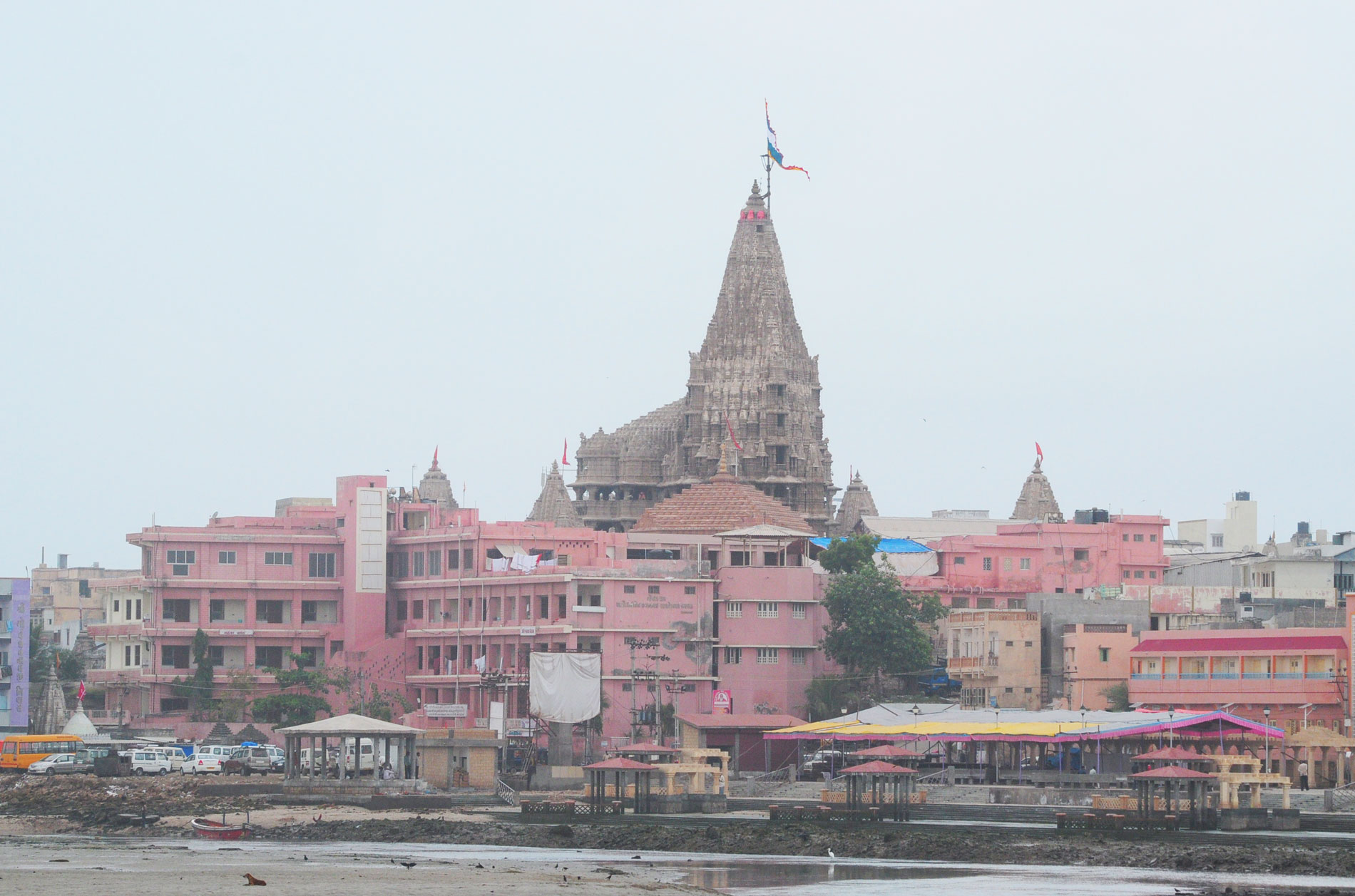
Dwarka
Fifty-six stone steps descend from the southern gate of the Dwarkadhish Temple to the ghats of the Gomti River, where the water meets the Arabian Sea. That gate is called the Swarga Dwara -- the Gate to Heaven. Pilgrims who come to Dwarka enter through the northern gate, the Moksha Dwara, the Door to Salvation, and they take those 56 steps down to the river to bathe before entering the temple. The ritual geography is deliberate: you arrive seeking liberation, and you leave through paradise. Dwarka is one of the four sacred dhams established by Adi Shankaracharya at the corners of India, one of the seven ancient holy cities known as the Sapta Puri, and -- according to tradition stretching back to the Mahabharata -- the kingdom that Krishna himself built by reclaiming land from the sea.
The Kingdom Beneath the Waves
Hindu tradition holds that Krishna founded Dwarka after leaving Mathura, building a city on land reclaimed from the Arabian Sea. When Krishna departed the mortal world, the ocean swallowed the city whole. For centuries, this was mythology. Then marine archaeologists from the National Institute of Oceanography began finding structures underwater off the coast -- stone anchors, walls, what appeared to be a planned settlement. Archaeological excavations on land, beginning in 1963, uncovered artifacts suggesting continuous habitation dating back to the Indus Valley civilization. The earliest foundations of the Dwarkadhish Temple may date to around 200 BCE, though the five-story structure visitors see today, supported by 72 pillars and built of limestone and sandstone, was largely rebuilt in the 15th and 16th centuries after Sultan Mahmud Begada of Gujarat sacked the town and destroyed the temple in 1473. What makes Dwarka remarkable is this layering: a living pilgrimage city built atop archaeological evidence that lends at least partial credibility to its own origin story.
Temples at the River's Mouth
The Gomti Ghat, where the river meets the sea, is crowded with shrines. Small temples dedicated to Samudra, the god of the sea, stand alongside shrines to Saraswati and Lakshmi. The Samudra Narayana temple marks the exact confluence. At the Chakra Narayana temple, a stone bearing the imprint of a chakra is venerated as a manifestation of Vishnu. The Gomati temple houses an idol of the river goddess herself, said to have been brought to earth by the sage Vasishta. Two kilometers from the main complex stands the Rukmini Devi Temple, dedicated to Krishna's chief queen. Though tradition claims the temple is 2,500 years old, its current form dates to the 12th century. The exterior is richly carved with sculptures of gods and goddesses, with panels at the tower's base depicting naratharas -- human figures -- and gajatharas -- elephants -- in the detailed sculptural vocabulary of medieval Gujarati temple architecture.
The Island of Bet Dwarka
Off the coast lies Bet Dwarka, an island in the Arabian Sea considered the original residence of Krishna. Before the Okha port was developed, Bet Dwarka served as the ancient harbor. The main temple here, credited to the 15th-century Vaishnava guru Vallabhacharya, follows a distinctive tradition: pilgrims offer rice, echoing the story of Sudama, Krishna's childhood friend who brought humble rice as a gift and received divine abundance in return. Smaller shrines on the island are dedicated to Shiva, Vishnu, Hanuman, and Devi. The Sudarshan Setu, a cable-stayed bridge that is one of the longest in India, now connects the mainland to the island. Below the bridge and beneath the waters, the story goes deeper still: the Gujarat government has signed agreements to develop India's first submarine tourism here, offering visitors the chance to see the underwater structures that may -- or may not -- be the remnants of Krishna's legendary city.
Pillars of Light
Sixteen kilometers from the Dwarkadhish Temple stands the Nageshvara Jyotirlinga, one of the twelve Jyotirlingas -- "pillars of light" -- sacred to Shiva. The deity is housed in a subterranean cell, the temple itself among the most ancient Shiva shrines in western India. A lighthouse at Dwarka Point on the peninsula provides a more literal kind of illumination: a fixed light 70 feet above sea level, visible for 10 miles, its radio beacon powered by solar panels. Below it, Gopi Talab, a lake in the western part of town, holds cultural significance, while a similar lake at Bet Dwarka yields Gopi Chandan, a fragrant mud that devout Hindus apply to their foreheads as a sanctity symbol. Nearby Shivrajpur Beach, about 14 kilometers from town, has earned the prestigious Blue Flag certification -- one of only eight Indian beaches to achieve this international environmental standard.
Midnight at Janmashtami
Dwarka's defining festival is Janmashtami, celebrated in August or September to mark the birth of Krishna. The celebrations run through the night. Bhajans and sermons fill the temple complex until midnight, when the festivities shift from devotion to theater. Local boys build a human pyramid, and the youngest, dressed as Krishna, climbs to the top to strike a pot of butter -- reenacting the childhood mischief of a god who stole butter from the gopis. This ritual, known as Dahi Handi, transforms the sacred precincts into a carnival of devotion and play. The Gugli Brahmins, hereditary pilgrimage priests of Dwarka, oversee the ceremonies as their families have for generations. At this westernmost corner of India, where one of Shankaracharya's four seats of learning still operates an arts college, the boundary between mythology and daily life is not so much blurred as simply absent. Dwarka is a place where the stories are the history, and the history continues to be lived.
From the Air
Located at 22.24°N, 68.97°E on the western tip of the Okhamandal Peninsula in Gujarat, at the mouth of the Gulf of Kutch facing the Arabian Sea. The Dwarkadhish Temple's spire is a prominent landmark. Bet Dwarka island is visible offshore, connected by the Sudarshan Setu bridge. Nearest airport is Jamnagar Airport (VAJM), approximately 131 km to the east. From the air, the peninsula, the Gomti River mouth, and the lighthouse at Dwarka Point are key visual references. Best viewed at 3,000-5,000 ft in clear conditions.