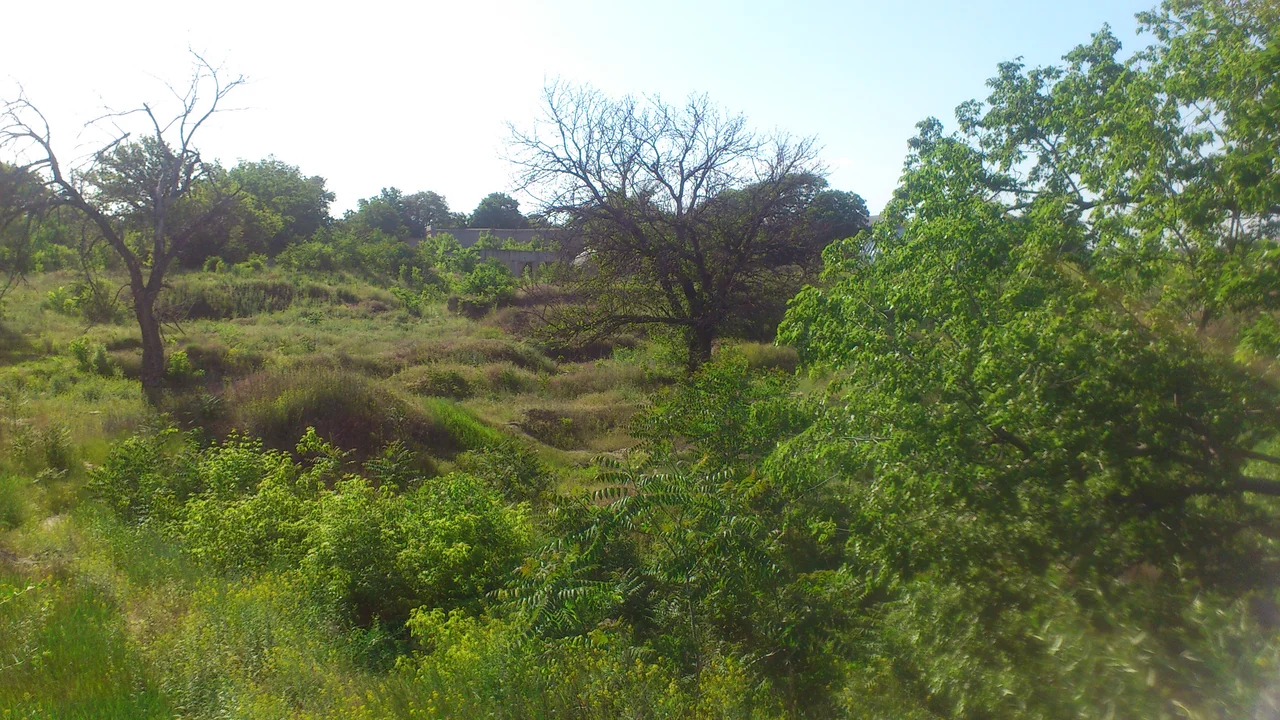

Dykyi Sad Archaeological Site
In the middle of Mykolaiv, in a patch of ground once called the Wild Garden, archaeologists have uncovered something that predates almost everything around it by thousands of years. Buried under the modern city are the remains of a fortified Bronze Age settlement, a port town that stood between roughly 1250 and 925 BC, in the age of the legendary Trojan War. This is Dykyi Sad, and it is unlike anything else found in Ukraine: the only steppe settlement of its era discovered in the country, a fragment of a lost world quietly surfacing in the heart of a working shipbuilding city.
A Garden That Went Wild
The name is almost accidental. The land was originally laid out as a garden by Admiral Greig during his time as governor of the city, and officially it was the Admiral's Garden. But the trees planted there were wild and bore no fruit, and so people simply called it the Wild Garden, Dykyi Sad, and the popular name stuck. The garden did not survive the twentieth century intact. Through two world wars, desperate residents cut the trees down for firewood when coal ran short, and after the Second World War the place was left a near-wasteland with only a few bushes clinging on. The ground was eventually built up again, but the old name endured, an ordinary city plot carrying the memory of something far older beneath it.
The Town From the Age of Troy
What lies under the garden is astonishing. Excavations have revealed a settlement of the Late Bronze Age, dated to around 1250 to 900 BC and belonging to the Bilozerka culture, with a level of development that marks it as a genuine port city. It originated some five hundred years before the Greeks founded nearby Pontic Olbia, and it lasted for roughly three centuries before it, too, faded. That timing is what gives Dykyi Sad its power to move: this was a living Black Sea harbor in the era of the Trojan War, contemporary with the world Homer would later sing about. It is, as researchers describe it, the only surviving monument of a Black Sea port city from the age of legendary Troy.
Homer's Cimmerians?
The most tantalizing idea of all connects Dykyi Sad directly to the Odyssey. Some researchers have proposed that this site is the City of the Cimmerians that Homer describes, a shadowy place at the edge of the world wrapped in mist and darkness. The geography of the Odyssey is famously contested, and no one can prove the identification. But if it were ever confirmed, it would make Mykolaiv the oldest city in Ukraine mentioned in any written source, its origins reaching back into the world of epic poetry. In 2016 the Mykolaiv City Council petitioned to turn the site into an open-air park-museum, an effort to protect and share a place where the ordinary ground of a modern city opens directly onto the Bronze Age.
From the Air
The Dykyi Sad site lies within Mykolaiv at about 46.98 degrees north, 31.98 degrees east, on high ground near the confluence of the Ingul and Southern Bug rivers in the city center. From the air it appears as an open park plot amid the surrounding urban grid, close to the rivers that made it a port three thousand years ago. Nearest airport is Mykolaiv International (UKON) just north of the city; Kherson (UKOH) and Odesa International (UKOO) lie further off along the coast.
Nearby Stories
- Pontic Olbia 9.1 km away
- Yelanets Steppe Nature Reserve 40 km away
- Kuialnyk Estuary 45 km away
- Granite-Steppe Lands of Buh 70 km away
- Vorontsov Lighthouse 71 km away
- Skadovsk 84 km away
- Church of the Nativity of the Theotokos 102 km away
- Dzharylhach 115 km away