Dynamic Earth
The irony is almost too neat. Dynamic Earth, Edinburgh's science centre devoted to the story of the planet, sits on ground where James Hutton -- the 18th-century geologist who first grasped that the Earth was unimaginably old -- lived and worked. The building stands in Holyrood, at the foot of Salisbury Crags, the very cliffs where Hutton studied rock formations and overturned centuries of Biblical chronology. Before that, the site was a gas-works and a brewery. Opened in 1999 by Queen Elizabeth II, the centre transforms industrial wasteland into a journey through 4.5 billion years of planetary history.
Millennium Ambition
Dynamic Earth was one of several projects funded by the Millennium Commission in the late 1990s, alongside the Glasgow Science Centre, the Falkirk Wheel, and London's much-maligned Millennium Dome. At a cost of around 34 million pounds, it was part of a 150-million-pound urban regeneration scheme for the Holyrood area. The brewery firm Scottish & Newcastle had donated the site for public use in 1988, though the brewery itself did not vacate until the mid-1990s. Dynamic Earth was the first major UK millennium attraction to open, beating London to the punch -- and unlike the Dome or The Big Idea in Irvine, which closed after just three years, it has endured.
A Tent at the Foot of the Crags
The building itself, designed by Hopkins Architects, is a striking piece of architecture: a fabric membrane stretched over a steel skeleton, held aloft by steel masts, resembling a vast white tent pitched against the dark basalt of Salisbury Crags. The design incorporates the original stone wall from the Abbey Brewery's ale stores, weaving industrial archaeology into the futuristic structure. An amphitheatre at the front serves as a gathering point, while the entrance area was designed to feel like an outdoor space despite being fully enclosed. The Royal Institute of British Architects recognized it with a RIBA Regional Award in 2001, and it received a Civic Trust Award in 2000.
Inside Deep Time
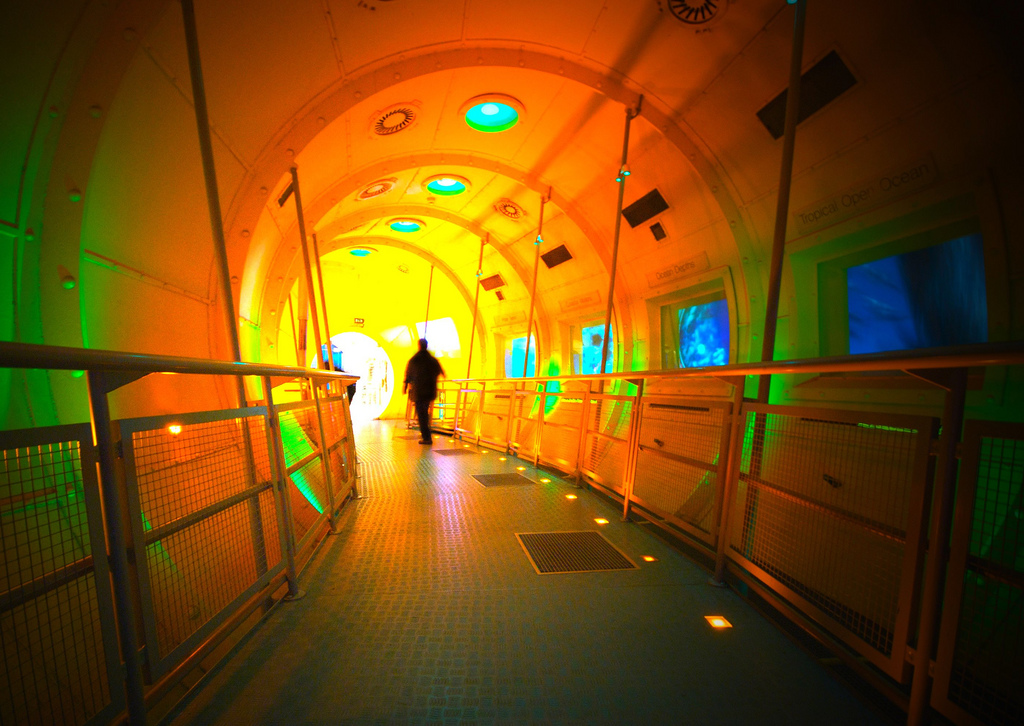
The interior is designed as immersion rather than exhibition. Visitors encounter an iceberg, experience a simulated earthquake, and travel through the Deep Time Machine, which uses multimedia and 4D techniques to compress the creation and evolution of the Earth into a walkable narrative. A 360-degree digital planetarium -- the ShowDome -- projects the cosmos overhead. The facility earned a five-star rating from VisitScotland, and by 2007 had received over three million visitors. School parties account for a significant share: in 2006, some 46,500 of the 202,500 annual visitors arrived in organized groups, making Dynamic Earth as much a classroom as an attraction.
Hutton's Ground
What gives Dynamic Earth its particular resonance is the ground beneath it. James Hutton walked these streets in the 1780s, studying the junction between sedimentary and igneous rock on the face of Salisbury Crags -- what geologists now call Hutton's Section. He proposed that the Earth was shaped not by sudden catastrophe but by slow, continuous processes operating over vast stretches of time. It was a radical idea, and it was born here, within sight of the building that now tells the story of the planet his work made comprehensible. The Scottish Parliament sits next door. Arthur's Seat rises behind. Between the ancient volcano and the modern legislature, Dynamic Earth occupies a sliver of ground where science, history, and politics converge.
From the Air
Dynamic Earth is at 55.951N, 3.174W in Edinburgh's Holyrood district, identifiable by its distinctive white membrane roof at the foot of Salisbury Crags. The Scottish Parliament building is immediately adjacent. Arthur's Seat (251m) rises to the south. Nearest airport: Edinburgh (EGPH), approximately 7 nm west. Best viewed at 2,000-3,000 ft.