Dzanga-Sangha Special Reserve
Where the borders of the Central African Republic, Cameroon, and the Republic of the Congo meet, the Sangha River bends through lowland rainforest so dense that the canopy blocks the sky. This is Dzanga-Sangha, a reserve that forms one third of the Sangha Trinational, a UNESCO World Heritage Site. Together with Cameroon's Lobeke National Park and the Congo's Nouabale-Ndoki National Park, it protects one of the largest and least disturbed tracts of tropical forest in Central Africa. Getting here requires either a full day's overland drive from Bangui on uncertain roads, or a chartered Cessna to the town of Bayanga. The difficulty of arrival is part of the point. What survives here has survived precisely because the modern world has been slow to find it.
Forest Without End
Dzanga-Sangha is entirely covered in lowland rainforest, threaded by the Sangha River, a major tributary of the Congo. The forest is not a backdrop to the reserve; it is the reserve. Western lowland gorillas move through the understory in family groups. Forest elephants, among the rarest of their kind, gather at mineral clearings called bais, where they can be observed from elevated platforms. Chimpanzees, forest buffaloes, bongos, giant forest hogs, red river hogs, sitatungas, and multiple species of duiker and monkey inhabit the forest at every level. The reserve's megafauna reads like a catalog of Central Africa's most elusive large mammals, species that elsewhere have been hunted into scarcity or pushed to the margins of fragmented habitat.
Tracking the Silverback
Gorilla tracking is the reserve's signature experience and its most expensive, at 300 euros per person. Accompanied by an international team of researchers, visitors walk through the jungle on the trail of habituated western lowland gorilla groups. Unlike their mountain cousins in Rwanda and Uganda, western lowland gorillas live in dense forest where visibility rarely exceeds a few meters, and encounters feel less like observation than discovery. The reserve also offers agile mangabey tracking, following a poorly understood monkey species with a vast vocal repertoire, and saline tours that trace elephant paths through the jungle to clearings where dozens of forest residents gather. A pirogue ride on the Sangha River provides a quieter perspective, drifting in a dugout canoe through swamps to palm trees where wine is extracted from the sap.
The Ba'aka and the Forest
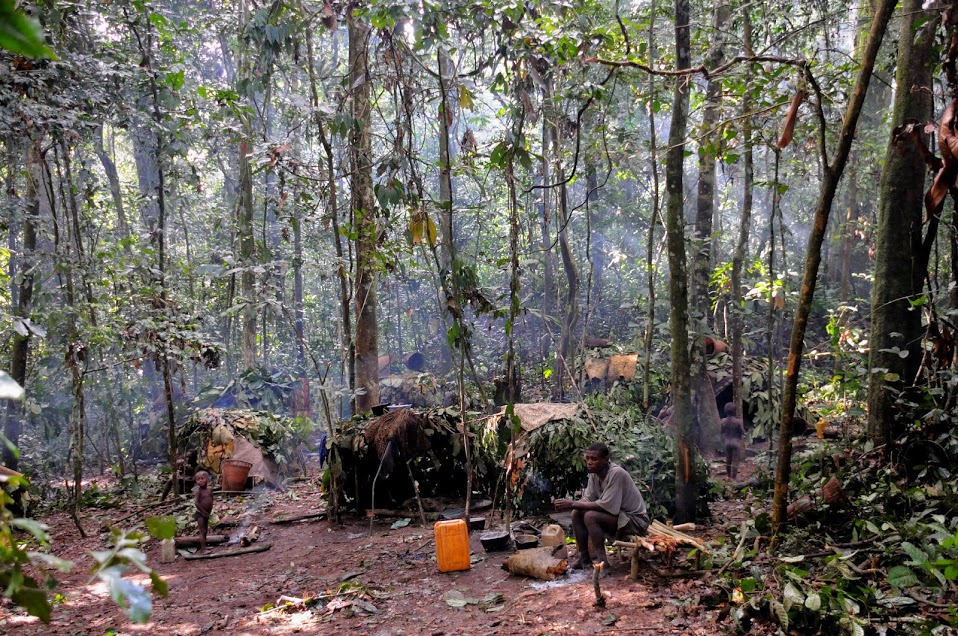
The Ba'aka people have lived in these forests for thousands of years, and the reserve's community activities offer visitors a window into that relationship. Net hunting with Ba'aka men involves walking through the jungle in pursuit of small game, then preparing the catch with sauces made from forest plants over an open fire. Medicinal plant collection with Ba'aka women reveals a pharmacological knowledge passed down through millennia: leaves pressed for sap, rolled to apply medicines to the eyes or ears, each plant carrying a name and a purpose that Western science has barely begun to catalog. Evenings can be spent in Ba'aka music and dance, with polyphonic singing that UNESCO has recognized as a masterpiece of intangible cultural heritage. The Ba'aka are not performers for hire but participants in an exchange, sharing knowledge of a forest they have coexisted with far longer than any nation has claimed it.
Roads to the Interior
Reaching Dzanga-Sangha is an expedition in itself. From Bangui, the Central African Republic's capital, the drive to Bayanga can be done in one very long day if conditions are good, with a recommended stopover at the N'gotto park project. Chartering a small aircraft cuts the journey to roughly an hour. Travelers from the Republic of the Congo can fly to Ouesso on a scheduled Trans-Air Congo flight and arrange for a boat to carry them upriver. From Cameroon, overland routes pass through Bertoua and Yakadouma to the Sangha River. From Gabon, charter flights to Bayanga or Ouesso are possible. Within the reserve, 4x4 vehicles and motorized pirogues provide transport. As of 2023, the national park is under government control, though caution is advised for road travel from Bangui in a country where stability has been hard won.
Three Nations, One Forest
The Sangha Trinational, inscribed as a UNESCO World Heritage Site, represents a rare instance of three nations cooperating to protect a single ecosystem. The forest does not recognize borders, and neither do the elephants, gorillas, and chimpanzees that move through it. Dzanga-Sangha's contribution to this trinational effort is the Sangha River corridor and the bais where forest elephants congregate, visible from platforms that offer some of the most extraordinary wildlife viewing in Africa. The reserve faces the same pressures as wild places everywhere: growing human populations, commercial hunting, and the economic incentives that make a dead elephant more immediately valuable than a living one. But the forest here remains uncommercialised in a way that is increasingly rare on the continent, and the partnership between Ba'aka knowledge, international research, and three governments' commitment to a shared border offers a model for what conservation might look like when the forest comes first.
From the Air
Dzanga-Sangha Special Reserve is located at approximately 3.43°N, 16.33°E in the southwestern corner of the Central African Republic, near the tripoint with Cameroon and the Republic of the Congo. The nearest airstrip is at Bayanga, reachable by chartered Cessna from Bangui (roughly one hour). Bangui M'Poko International Airport (FEFF) is the country's main hub. The reserve is entirely under forest canopy, visible from altitude as unbroken green stretching to the Sangha River. Expect tropical humidity with year-round rainfall and limited visibility below the canopy.