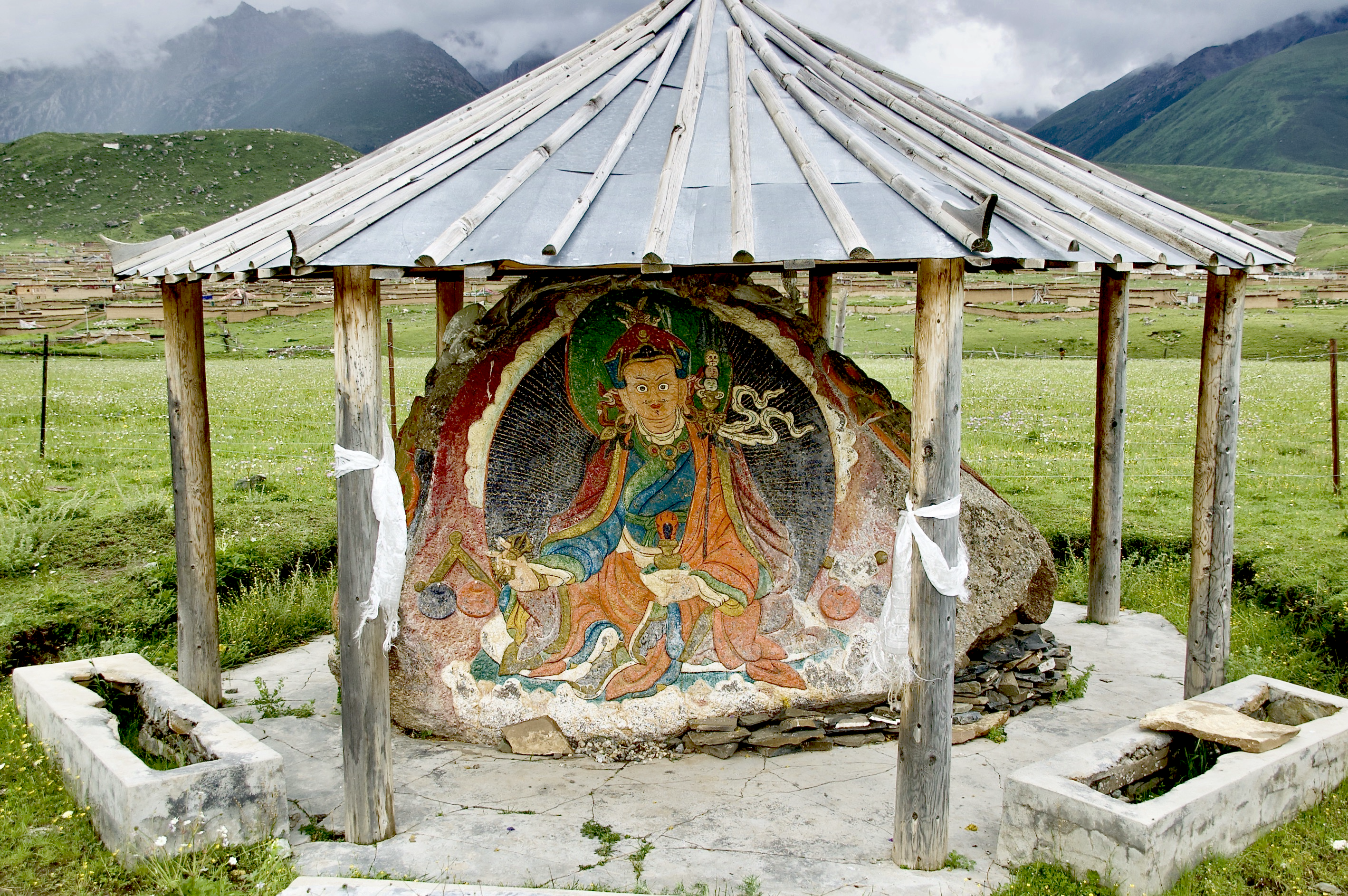
Dzogchen Monastery
Twice burned to the ground. Twice rebuilt. Dzogchen Monastery has a relationship with destruction that would have ended most institutions, but this is one of the six mother monasteries of the Nyingma tradition, the oldest school of Tibetan Buddhism, and its community has treated each catastrophe as a test rather than a conclusion. Founded in 1684 in Kham, within modern-day Dege County in Sichuan's Garze Tibetan Autonomous Prefecture, Dzogchen grew into the largest Nyingma monastery of all time before fire and political violence reduced it to ashes. Today it exists in two locations simultaneously: a reconstructed complex in its original valley in Tibet, and a thriving exile monastery in South India chosen by the Dalai Lama himself.
Five Hundred Monks and Thirteen Retreats
Pema Rigdzin, the 1st Dzogchen Rinpoche, founded the monastery in 1684. Over the following two centuries it became renowned for its Sri Singha Shedra, a monastic college established by Gyelze Zhenpen Taye during the time of the 4th Dzogchen Rinpoche, shortly after an earthquake nearly destroyed the complex in 1842. The monastery attracted some of the most important figures in Tibetan Buddhism: Patrul Rinpoche, Jamgon Ju Mipham Gyatso, and Khenpo Shenga all lived and taught within its walls. By the time of the 5th Dzogchen Rinpoche, Thubten Chokyi Dorje (1872-1935), the monastery was at its peak: five hundred monks in residence, thirteen retreat centers, and an estimated 280 branch institutions. A gathering of all its affiliated communities would have drawn tens of thousands of lamas, tulkus, khenpos, monks, and nuns. Dzogchen was also one of the most celebrated centers of sacred ritual dance, the tradition now commonly known as lama dancing.
Fire, Rebuilding, and Fire Again
In 1936 - the Fire Mouse year in the Tibetan calendar, a name that proved grimly apt - the monastery's main temple burned. The community rebuilt. Then in 1959, Chinese forces destroyed the entire complex, burning it to the ground for the second time in its history. This destruction was part of a broader campaign against Tibetan religious institutions that accompanied China's consolidation of control over the region. Dzogchen Monastery also served as the principal repository of the Konchok Chidu cycle, part of the Jangter or Northern Treasure tradition, a collection of revealed texts by the treasure-finder Jatson Nyingpo. The destruction of the physical monastery threatened not just a community but an entire lineage of transmitted knowledge.
The Dalai Lama's Choice
Following the destruction of the 1950s, the Dzogchen community regrouped in exile. The 14th Dalai Lama personally selected the site for a new monastery at the Dhondenling Tibetan settlement in Kollegal, South India, on land near his own residence. Construction began in 1985, precisely three hundred years after the original monastery's completion in Kham. In January 1992, the Dalai Lama formally inaugurated the new complex, spending eleven days giving teachings and empowerments to several thousand attendees from across South India and beyond. He observed that the work of the "outer monastery" was complete - meaning the buildings and the gathering of monks - and that the work of the "inner monastery" could now begin. In December 2000, when the Dzogchen Rinpoche visited, up to 10,000 people gathered for teachings and blessings, traveling from India, Nepal, Australia, Europe, Singapore, the United States, and Canada.
Two Valleys, One Tradition
Since the early 1980s, reconstruction has also been underway at the original site in Kham. The monastery now has 300 legally registered monks in residence, a nunnery, and roughly 750 others staying temporarily for varying periods. The complex includes a shedra for monastic study and a school teaching traditional Tibetan medicine. Deeper in the Dzogchen valley, at a place called Pema Tang, a newly built retreat center and temple complex continues the tradition of intensive meditation practice that defined the monastery from its founding. The existence of Dzogchen in two places at once - in its ancestral valley in eastern Tibet and in its exile home in Karnataka - mirrors the broader Tibetan Buddhist experience of maintaining continuity across displacement. The monastery's name has become synonymous with the Dzogchen meditation tradition itself, one of the highest teachings in the Nyingma school, and its survival through centuries of earthquake, fire, and political destruction suggests that the tradition has proven at least as durable as the buildings that house it.
From the Air
Located at 32.12°N, 98.86°E in the Dzogchen valley, Dege County, Garze Tibetan Autonomous Prefecture, western Sichuan. Elevation approximately 4,000 meters (13,100 feet). The monastery is situated in a deep mountain valley accessible by a single road. Nearest airport is Chamdo Bangda Airport (ZUBD) approximately 200 km to the west. The exile monastery is located in Kollegal, Karnataka, South India, accessible via Mysore Airport (VOMY). Expect high-altitude conditions at the Tibet site with potential for rapid weather changes.