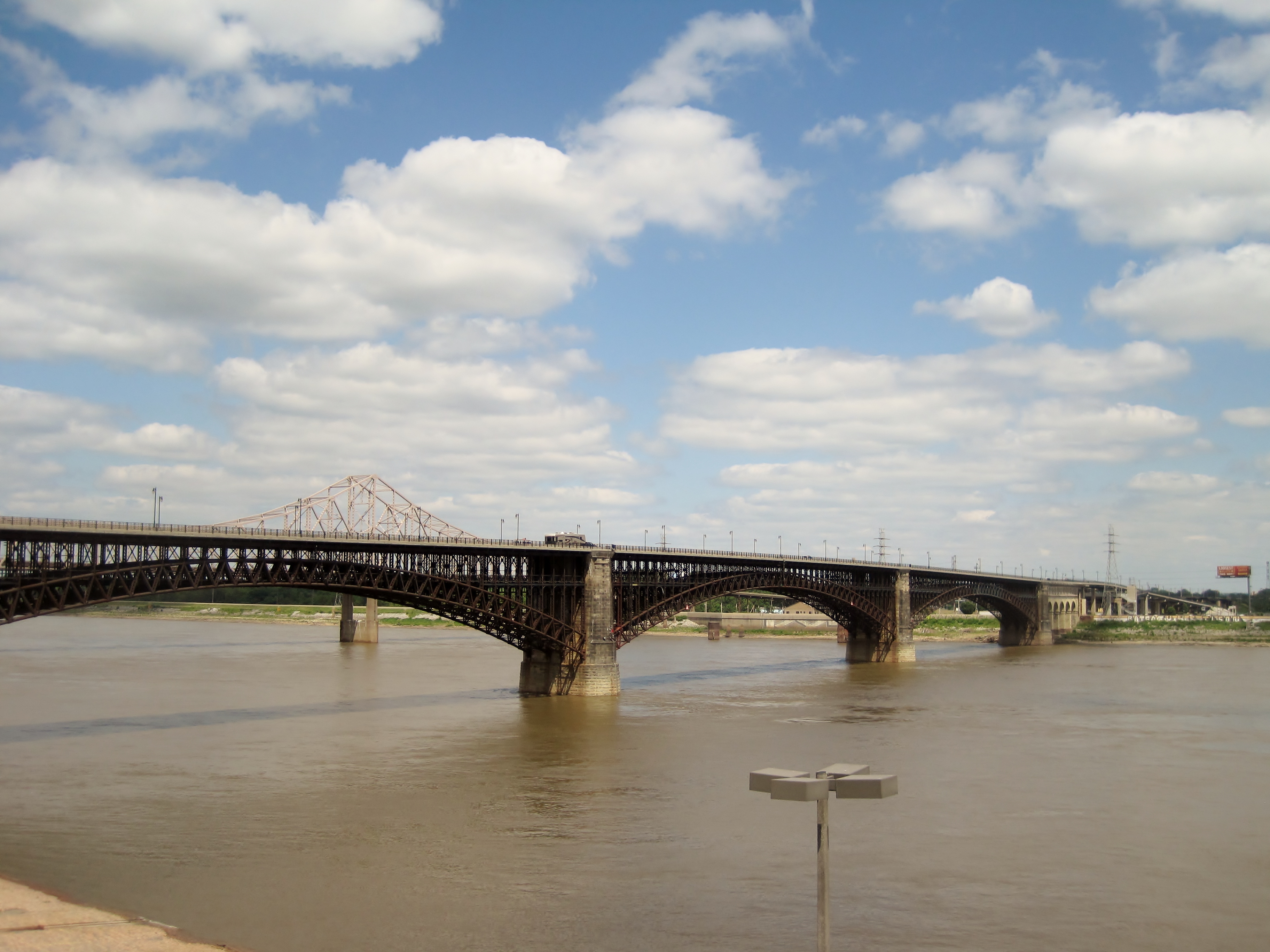
Eads Bridge: The Impossible Crossing
The steamboat companies thought they had won. By lobbying for bridge spans and clearances so extreme that no engineer could possibly build them, they expected to kill the project entirely and protect their monopoly on crossing the Mississippi at St. Louis. What they got instead was James Buchanan Eads, a man with no experience building bridges, who proceeded to pioneer the structural use of steel, sink foundations more than 100 feet below water level using the largest pneumatic caissons ever constructed, and erect a 520-foot center arch that was the longest rigid span on earth. When skeptics questioned whether the finished bridge could bear weight, Eads marched a circus elephant across it. The crowds cheered. The steamboat era was over.
Steel for the First Time
The Eads Bridge, completed in 1874, pioneered the large-scale use of steel as a structural material at a moment when wrought iron was the default for major construction. The steel superstructure was erected by the Keystone Bridge Company, founded in 1865 by Andrew Carnegie, linking two of the era's most consequential figures in a single project. Eads argued that steel's superior compressive strength was ideal for the upright arch design he envisioned. The bridge also employed chromium steel components, the first use of structural alloy steel in a major building project, though later testing in 1988 showed the chromium content was actually too low to meaningfully affect the steel's strength. The engineering principles Eads developed here influenced the construction of the Brooklyn Bridge, which began three years after work on the Eads Bridge started.
Foundations in the Dark
The Mississippi at St. Louis presented formidable challenges: a powerful current, winter ice floes, and the need to reach bedrock far below the riverbed. Eads used pneumatic caissons, a technology barely tested at this scale, to sink foundations more than 100 feet below the water's surface, the deepest underwater constructions attempted at the time. Workers descended into pressurized chambers at the river bottom to excavate material and lay foundations. The human cost was severe: fifteen workers died, two were permanently disabled, and 77 were severely afflicted by what was then called caisson disease, now known as decompression sickness. These deep caissons marked a new chapter in civil engineering, establishing techniques that would be used for bridge construction for decades to come.
The Elephant Test
When the Eads Bridge was ready to open on July 4, 1874, the celebration matched the engineering ambition. A parade stretched through the streets of St. Louis. A fifteen-car train filled with 500 dignitaries crossed from East St. Louis and traveled through a connecting tunnel beneath downtown. But the most memorable moment came when a circus elephant lumbered across the span toward Illinois, testing the popular belief that elephants possessed instincts that would prevent them from stepping on unsafe structures. Two weeks later, Eads sent fourteen locomotives across the bridge simultaneously. The New York Times had already called the project the World's Eighth Wonder during construction. The cost was nearly $10 million, a staggering sum that would burden the project for years.
Bankrupt in a Year
For all its engineering triumph, the Eads Bridge was a financial disaster. St. Louis had historically focused on river trade and lacked adequate rail terminal facilities; the bridge was poorly planned to coordinate railroad access. The railroads boycotted it, resulting in lost tolls. Within a year of opening, bridge operations went bankrupt. The bridge was sold at auction for 20 cents on the dollar, a sale so catastrophic it caused the National Bank of the State of Missouri to collapse, the largest bank failure in the United States at that time. Eads himself escaped financial consequences and was never indicted, though many involved with the bridge's financing were. The Terminal Railroad Association of St. Louis eventually acquired the bridge in 1877.
Among the Most Beautiful Works of Man
The Eads Bridge endured long after the financial wreckage cleared. At the 1893 Columbian Exposition, Missouri exhibited a model of it made from sugar cane. In 1898, it appeared on the $2 Trans-Mississippi postage stamp. On its 100th anniversary in 1974, New York Times architectural critic Ada Louise Huxtable described it as "among the most beautiful works of man." The highway deck was closed to automobiles from 1991 to 2003 but has since been restored. The former railroad deck now carries MetroLink, St. Louis's light rail system, which began service over the bridge in 1993. A $48 million rehabilitation completed in 2016 replaced 1.2 million pounds of support steel dating to the 1880s, extending the bridge's life to at least 2091. Today the Eads Bridge sits on the St. Louis riverfront between Laclede's Landing and the Gateway Arch, the oldest surviving bridge on the Mississippi River and a National Historic Landmark.
From the Air
Located at 38.63N, 90.17W spanning the Mississippi River between St. Louis, Missouri, and East St. Louis, Illinois. From altitude, the bridge is easily identified by its three distinctive steel arches crossing the river just north of the Gateway Arch. Laclede's Landing is to the north and the Arch grounds to the south. The bridge carries both vehicular traffic and MetroLink light rail. Nearest major airport is St. Louis Lambert International (KSTL). The Stan Musial Veterans Memorial Bridge is visible to the north. Best viewed at lower altitudes where the arch structure is clearly defined against the river.