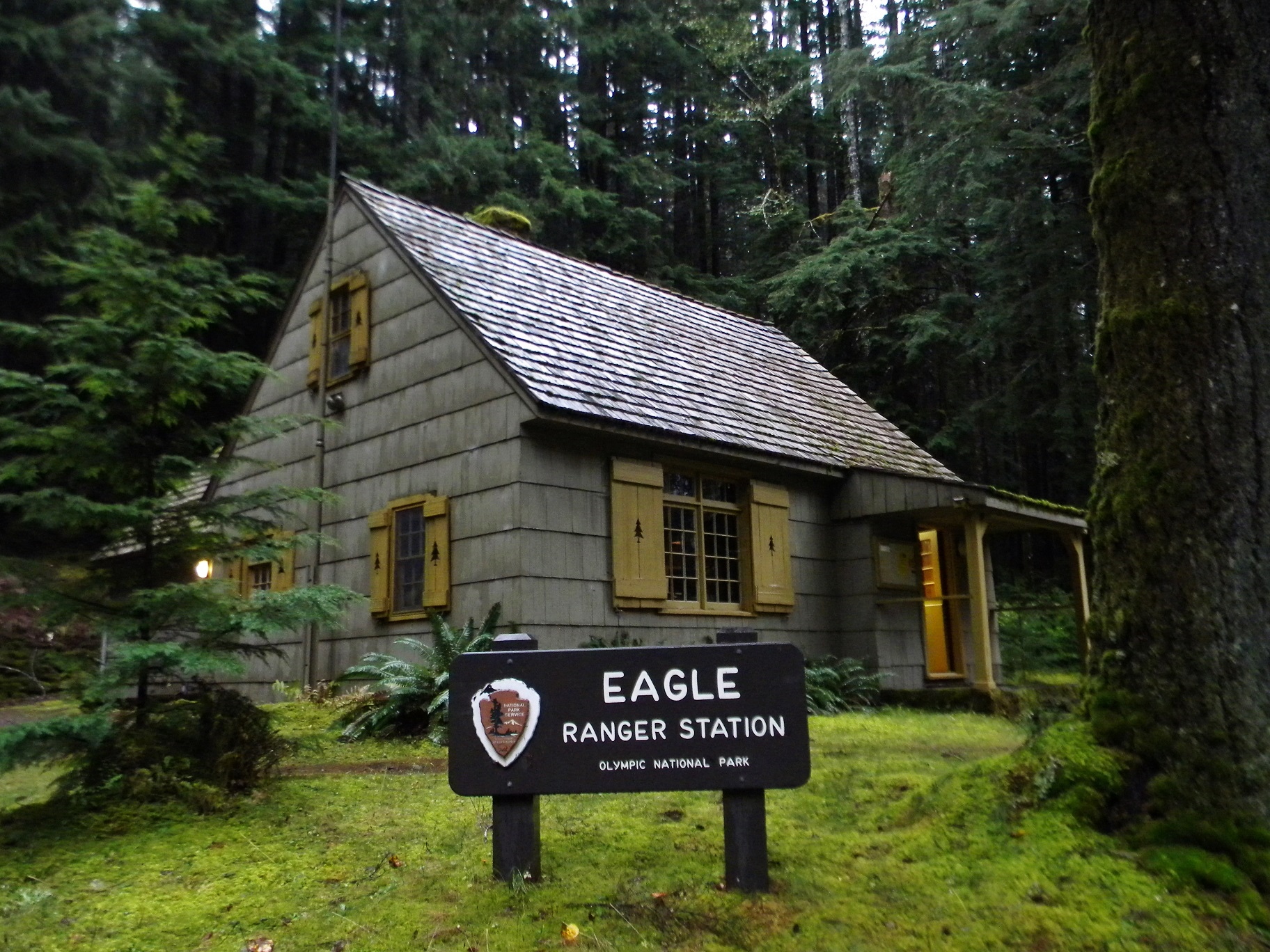
Eagle Ranger Station
Look closely at the window shutters on the Eagle Ranger Station and you will find pine-tree cutouts, the symbol of the U.S. Forest Service. It is a small detail on a small building, but it tells a story of institutional pride, craft, and a moment in American history when the federal government was building its way into the wilderness. This compound of three buildings in what is now Olympic National Park began as a Forest Service outpost in the Olympic National Forest, built before the park existed, before the land's administrative identity shifted from resource extraction to preservation.
Built by Two Agencies
The residence came first, in 1936, a wood-frame structure with a gabled roof and an asymmetrically placed porch framed in heavy timbers. The Forest Service designed it in their standard construction style, blending bungalow proportions with rustic details. The main window on the front facade is divided by a heavy mullion, with transoms and twelve small panes that catch light from the Sol Duc valley. Upstairs windows are six-over-six double-hung sashes, flanked by those distinctive shutters. A garage went up the same year, also wood-frame, clad in shingles. Then in 1940, the National Park Service added a generator house, built by the Civilian Conservation Corps. The one-story structure sits about 50 feet east of the residence, topped by a hipped roof and a small cupola. Three buildings, two agencies, one purpose: putting people in the forest to manage it.
From Forest to Park
The Eagle Ranger Station exists because of a jurisdictional transformation that reshaped the entire Olympic Peninsula. When the residence was built in 1936, these woods belonged to the Olympic National Forest, managed by the U.S. Forest Service for timber production, watershed protection, and recreation. Two years later, in 1938, Congress established Olympic National Park, and the land around the Sol Duc valley passed to the National Park Service. The ranger station's dual parentage is written into its architecture: the residence and garage reflect Forest Service standards, while the generator house reflects Park Service priorities, built with CCC labor as part of the New Deal's massive investment in public lands infrastructure. The station is now known as the Sol Duc Ranger Station, its original name largely forgotten.
Depression-Era Craft
The buildings at Eagle Ranger Station are modest in scale but careful in execution. The residence's shingle cladding, its Arts and Crafts-influenced proportions, and the fine mullion work on its windows reflect a construction ethic that valued durability and aesthetics even in remote backcountry settings. The Civilian Conservation Corps workers who built the generator house and landscaped the grounds brought the same ethic. These were young men employed by a federal program designed to combat unemployment during the Great Depression, and the infrastructure they built across America's public lands has proved remarkably enduring. The Eagle Ranger Station's compound was added to the National Register of Historic Places on July 13, 2007, recognized not as a grand architectural achievement but as a well-preserved example of the rustic federal style that defined how America built in its wildest places during the 1930s.
From the Air
Located at 47.97N, 123.86W in the Sol Duc valley of Olympic National Park. The station is a small compound in dense forest, difficult to spot from altitude. Nearest airport is William R. Fairchild International Airport (KCLM) in Port Angeles, about 30 miles east. The Sol Duc River valley is the primary visual landmark. Best viewed at low altitude if following the Sol Duc valley, but the buildings are small and surrounded by old-growth forest canopy.