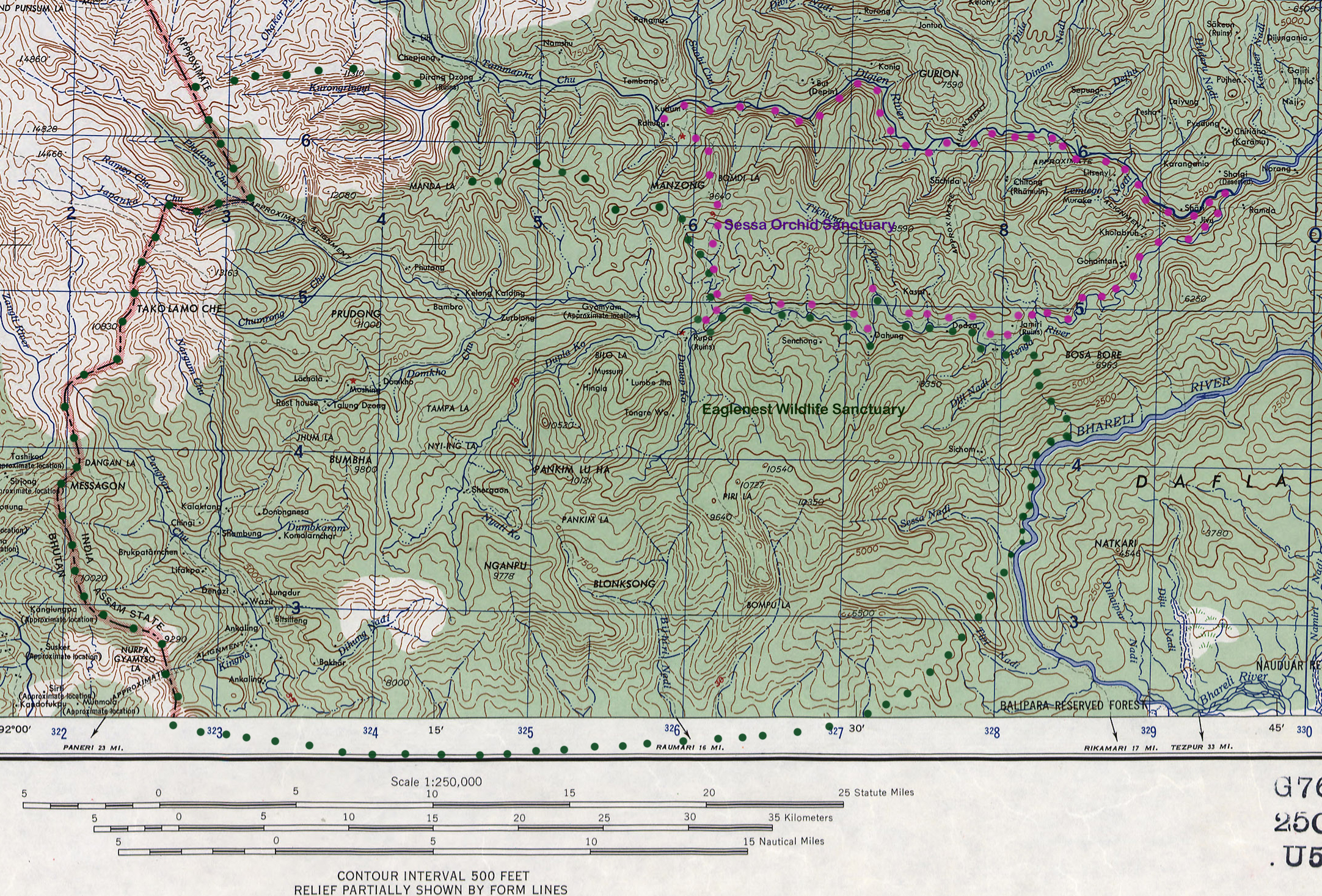
Eaglenest Wildlife Sanctuary
In 1995, an ornithologist named Ramana Athreya was birding in the eastern Himalayan foothills of Arunachal Pradesh when he spotted something that did not match any known species. The bird was small, olive-and-yellow, with a distinctive black cap. It took another eleven years before he could formally describe it to science: Bugun liocichla, named for the indigenous Bugun community whose forest it inhabited. The place where this bird revealed itself to the world was Eaglenest Wildlife Sanctuary, a protected area so remote that its primary defense against poaching has been the terrible condition of the single road leading into it.
Named for Soldiers, Defined by Rain
The sanctuary owes its name not to any local tradition but to the Indian Army's Red Eagle Division, which was posted in the area during the 1950s. What the soldiers left behind was a name; what nature provided was everything else. Eaglenest sits in the West Kameng District, part of a 3,500-square-kilometer protected area complex that includes Pakke Tiger Reserve, Sessa Orchid Sanctuary, and associated forest blocks - the largest contiguous closed-canopy forest tract in Arunachal Pradesh. The Eaglenest and Sessa ridges rise to 3,250 and 3,150 meters respectively, forming the first major barriers to the monsoon as it pushes north from the Assam plains. The southern slopes receive over 3,000 millimeters of rain annually; the northern slopes, sheltered in the rain shadow, get about half that. This asymmetry creates dramatically different ecosystems on either side of the same ridge.
A Vertical Menagerie
An unpaved road climbs from the sanctuary's base to Eaglenest Pass at 2,800 meters, threading through every altitudinal life zone in between. This single road gives scientists and ecotourists access to a biological gradient that few protected areas can match. Birders come for the three tragopan species - a distinction that may be unique in India - and for the Bugun liocichla, still known from only this location. Herpetologists find 34 species of amphibians, 24 species of snakes, and 7 species of lizards, including the Abor Hills agama, rediscovered here after 125 years of absence from scientific records. The Darjeeling false-wolfsnake, previously known from just five specimens worldwide, lives in these forests. Among the mammals, clouded leopards, marbled cats, red pandas, and Asiatic black bears share the canopy with the Arunachal macaque, a primate first noticed in 1997 but not formally described as a new species until 2004.
Elephants at the Roof of Their Range
Wild Asian elephants regularly climb from the Assam plains into Eaglenest, reaching the ridge at 3,250 meters in summer - the highest elevation that wild elephants are known to reach anywhere. At 11,000 feet, these animals are pushing the limits of their species' physiological range, moving through subtropical pine forests and into terrain more commonly associated with red pandas and tragopans. The reason for these high-altitude migrations has grown more urgent. Illegal forest clearance on the Assam plains adjacent to Eaglenest has intensified human-elephant conflict below, forcing the animals to spend longer periods in the sanctuary's upper reaches. This extended presence threatens to deplete food resources faster than the forest can regenerate, turning what was once a seasonal migration into something closer to a permanent displacement.
Protected by Isolation
Eaglenest has no settlements within its boundaries, a fact that has minimized hunting pressure. Its physical protection comes not from fences or guards but from geography: the single-lane road is so poor that reaching the interior requires genuine commitment. The Critical Ecosystem Partnership Fund has identified the Eastern Himalayan region around Arunachal Pradesh as a critical global biodiversity area, and BirdLife International has designated Eaglenest and Sessa as an Important Bird Area. Conservation International places it within the Himalaya Biodiversity Hotspot. These designations reflect what the road's difficulty already enforces - that Eaglenest is a place where biological wealth has survived in part because humans have found it hard to get there. Whether that accidental protection can hold as road conditions improve and encroachment from the plains continues is the central conservation question the sanctuary faces.
From the Air
Located at 27.10°N, 92.40°E in the Himalayan foothills of West Kameng District, Arunachal Pradesh. Best viewed at 8,000-15,000 feet AGL to appreciate the altitude gradient from Assam plains to Eaglenest Ridge at 3,250 m. The sanctuary is part of a vast forested complex visible as unbroken green canopy along the Himalayan front range. The Bhutan border lies to the west. Nearest airports are Tezpur Airport (VETZ), approximately 90 km south, and Lokpriya Gopinath Bordoloi International (VEGT) in Guwahati, approximately 200 km southwest.