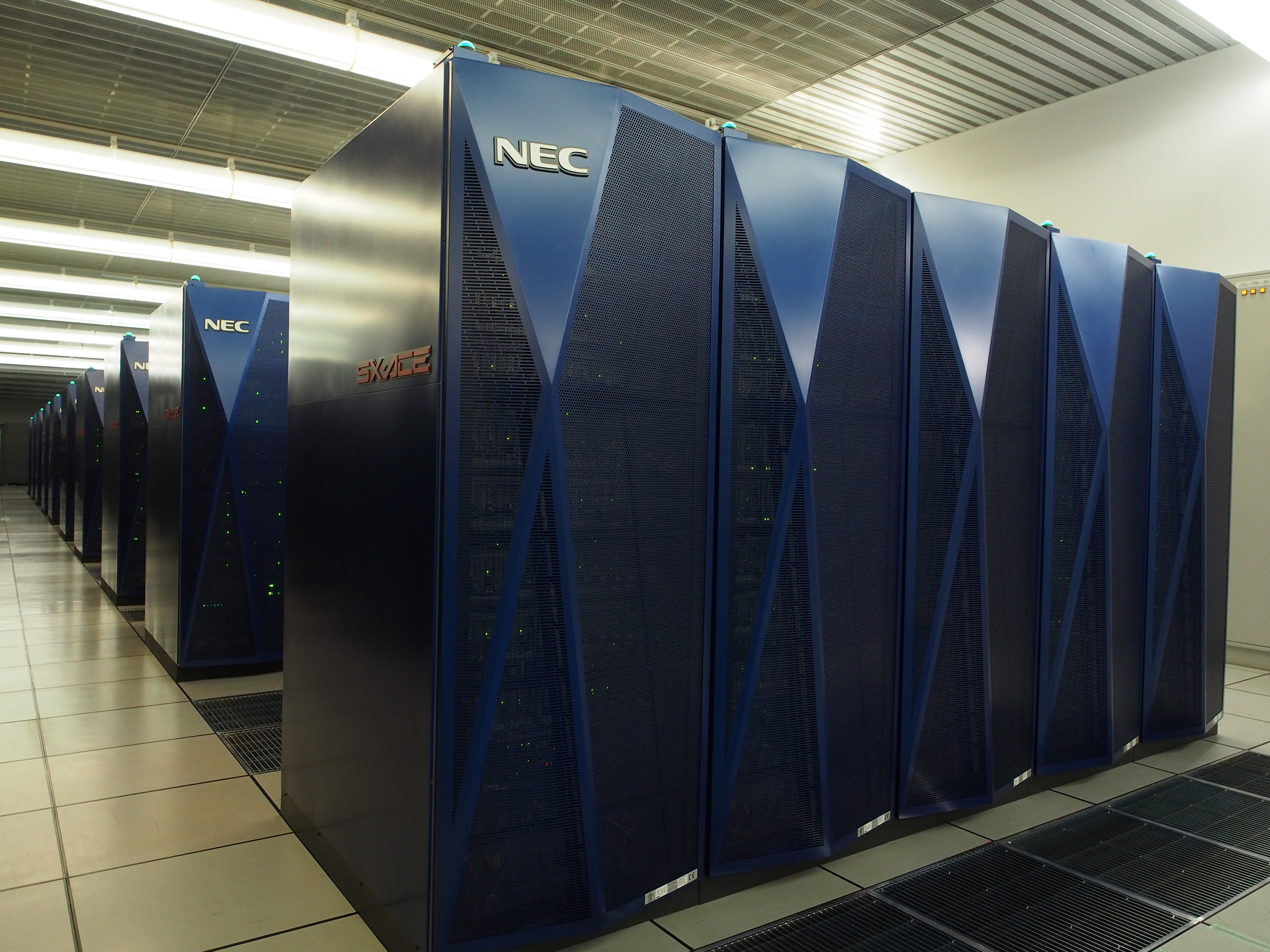
Earth Simulator: The Machine That Modeled a Planet
For two years, the most powerful computer on Earth sat in Yokohama, Japan, and its sole purpose was to simulate the Earth itself. When the first-generation Earth Simulator came online on March 11, 2002, it clocked 35.86 teraflops on the LINPACK benchmark -- nearly five times faster than ASCI White, the previous record holder. The American supercomputing community called it the "Computenik moment," a shock reminiscent of Sputnik. Japan had built a machine capable of modeling the planet's entire atmosphere and ocean systems down to a resolution of 10 kilometers, and it had done it with a clear, singular goal: to understand what climate change was going to do to the world.
Sixty Billion Yen and a Building Full of Processors
The Earth Simulator Project began as a Japanese government initiative in 1997, commissioned jointly by the Japan Aerospace Exploration Agency (JAXA), the Japan Atomic Energy Research Institute, and JAMSTEC -- the Japan Agency for Marine-Earth Science and Technology. NEC won the contract and built the system on its SX-6 vector processor architecture: 640 nodes, each containing eight vector processors and 16 gigabytes of memory, for a total of 5,120 processors and 10 terabytes of RAM. Two nodes fit inside each cabinet, a meter wide by 1.4 meters deep by 2 meters tall, and each cabinet drew 20 kilowatts of power. The whole system included 700 terabytes of disk storage and 1.6 petabytes of tape-based mass storage. Construction started in October 1999 at the JAMSTEC Yokohama Institute of Earth Sciences, and the project cost 60 billion yen -- roughly half a billion U.S. dollars at the time. It was, by any measure, an enormous bet on computational climate science.
The Computenik Moment
The Earth Simulator topped the TOP500 list of the world's fastest supercomputers from 2002 until September 29, 2004, when IBM's Blue Gene/L prototype finally surpassed it. During those two years, the machine ran holistic climate simulations that modeled both atmospheric and oceanic circulation at resolutions previously impossible. Climate scientists could visualize typhoon formation, track ocean current interactions, and study the cascading effects of rising greenhouse gas concentrations with a fidelity that changed how the field approached global modeling. The machine's dominance forced the United States and other nations to accelerate their own supercomputing programs, and it demonstrated that purpose-built scientific computing could leapfrog general-purpose designs. The Earth Simulator was not just fast -- it was focused, and that focus produced results.
Generations of Power
The original Earth Simulator gave way to the Earth Simulator 2 in March 2009, an NEC SX-9/E system that traded raw node count for per-node performance. ES2 had a quarter as many nodes but each delivered 12.8 times the computing power, achieving a peak of 131 teraflops and a delivered LINPACK performance of 122.4 teraflops -- making it the most efficient supercomputer in the world at the time. In November 2010, ES2 topped the Global FFT measure of the HPC Challenge Awards at 11.876 teraflops. The third generation arrived in March 2015, an NEC SX-ACE system with 5,120 nodes and peak performance of 1.3 petaflops. From 2017 to 2018, ES3 ran alongside Gyoukou, an immersion-cooled supercomputer capable of 19 petaflops. The fourth generation, ES4, marks a shift in architecture: AMD EPYC processors paired with NEC SX-Aurora TSUBASA Vector Engines and NVIDIA Ampere A100 GPUs, blending traditional vector processing with modern accelerator technology.
A Climate Cathedral in Yokohama
The Earth Simulator sits inside the JAMSTEC Yokohama Institute of Earth Sciences, a facility on the western shore of Tokyo Bay that has been dedicated to understanding the planet's physical systems for more than two decades. The institute's researchers use the machine to model everything from deep-ocean circulation to solid-earth geophysics, from earthquake dynamics to the long-term trajectory of global warming. Four generations of hardware have occupied the same building, each more powerful than the last, each pushing the boundaries of what computational science can tell us about the planet we inhabit. The name itself carries a kind of audacity -- to simulate the Earth requires not just processing power but the ambition to believe that mathematics and physics, given enough computation, can capture the behavior of a world.
From the Air
Located at 35.38°N, 139.63°E on the western shore of Tokyo Bay in Yokohama, Japan. The JAMSTEC facility sits in the Kanazawa district near the waterfront. Best viewed at 3,000-5,000 feet AGL. The building itself is a large institutional structure not easily distinguished from altitude without prior knowledge. Yokohama is immediately south of Tokyo. Nearest airports include Tokyo Haneda (RJTT) approximately 15 nautical miles north and Naval Air Facility Atsugi (RJTA) approximately 20 nautical miles west. Tokyo Bay dominates the eastern horizon.