Eassie Stone
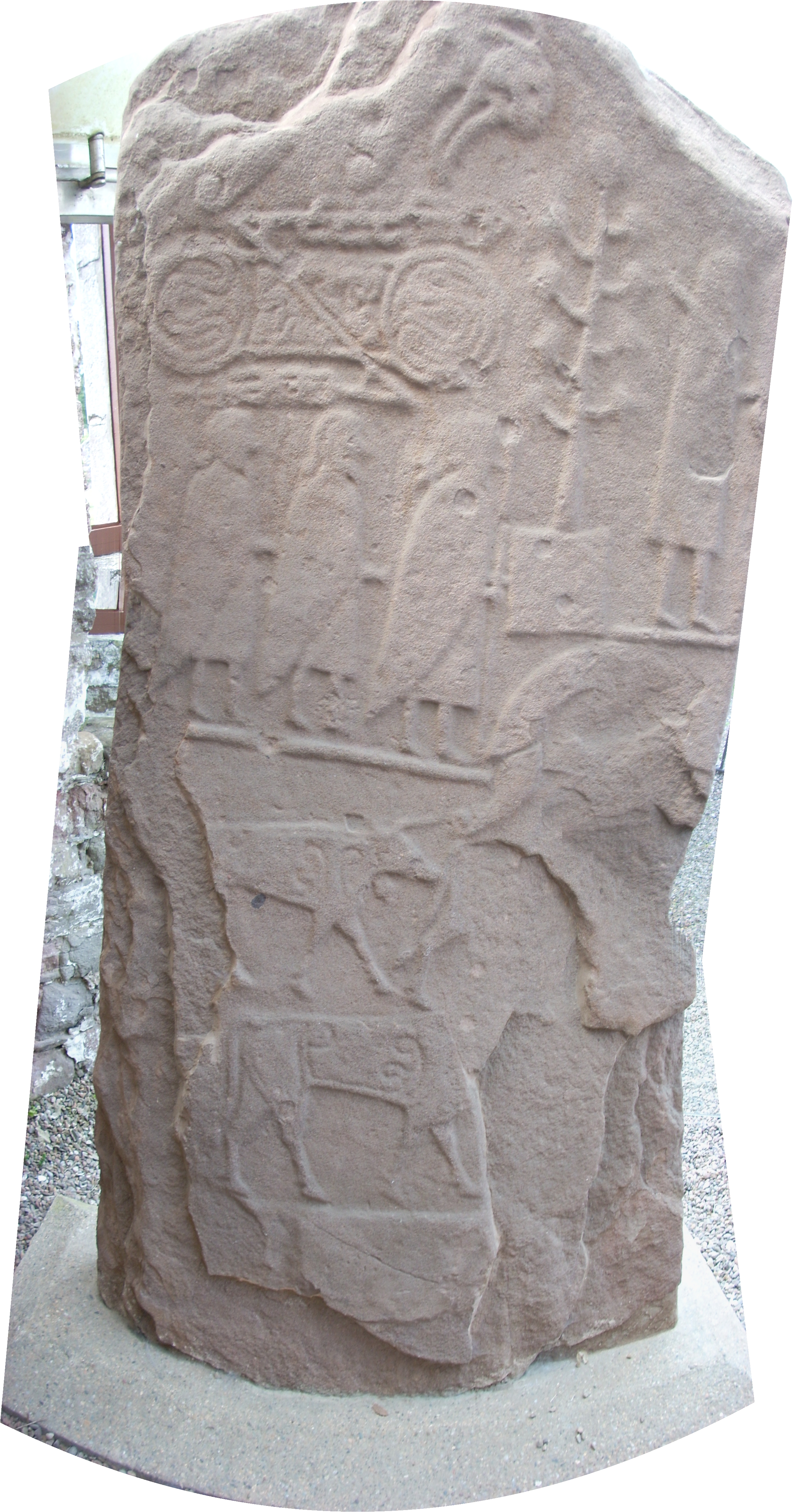
Inside the roofless shell of Eassie's old parish church, protected by a purpose-built shelter with transparent walls, a single stone slab stands just over two metres tall. The Eassie Stone is a Class II Pictish monument from about the mid-8th century, and it packs an entire world onto two faces of weathered sandstone: angels with four wings, a warrior with a shield and spear, hunting hounds pursuing a stag, cattle grazing, cloaked figures in conference, and -- most strikingly -- a figure standing before a potted tree from whose branches, according to historian Lloyd Laing, human heads may hang.
Two Faces of a Civilization
The front of the Eassie Stone is dominated by a cross with circular rings in its angles, surrounding a central boss decorated with a keywork design. Complex interlaced knotwork fills the arms and shaft -- the kind of intricate geometric carving that links Pictish art to the broader insular tradition of early medieval Britain and Ireland. The upper quadrants once held a pair of angels, though the right-hand figure is almost entirely lost to damage. A similar four-winged angel appears on the nearby Glamis 2 stone, suggesting a workshop connection between the two. Below the angels, the stone divides between the sacred and the worldly: a cloaked warrior armed with a buckler and spear occupies the lower left, while a stag and hunting hounds fill the lower right.
Symbols Without a Dictionary
The reverse face mixes figural scenes with Pictish symbols in a composition that has fascinated and frustrated scholars for over two centuries. At the top, a damaged Pictish beast overlies a double disc and Z-rod. Below, a trio of cloaked figures stands alongside the enigmatic tree scene. Heavily weathered horseshoe and Pictish beast symbols are barely visible lower down, and the base holds representations of cattle. The stone belongs to what scholars call the Aberlemno School of Pictish sculpture, a grouping that includes the famous Aberlemno Kirkyard Stone, stones at Kirriemuir and Monifieth, and others scattered across Angus and Perthshire. These stones share stylistic features -- carving techniques, compositional approaches, iconographic choices -- that suggest they were produced by related workshops or a school of sculptors working within a shared tradition.
Lost and Found in the Burn
The stone was discovered in the bed of the Eassie Burn around 1786 by Reverend Cordiner. How it came to be there is unknown -- whether toppled by weather, buried by floodwaters, or deliberately hidden during some period of upheaval. For over a century after its discovery, the stone stood exposed to the Scottish elements. In the 1960s, it was finally given the shelter it now occupies, a simple transparent structure built within the ruined walls of the old church. The church itself probably dates to the 16th century, built on the site of an earlier building. That layering of sacred sites -- a Pictish monument in a medieval church in a purpose-built modern shelter -- is characteristic of Scotland's relationship with its deep past. The village of Eassie sits on the A94 road, four kilometres west of Glamis and six kilometres east of Meigle, placing the stone at the heart of the richest concentration of Pictish sculpture in Scotland.
From the Air
Located at 56.61N, 3.06W in the village of Eassie, Angus, on the north side of the A94 road. The stone is sheltered in a ruined church visible as a small roofless structure. Glamis Castle is 4km east and the Meigle museum is 6km west. Nearest airport: Dundee (EGPN) 13nm southeast.