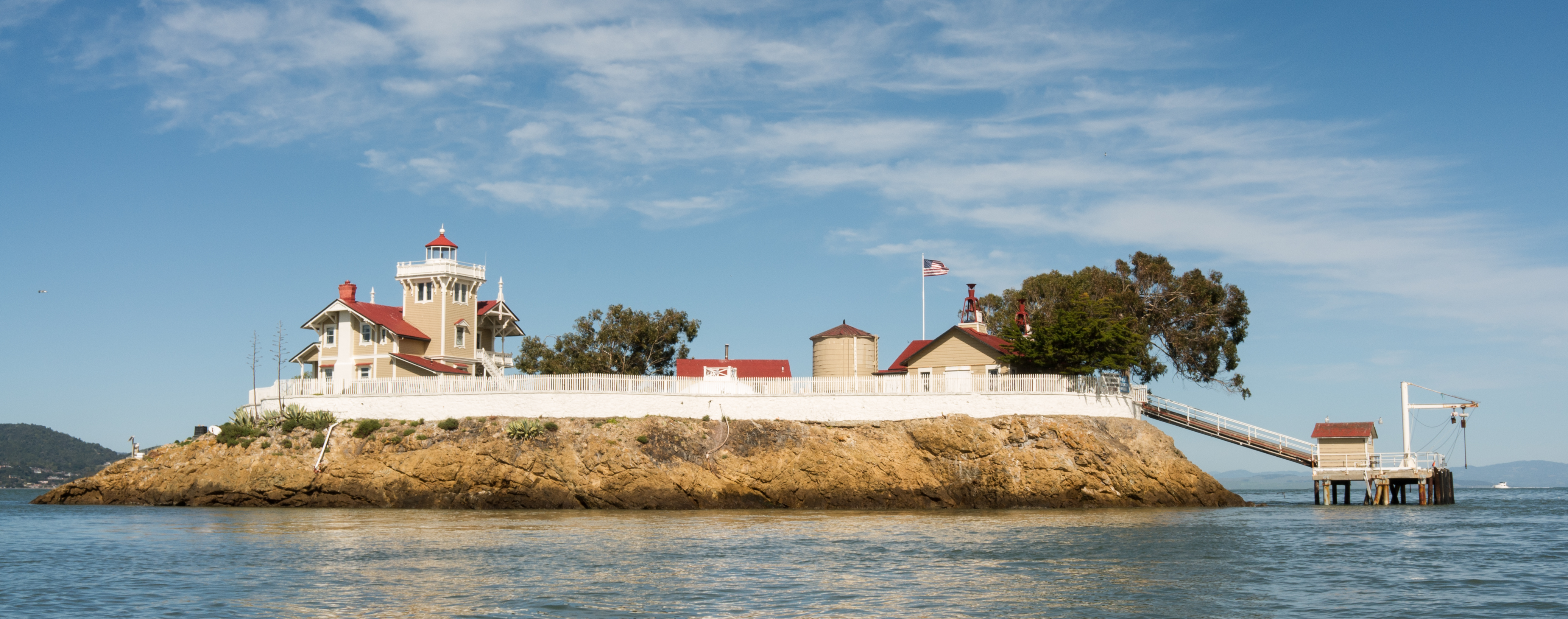
East Brother Island Light
You can sleep inside a lighthouse. Not next to one, not near one -- inside a functioning light station on a one-acre rock island in the middle of San Francisco Bay. East Brother Island Light has been guiding ships through the narrows between San Francisco Bay and San Pablo Bay since March 1, 1874, and since 1980, its keeper's house has operated as a bed-and-breakfast where guests wake to foghorns, tidal currents, and views of Mount Tamalpais rising above the Marin shoreline.
Blasting a Foundation
The U.S. government knew it needed a light to mark the entrance to San Pablo Bay, but mainland property near Point San Pablo proved too expensive. The solution was characteristically direct: they already owned the island, so they dynamited it flat. Large-scale blasting leveled East Brother Island's rocky surface to create a foundation for the two-story keeper's house, its attached light tower, and a fog signal building. Architect Paul J. Pelz designed the station in the American Stick style, the same design he used for a series of sister stations along the Pacific Coast -- Point Fermin in San Pedro, Mare Island in the Carquinez Strait, Point Hueneme, and Hereford Inlet Light in New Jersey. Of those siblings, only East Brother and Point Fermin still stand. The lamp was first lit on March 1, 1874.
Twenty-Year Men
The lighthouse demanded everything from its keepers. Families lived on the tiny island year-round, lighting the whale-oil wick each evening and firing up steam boilers on foggy nights to drive the foghorns, hauling coal up a long ramp from the boat dock. Two keepers logged twenty years each -- longer than any others. John Stenmark, originally from Sweden, joined the lighthouse service at twenty and was appointed keeper at East Brother in 1894, raising four children on the rock. Willard Miller began his tenure in 1922 and oversaw the station's modernization: the light was upgraded to a fifth-order Fresnel lens powered by a 500-watt bulb, and the steam fog signal was converted to a compressor-driven diaphone. On March 4, 1940, a fire destroyed the island's wharf, boathouse, and four boats -- a catastrophe for a station accessible only by water.
Saved From the Wrecking Ball
The United States Lighthouse Service operated East Brother until 1939, when it merged with the Coast Guard. The light was automated in 1969, and the government planned to demolish the keeper's house and auxiliary buildings, keeping only the automated light. Local residents protested. The lighthouse was listed on the National Register of Historic Places in 1971, but neglect continued for years. In 1979, a nonprofit group -- East Brother Light Station, Inc. -- formed to rescue the landmark. Government grants, private donations, and volunteer labor restored the Victorian structures. The following year, the keeper's house opened as a bed-and-breakfast, turning a maintenance burden into a self-sustaining preservation model.
A Night on the Rock
Guests reach East Brother Island by boat from the Richmond shoreline, a short crossing that feels longer as the city falls away behind them. The island holds a water cistern blasted thirty feet into the rock, capable of storing 50,000 gallons of rainwater -- an engineering marvel from an era when the station was entirely self-sufficient. Today, the light still operates, marking the channel for tankers and container ships moving between the refineries of the upper bay and the open Pacific. Because the station was built in England and is not eligible for grants reserved for U.S.-built vessels, maintenance depends on the nonprofit and its supporters. The island sits between two worlds: the industrial shoreline of Richmond to the east, the green hills of Marin to the west. At night, with the light rotating above and the bay dark around you, the twenty-first century feels very far away.
From the Air
East Brother Island Light is located at 37.9633N, 122.4334W on a tiny rock island in San Rafael Bay near Point San Pablo, Richmond. The white Victorian lighthouse is visible from 2,000-3,000 feet AGL as a small structure on a rocky islet. Nearby airports: KOAK (Oakland International, 14nm SE), KSFO (San Francisco International, 18nm S). The island marks the narrows between San Francisco Bay and San Pablo Bay.