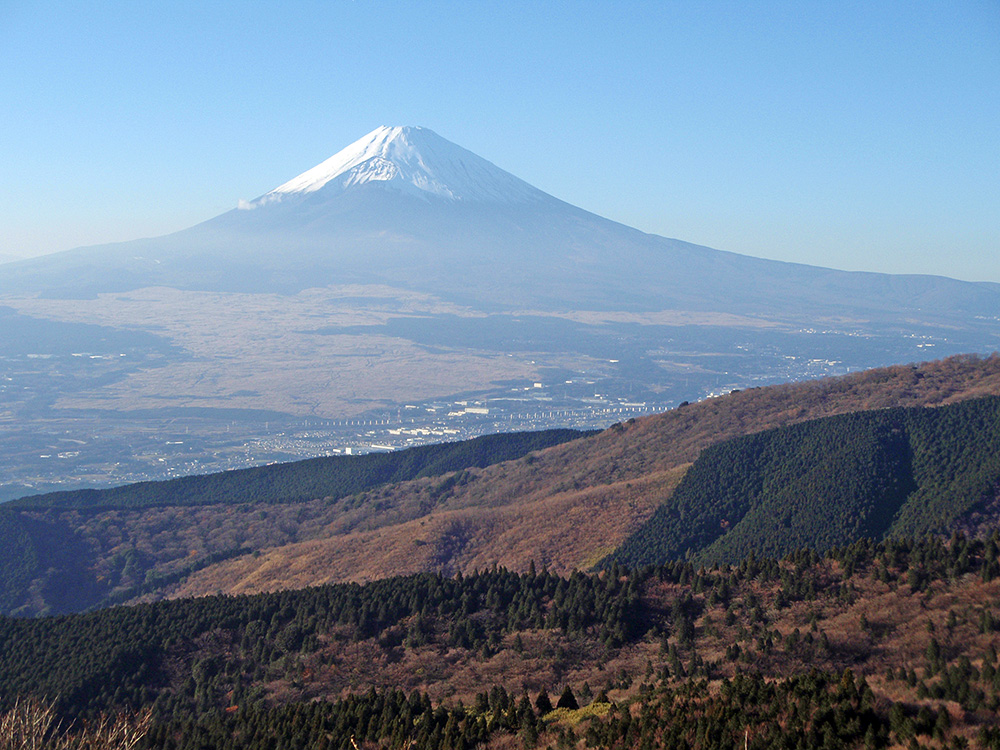
East Fuji Maneuver Area
Every August, the thunder rolls across Fuji's eastern foothills and it is not the weather. Eighty tanks grind through volcanic soil, 80 artillery pieces fire in coordinated volleys, 30 aircraft streak overhead, and more than 2,000 soldiers of the Japan Ground Self-Defense Force demonstrate what modern combined-arms warfare looks like -- all within sight of Japan's most sacred mountain. The East Fuji Maneuver Area has been military ground for over seven centuries. At 88.09 square kilometers, it sprawls across the municipalities of Gotemba, Susono, and Oyama in Shizuoka Prefecture, a vast expanse of hilly terrain that has served every incarnation of Japanese military power from medieval samurai to 21st-century mechanized infantry.
Samurai Drills to Imperial Guns
The military pedigree of this ground runs deep. In the 13th century, samurai of the Kamakura Shogunate used the open terrain at Fuji's base for mounted combat training -- the wide volcanic slopes providing the kind of unobstructed ground that horsemen needed. The area's sparse population and rugged topography made it a natural choice for military exercises long before the modern concept of a dedicated training range existed. When the Imperial Japanese Army formalized its use of the area in 1898, it was following a tradition already six centuries old. The Fuji-Susono Maneuver Area was officially established in 1912, and supporting installations followed quickly: Camp Takigahara in 1908, Camp Itazuma in 1909, and Camp Komakado in 1936. By the 1930s, the eastern flank of Fuji had become the Imperial Army's primary training complex on Honshu.
Four Years in Court
After Japan's defeat in 1945, American occupation forces took control of the training area. When the post-war Japan Ground Self-Defense Force was established in 1954, it desperately needed training facilities -- but getting access to East Fuji proved anything but simple. Local landholders, whose families had lived in the area for generations, opposed the military's return. The American military, still using the grounds for its own exercises, was reluctant to share. What followed was four years of legal wrangling, from 1955 to 1959, before the JGSDF was finally granted access. Even then, the arrangement was complex. The United States Marine Corps retained Camp Fuji, a facility carved from the northern half of Camp Takigahara in 1953, which it operates to this day. It was not until July 31, 1966, that the East Fuji Maneuver Area and its surrounding bases -- with the notable exception of Camp Fuji -- were formally returned to Japanese government control.
Fire and Steel Beneath the Volcano
The annual Fuji Firepower Demonstration, held each August, is the most visible expression of what happens on this ground year-round. For decades, the two-hour exhibition drew tens of thousands of spectators -- military officials, foreign dignitaries, and Japanese civilians alike -- who watched from grandstands as the JGSDF demonstrated the full spectrum of its ground combat capability. Since 2023, however, in-person public attendance has ended; the demonstration is now broadcast via official YouTube livestream only. Type 10 main battle tanks maneuver across the hilled range while artillery batteries deliver coordinated fire missions. Attack helicopters make gun runs. The backdrop is Mount Fuji itself, its snowcapped cone rising behind the smoke and dust. For the JGSDF, the event serves a dual purpose: it is both a training validation exercise and a public relations effort, designed to build understanding and trust with the local communities that live alongside the constant rumble of military operations.
Shared Ground, Complicated Neighbors
The East Fuji Maneuver Area exists in an unusual state of shared sovereignty. The JGSDF controls most of the range, but the U.S. Marine Corps' Combined Arms Training Center at Camp Fuji operates within it under the terms of the U.S.-Japan Security Treaty. American Marines from units stationed across the Pacific regularly rotate through Camp Fuji for live-fire exercises and cold-weather training. Meanwhile, the cities of Gotemba and Susono have grown right up to the range boundaries. Residents live with the sound of artillery, the sight of military convoys on local roads, and the knowledge that one of Asia's most active military training facilities is their next-door neighbor. It is a tension as old as the training area itself -- the same tension that drove those four years of litigation in the 1950s -- and it is managed, if never fully resolved, through ongoing dialogue between the defense establishment and the communities that share Fuji's foothills.
From the Air
Located at 35.32N, 138.85E on the eastern slopes of Mount Fuji in Shizuoka Prefecture. The training area covers 88.09 square kilometers and is clearly visible from the air as a large, sparsely vegetated expanse with cleared ranges, impact areas, and military roads contrasting with surrounding forest and agricultural land. CAUTION: This is an active military training area -- check NOTAMs carefully for temporary restricted airspace, especially during August when the annual Fuji Firepower Demonstration involves live artillery fire and military aircraft. Camp Fuji (USMC) is located within the area. Nearest airports: Mount Fuji Shizuoka Airport (RJNS) approximately 35nm south, Tokyo Haneda (RJTT) approximately 55nm east. Mount Fuji (3,776m) provides an unmistakable visual reference to the northwest.