Easter Island: The Mystery of Rise and Collapse
The moai stand with their backs to the sea, nearly 900 stone giants facing inward across the island their creators called Rapa Nui. Some weigh over 80 tons. Some stand over 30 feet tall. They were carved from volcanic rock between 1250 and 1500 AD by a Polynesian civilization that somehow transported them miles from the quarry to platforms around the island's coast. Then the statue-building stopped. When Europeans arrived in 1722, the population had crashed, the forests were gone, and many statues had been toppled. What happened on Easter Island became a parable about environmental collapse - and a scientific controversy that continues today.
The Builders
Polynesians reached Easter Island around 1200 AD, sailing thousands of miles across the Pacific in double-hulled canoes to settle the most isolated inhabited island on Earth - 2,300 miles from Chile, 2,500 miles from Tahiti. What they found was a lush island covered in giant palm trees, rich in birds and marine life. What they built was extraordinary.
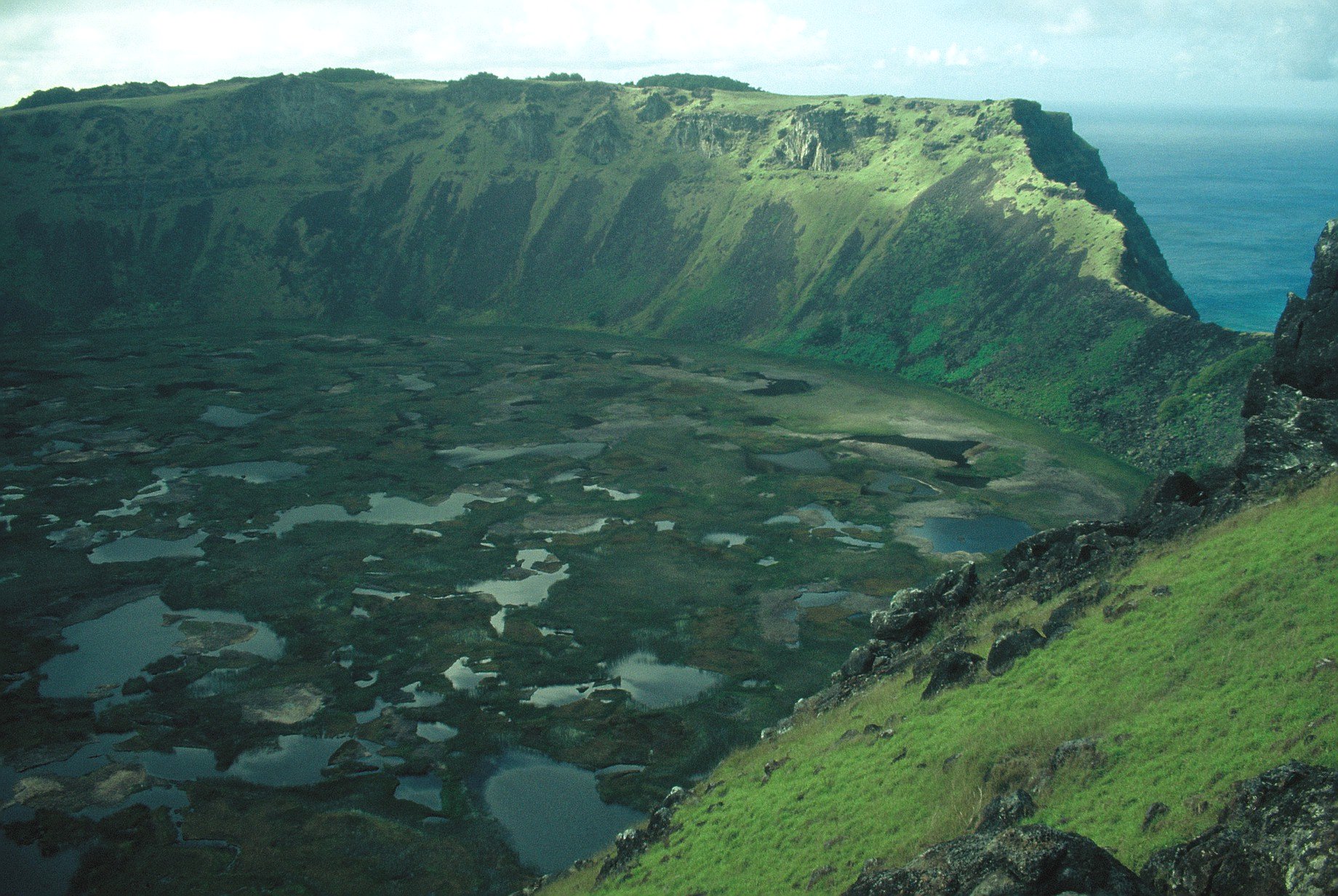
The moai were carved in the quarry at Rano Raraku, a volcanic crater where nearly 400 unfinished statues still lie. Completed statues were somehow moved up to 11 miles to platforms called ahu around the island's perimeter. How they moved them remains debated - rollers, sleds, ropes, or a 'walking' technique where teams rocked the statues forward. The engineering was remarkable regardless of method.
The Collapse
The traditional story, popularized by Jared Diamond's 'Collapse,' describes ecological suicide. The islanders cut down all the trees to move statues and build canoes. Deforestation led to soil erosion, crop failure, and the extinction of native birds. Without trees for canoes, fishing declined. The population, which may have reached 15,000, crashed. Warfare broke out between clans. The moai were deliberately toppled. By the time Europeans arrived, only about 2,000 people remained.
This narrative became a cautionary tale about unsustainability - a preview of what Earth itself might experience. Easter Island was humanity's fate in miniature, a closed system where overconsumption led inexorably to collapse.
The Revision
Recent research has complicated this narrative. Anthropologist Terry Hunt and archaeologist Carl Lipo argue that rats, not humans, destroyed the palm forests - rats that arrived with the colonizers and ate the palm nuts that would have regenerated the trees. They suggest the population was never as large as estimated and that the 'collapse' was less dramatic than claimed.
Other researchers point to European contact as the real catastrophe. Slave raids in 1862 kidnapped about 1,500 islanders - half the remaining population - for forced labor in Peru. When a few survivors returned, they brought smallpox. By 1877, only 111 Rapanui remained. This was colonial genocide, not environmental collapse.
The Moai Today
Nearly 900 moai remain on the island, about 400 still at the quarry in various stages of completion, the rest scattered around the coast. Some stand on restored ahu platforms, their red stone topknots (pukao) replaced on their heads. Many lie face-down where they were toppled centuries ago. A few stand inland, apparently abandoned during transport.
The moai are protected as UNESCO World Heritage sites, but they face new threats - erosion, tourism pressure, and climate change causing coastal damage to ahu platforms. The islanders, whose population has recovered to about 7,750, balance preservation with the tourism that dominates the economy.
What Easter Island Means
Easter Island's story has been used to prove many things - that civilizations inevitably destroy their environments, that rats are worse than humans, that colonialism kills more surely than deforestation. The truth is probably complex: multiple factors - deforestation, rat predation, drought, internal conflict, European disease and slavery - combined to transform the island.
What's undeniable is the achievement. A small population on a remote island, without metal tools or wheels, carved and moved monuments that rival the pyramids in ambition. The moai face inward, watching over the descendants of those who made them, proof that human creativity can flourish anywhere - and that even extraordinary civilizations are fragile.
From the Air
Easter Island (27.11S, 109.35W) lies 2,300 miles west of Chile in the southeastern Pacific. Mataveri International Airport (SCIP/IPC) has one runway (3,350m) - one of the longest in South America, designated as a Space Shuttle emergency landing site. The island is triangular, formed by three volcanoes. Rano Raraku quarry is on the eastern slope. Moai and ahu platforms are visible around the coastline. Weather is subtropical oceanic - warm year-round, rainfall distributed throughout the year. The island is small (63 square miles) and entirely visible from above.