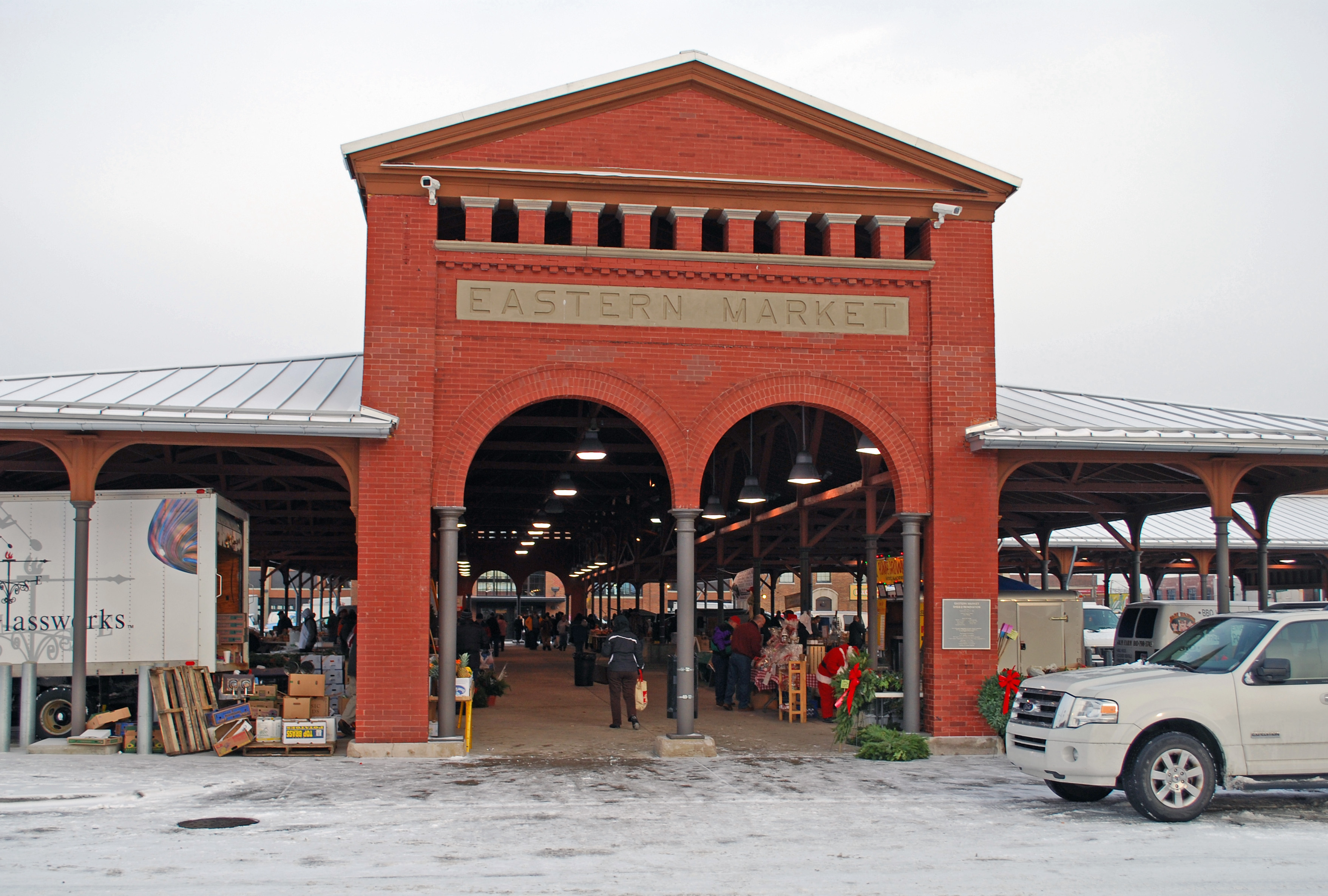
Eastern Market, Detroit
Forty thousand people on a summer Saturday, and every one of them knows exactly which shed to visit. The flower vendors are in one place, the meat cutters in another, the spice merchants in a third, and the fruit farmers have been setting up in the same spots long enough that their grandchildren now work the stalls. Eastern Market in Detroit is not a trendy revival or a developer's vision of urban renewal -- it is the longest-running version of itself, a farmers' market that has occupied this site since 1891 and has never stopped operating. At roughly 43 acres, it is the largest historic public market district in the United States, listed on the National Register of Historic Places since 1978, and it has survived two world wars, the Great Depression, Detroit's population collapse, and a municipal bankruptcy without missing a Saturday.
From Cadillac Square to the Sheds
Detroit's original market sat at City Hall in Cadillac Square from 1841 onward, but by the late nineteenth century the city was growing too fast for the space. An informal market for hay and wood had already sprung up a mile northeast of downtown, near the present intersection of Gratiot Avenue and Russell Street, and in 1891 city leadership made it official. The open-air sheds that define Eastern Market today were built to house the vendors. During the Great Depression, the market became a lifeline: Detroiters could buy directly from regional farmers at prices well below store retail, and the farmers in turn had a guaranteed customer base when rural economies were collapsing. That mutual dependence between city and farm has never really broken.
Painted Walls and the Detroit Unity Bell
Walk the blocks around the sheds today and the walls shout at you. The annual Murals in the Market festival, launched by the art publisher 1XRUN, commissions local and international artists to paint large-scale murals across the district's buildings each fall. The event is part of Detroit Month of Design, which brings gallery openings, artist panels, and the signature Eastern Market After Dark evening celebration to the neighborhood. Art galleries, makerspaces, and independent shops have filled storefronts along Gratiot Avenue -- places like Trinosophes, Inner State Gallery, and People's Records. In 2022, the Detroit Unity Bell, salvaged from the demolished Old City Hall, was installed in the market. The bell's name deliberately echoes Philadelphia's Liberty Bell, and it rings out over a district that has become as much about cultural identity as about produce.
More Than a Farmers' Market
Eastern Market's calendar reads like a city's appetite laid bare. Flower Day in May draws crowds for flats of annuals and hanging baskets. The Detroit Burger Battle arrives in June, the Taco Showdown in July, the Detroit Sandwich Party in September. The Detroit Festival of Books pulls over 10,000 attendees each July. The Fall Beer Festival in October features more than 90 Michigan breweries, and Whiskey Wonderland closes out November. On Detroit Lions home game days, the market's parking lots transform into a tailgating mecca. The wholesale market still runs every weekday night from April through November, keeping restaurants and grocers stocked. More than 150 businesses operate within the district, and the expanded historic designation now covers 76 structures beyond the original sheds. Eastern Market is not a weekend novelty -- it is a commercial engine that runs around the clock.
Feeding the City Forward
Detroit's vast stretches of vacant land -- a legacy of population loss -- have unexpectedly positioned the city as a national leader in urban agriculture. Eastern Market sits at the center of that movement. The Eastern Market Corporation, a nonprofit public-private partnership that took over operations from the city in 2006, has spent more than $10 million on shed renovations and invested in programs that connect low-income residents to fresh food, support farm-to-table supply chains, and help young chefs launch businesses. The market is currently participating in a Sustainable Cities Challenge to reduce its carbon footprint, encouraging district businesses to cut their reliance on fossil fuels and freight traffic. For a place that started as an informal hay market in the nineteenth century, Eastern Market has become something its founders could not have imagined: a model for how old public markets can anchor a city's food system, cultural life, and economic future simultaneously.
From the Air
Eastern Market is at 42.346N, 83.043W, approximately one mile northeast of downtown Detroit. From the air, the district is identifiable by its cluster of long, narrow market sheds with distinctive rooflines, bordered by Gratiot Avenue to the south, Mack Avenue to the north, and I-75 (Chrysler Freeway) to the west. The colorful murals covering surrounding buildings are visible at lower altitudes. Nearest airports: Coleman A. Young International (KDET) 3nm northeast, Detroit Metropolitan Wayne County (KDTW) 20nm southwest, Windsor Airport (CYQG) 6nm south across the Detroit River. Best viewed at 1,500-3,000 feet AGL to see the shed layout and surrounding mural district.