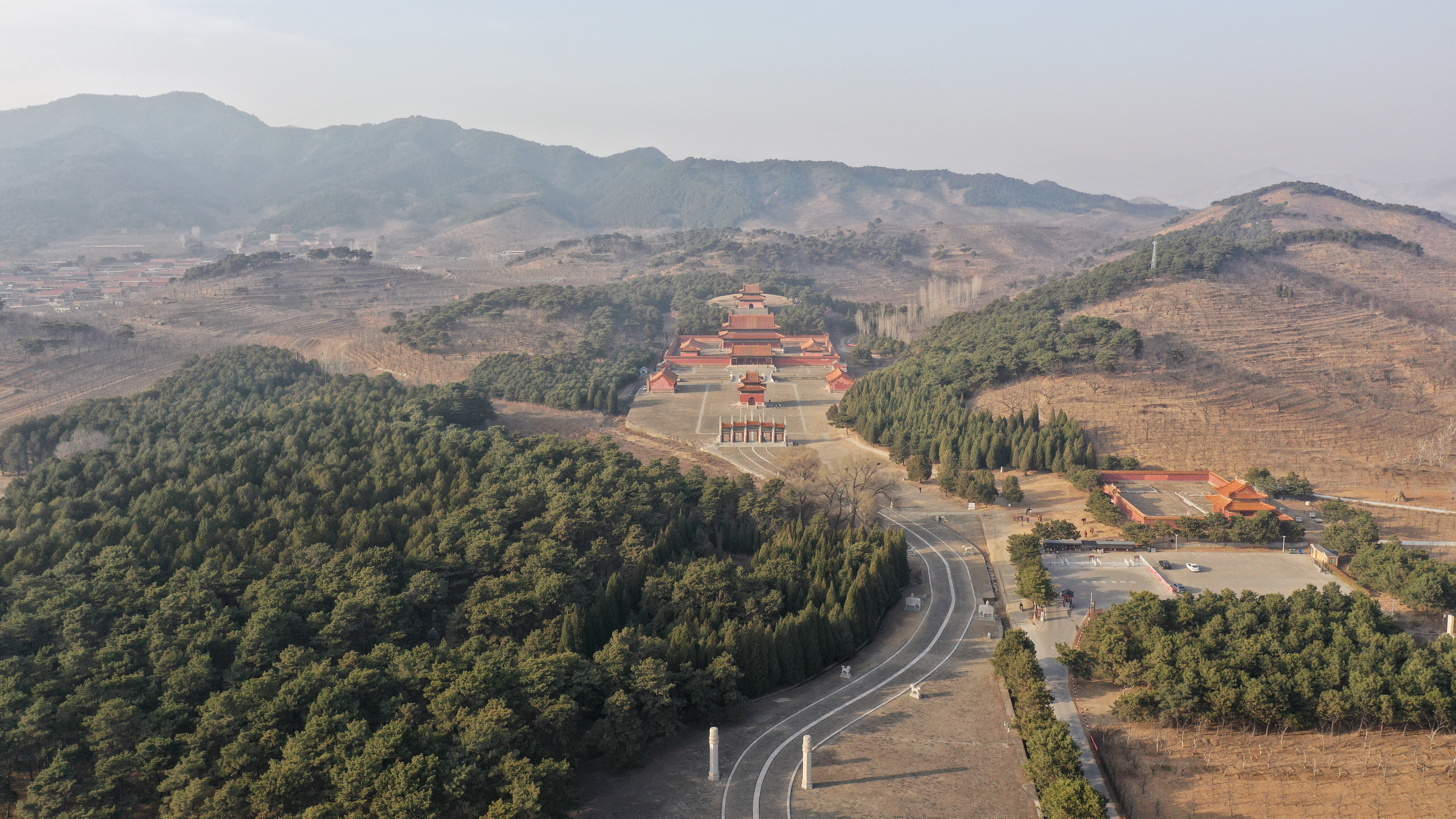
Eastern Qing Tombs
Five Qing emperors chose to spend eternity here, surrounded by mountains named Changrui, Jinxing, Huanghua, and Yingfei Daoyang. The Eastern Qing Tombs spread across 80 square kilometers of Zunhua County in Hebei Province, 125 kilometers northeast of Beijing, forming the largest, most complete, and best-preserved imperial mausoleum complex in China. Altogether, five emperors, fifteen empresses, 136 imperial concubines, three princes, and two princesses rest beneath these hills -- a subterranean court that mirrors the dynastic hierarchy they maintained in life.
The First Emperor's Choice
At the center of the complex lies Xiaoling, the tomb of the Shunzhi Emperor, who in 1644 became the first Qing emperor to rule over all of China. Shunzhi chose this site for reasons that blended geomantic calculation with practical geography: the mountains provided a natural amphitheater of protective ridges, while the distance from Beijing was close enough for the living court to visit but far enough to preserve the sanctity of the dead. Buried alongside Shunzhi are his empresses Xiaokangzhang -- the mother of the great Kangxi Emperor -- and Consort Donggo. Every subsequent mausoleum in the complex follows the pattern established by Xiaoling, creating a visual grammar of death that remained consistent across two centuries of construction.
Emperors East and West
The tombs radiate outward from Shunzhi's central mausoleum in a carefully planned layout. To the east stand Jingling, the tomb of the Kangxi Emperor, and Huiling, the tomb of the Tongzhi Emperor. To the west lie Yuling for the Qianlong Emperor, Dingling for the Xianfeng Emperor, and Ding Dongling, the joint tomb of the powerful Dowager Empresses Cixi and Ci'an. The Kangxi Emperor, who reigned for 61 years, and the Qianlong Emperor, who reigned for 60, represent the Qing dynasty at its zenith of power. Their burial chambers, along with those of Empress Dowager Cixi and two of Qianlong's concubines, are open to the public -- rare opportunities to descend into the subterranean world of imperial funerary architecture, where carved stone reliefs and vaulted chambers reveal the resources that China's rulers devoted to their afterlives.
The Emperor Who Left
Not every emperor intended to stay. The Daoguang Emperor initially planned to be buried at the Eastern Qing Tombs and construction began on his mausoleum here. But when water seeped into the burial chamber during construction, Daoguang took it as an inauspicious sign and ordered the entire project relocated to the Western Qing Tombs, over 100 kilometers away. The already-built structures were dismantled and moved. Only the tombs of two of his sons and two daughters remain at the Eastern site, in a section known as the Tomb of the Princess. Daoguang's departure created the alternating pattern where Qing emperors were buried at either the Eastern or Western tombs, a system that gave the dynasty's deceased rulers a geographic spread across northern China.
Looted, Protected, Enduring
The Eastern Qing Tombs have not rested entirely in peace. In 1928, warlord Sun Dianying's soldiers systematically looted several of the tombs, prying open the underground chambers and stripping them of jade, gold, and precious burial objects. The Empress Dowager Cixi's tomb was among those violated, her body reportedly dragged from its coffin. The looting shocked China and became one of the most infamous acts of grave robbery in Chinese history. Despite this desecration, the structural integrity of the complex survived. The tombs were designated a UNESCO World Heritage Site as part of the Imperial Tombs of the Ming and Qing Dynasties, recognizing both their architectural significance and their role as a record of how China's last dynasty prepared for the world beyond death. Today, the complex remains remarkably intact: stone spirit roads lined with carved animals, ceremonial gates, sacrificial halls, and the mountain-backed mound tombs themselves, all arranged according to principles of cosmic order that the Qing court believed would determine the fate of the dynasty for eternity.
From the Air
Located at 40.19N, 117.65E in Zunhua County, Tangshan, Hebei Province. The tomb complex is visible from altitude as a large area of structured landscape set against mountain ridges. The nearest major airports are Beijing Capital International (ZBAA/PEK), approximately 125 km to the southwest, and Tangshan Sannuhe Airport (ZBTS). The terrain transitions from plains to foothills. Best viewed from 5,000-10,000 feet AGL to appreciate the layout of the entire complex.