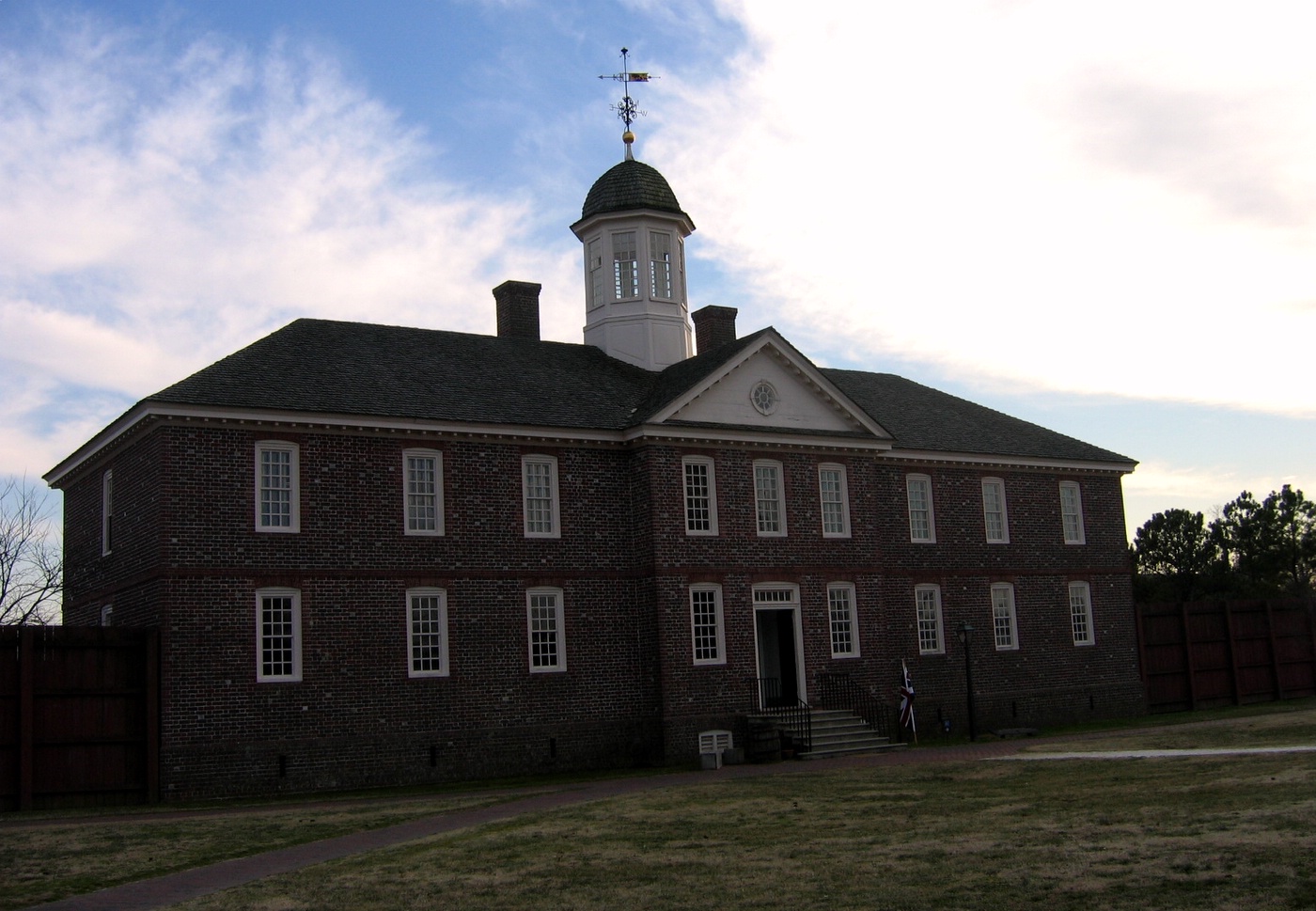
Eastern State Hospital
In November 1766, Royal Governor Francis Fauquier stood before the Virginia House of Burgesses and said something no colonial official had said before. He asked them to think about the mentally ill. 'A poor unhappy set of People who are deprived of their senses and wander about the Country, terrifying the Rest of their fellow creatures,' he called them, and urged that 'a legal Confinement, and proper Provision, ought to be appointed for these miserable Objects.' It was the first session since the Stamp Act crisis, and the legislators had politics on their minds, not charity. They passed a resolution to build a hospital but did nothing. Fauquier came back the following April and pressed them again, confessing he was already illegally confining a lunatic who would be 'mischievous to society' if released. He died on March 3, 1768, before his vision was realized. But on October 12, 1773, the institution he championed opened its doors in Williamsburg - the first public facility in what would become the United States built solely for the care of the mentally ill.
An Enlightenment Experiment
Fauquier's compassion was rooted in the intellectual currents of his age. The eighteenth century Enlightenment was reshaping how Europeans and colonists thought about human life and suffering. Philosophers like David Hume and Voltaire were investigating the worth of human existence, and their ideas were gradually altering perceptions of the mentally ill. In London, the Bethlehem Royal Hospital - known as Bedlam - still paraded its inmates for public entertainment, charging tourists for the spectacle. But Enlightenment attitudes were encouraging a new sensitivity, a growing conviction that mental illness was a disease of the mind, treatable like any physical sickness, not a moral failing or divine punishment. Fauquier channeled that philosophy into action in colonial Virginia. Every civilized country has such a hospital, he told the Burgesses. Virginia should be no different. Percival Goodhouse was thought to be among the first patients admitted when the hospital opened in 1773, beginning a new chapter in American approaches to mental health.
Dr. Galt's Radical Mercy
The most remarkable era at Eastern State began in 1841 when Dr. John Galt was appointed superintendent, overseeing roughly 125 patients. Galt introduced moral treatment practices, a philosophy that viewed the mentally ill as deserving respect and dignity rather than punishment. He provided talk therapy and occupational therapy, argued for in-house research, and dramatically reduced the use of physical restraints - going an entire year without using them, relying instead on calming drugs including laudanum. More radically, Galt proposed deinstitutionalizing patients in favor of community-based care, an idea repeatedly rejected by the hospital's overseers but remarkably prescient by more than a century. He pressed successfully for the admission of enslaved people with mental illness and trained the enslaved workers at the hospital to provide talk therapy alongside nurses and aides. Although he claimed to treat all patients equally regardless of race, Galt never published racial breakdowns of his patient population - a telling omission that leaves the full picture of his practice incomplete.
Between the Lines
When the Civil War reached Williamsburg, Eastern State found itself alternately under Union and Confederate control. On May 6, 1862, Union troops captured the asylum. What they found inside was grim: 252 patients had been locked in without food or supplies by fleeing white employees. Somersett Moore, the only non-African American employee who returned after the capture, gave the keys to the occupying soldiers to release the patients. Two weeks later, on May 17 or 18, Dr. Galt died of an overdose of laudanum. Whether his death was intentional or accidental remains unknown. The hospital he had transformed through compassion and progressive thinking did not sustain his legacy. In the decades that followed, science fell out of favor as a means of treating mental illness. The institution shifted to an era of custodial care, where the goal was no longer to cure patients but simply to house them comfortably, separated from the rest of society.
Fire, Tourism, and Reconstruction
On June 7, 1885, the original 1773 hospital burned to the ground. The fire started in newly installed electrical wiring - a consequence of the great expansion of facilities during that period. The institution continued operating, growing to house some 2,000 patients by 1935, with no room left to expand. Then came an unexpected pressure: the restoration of Colonial Williamsburg and the development of the Williamsburg Inn placed the hospital at the center of a booming tourist district. A psychiatric facility and a living-history theme park made uncomfortable neighbors. Between 1937 and 1968, all patients were transferred to a new facility on the outskirts of Williamsburg, where Eastern State Hospital continues to operate today. In 1985, the Colonial Williamsburg Foundation reconstructed the original 1773 building on its excavated foundations. Visitors to Colonial Williamsburg can now walk through a replica of the place where America first attempted to treat mental illness as a public responsibility - a building born from one governor's insistence that a civilized society does not abandon its most vulnerable citizens.
From the Air
Located at 37.288°N, 76.735°W in Williamsburg, Virginia. The reconstructed 1773 hospital is part of the Colonial Williamsburg historic area, visible as a brick building within the restored colonial district along Duke of Gloucester Street. The modern Eastern State Hospital facility operates on the outskirts of Williamsburg to the west. Best viewed at 1,500-3,000 ft AGL. Newport News/Williamsburg International Airport (KPHF) is approximately 12nm southeast. Williamsburg-Jamestown Airport (KJGG) is about 5nm southwest. The Colonial Williamsburg historic district and the College of William and Mary campus provide strong visual references. Watch for restricted airspace near Camp Peary to the northeast.