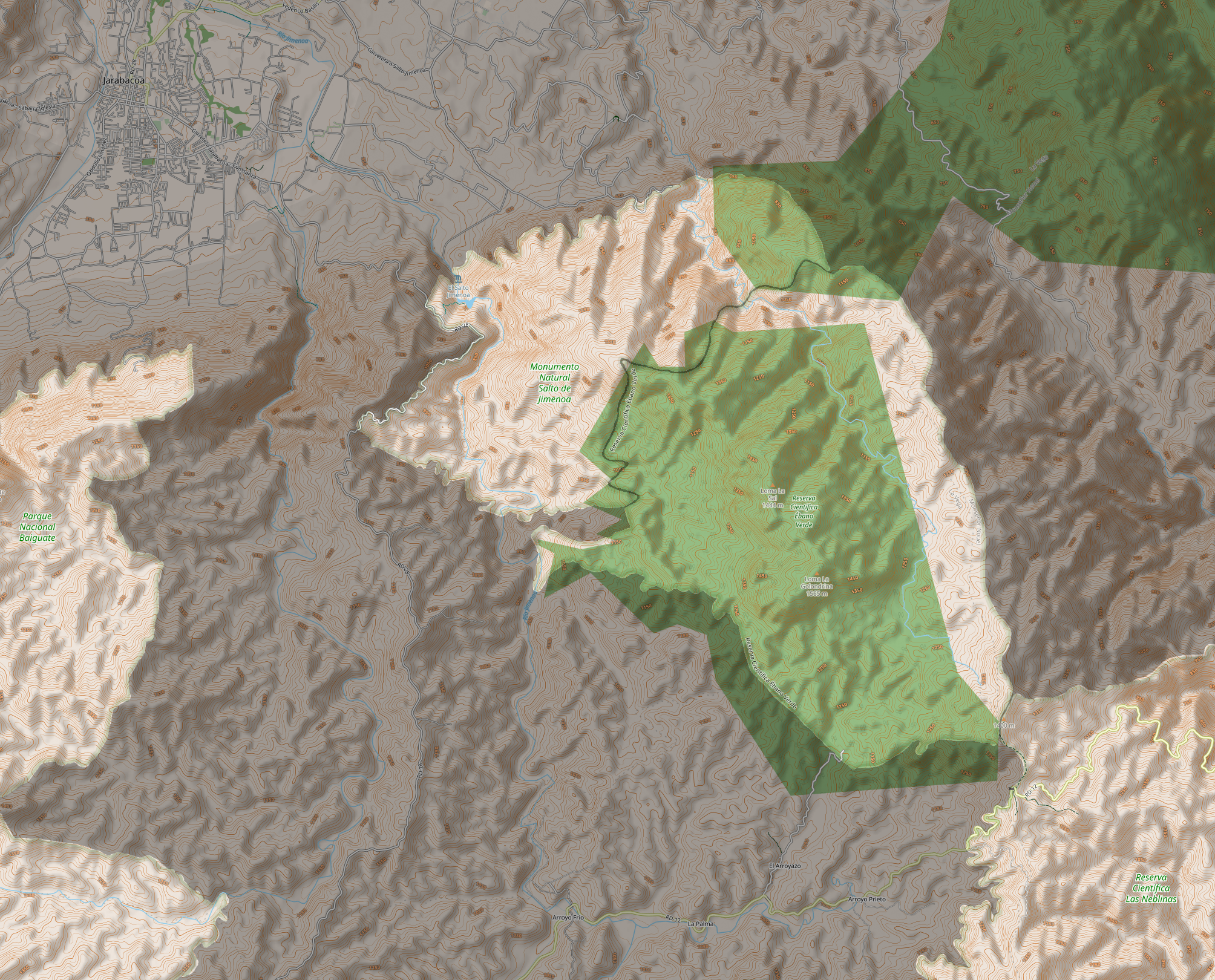
Ebano Verde Scientific Reserve
"Set the tractor on fire." That was President Joaquin Balaguer's response when he learned that road-building equipment had entered the Ebano Verde Scientific Reserve, threatening the extraction of dead timber he had reluctantly authorized. The order was carried out. The tractor was removed. The reserve survived. That anecdote captures something essential about this 29-square-kilometer patch of cloud forest on the eastern flank of the Cordillera Central: it exists because powerful people decided, sometimes dramatically, that it should. Created by presidential decree on October 26, 1989, Ebano Verde became the first protected area in the Dominican Republic managed by a private foundation rather than the government. Its namesake, the Ebano Verde tree, Magnolia pallescens, is a precious-wood species found nowhere else on Earth, thriving only in the perpetual mist of these mountains between 1,000 and 1,500 meters above sea level.
The Tree That Named a Forest
Magnolia pallescens is not what most people picture when they hear "magnolia." Forget the broad white blossoms of southern gardens. This is a Caribbean cloud forest species, an endangered hardwood whose timber was once so valuable it attracted international interest. The Green Ebony, as it translates, grows exclusively in the Bosque Nublado, the clouded forest classified as very humid lower montane forest. Its wood is dense, dark, and beautiful, qualities that nearly destroyed the species before protection arrived. When Hurricane David and Tropical Storm Federico struck in 1979, they toppled thousands of these trees across the Cordillera Central. The King World Wide Company of Miami caught wind of the windfall: 25 million feet of lumber lying on the ground. What followed was a years-long tug-of-war between conservation and commerce, with the trees themselves caught in the middle. The reserve exists, in part, as the resolution of that conflict.
Balaguer's Paradox
Joaquin Balaguer was no environmentalist by instinct. He governed the Dominican Republic for 22 years across multiple terms, often with an authoritarian hand. Yet it was Balaguer who created the Ebano Verde Scientific Reserve and Balaguer who intervened, sometimes theatrically, to protect it. In July 1992, he authorized Dr. Mario Collado's foundation to extract dead Ebano Verde lumber left by the 1979 hurricanes, splitting proceeds 40-60 between Collado's organization and the Dominican state. A commission was formed. Approvals were gathered. Then Balaguer learned that the Secretary of Public Works had sent a tractor into the reserve to repair a road near Loma de la Golondrina, which would have facilitated logging access. His reaction was instant and unambiguous. The tractor was ordered removed, the extraction plans were curtailed, and the forest was spared. Whether Balaguer acted from genuine ecological conviction or from the authoritarian instinct to control everything within his domain, the result was the same: the trees survived.
Walking Through the Clouds
No horses. No mules. No motorized vehicles. The only way to experience Ebano Verde is on foot, a restriction imposed because pack animals destroy the fragile soil and vegetation. Two trails are open to visitors. Sendero Bano de Nubes, the Path of Cloud Baths, descends through forests of palo de viento, a tree whose name means "wind stick" for the way it sways in the constant mountain breezes. Thick ferns of the Cyathea and Dicranopteris genera carpet the hillsides between the ridges, and streams below are lined with Manacla palms, the Sierra palms that create the distinctive vegetative zones called Manaclares. The second trail, Sendero La Sal, follows an older route through similar terrain. Both pass through air so saturated with moisture that the forest drips even when it is not raining. Annual rainfall ranges from 2,327 to 4,633 millimeters, with an average of 3,853. The temperature rarely exceeds 20 degrees Celsius and can drop to 11. This is the wet, cool heart of the Dominican highlands.
An Island of Endemics
Six hundred and twenty-one species of vascular plants have been cataloged within the reserve, 153 of them endemic to Hispaniola. Beyond the Ebano Verde itself, the forest shelters Pinguicula casabitoana, a carnivorous plant that traps insects on its sticky leaves, and an array of species with evocative local names: sangre de pollo (chicken blood), palo santo (holy wood), and pino criollo, the native Caribbean pine. The fauna is no less distinctive. Eight amphibian species and ten reptile species make up the reserve's herpetofauna, while the mammalian population includes the Hispaniolan solenodon, a venomous insectivore that has survived since the age of the dinosaurs and now teeters on the edge of extinction. Mexican free-tailed bats hunt through the canopy at dusk. The geological foundation beneath all this life is the Tireo formation, magmatic rocks and volcanic sediments from the Cretaceous period, meaning the ground itself dates back tens of millions of years.
Water for a Nation
The streams of Ebano Verde do not stay in the mountains. La Sal, Bonito, and Arroyazo flow outward to feed a network of rivers, including the Jimenoa, Camu, and Blanco, that supply the city of La Vega and fill the Tavera and Rincon dams. These dams generate hydroelectric power and provide irrigation water for the Cibao Valley, the agricultural heartland of the Dominican Republic. The reserve's founding by the Foundation for Human Betterment, Progressio, was motivated in part by the need to protect the Cibao's water supply. Deforestation upstream means drought downstream. Protecting 29 square kilometers of cloud forest, then, is not merely an ecological luxury but an infrastructure investment. Every drop of mist that condenses on a fern leaf, runs down a trunk, and seeps into the soil of Ebano Verde is a drop that will eventually turn a turbine or irrigate a field in the valley below.
From the Air
Located at 19.06N, 70.54W on the eastern Cordillera Central of the Dominican Republic. The reserve spans the provinces of La Vega and Monsenor Nouel, within the municipalities of Jarabacoa, Bonao, and Constanza. Loma de la Golondrina, the highest point, reaches 1,549 meters. The nearest major airports are Cibao International Airport (MDST) near Santiago, approximately 70 km northwest, and La Isabela International Airport (MDJB) in Santo Domingo, approximately 120 km south. From altitude, the reserve appears as a dense green patch of cloud forest on the eastern slopes of the Cordillera Central, often shrouded in cloud cover. The surrounding terrain includes the peaks of Las Neblinas, with elevations between 1,023 and 1,453 meters. Expect frequent low cloud and rain; this is one of the wettest areas in the Dominican Republic with annual rainfall averaging nearly 4,000 mm.