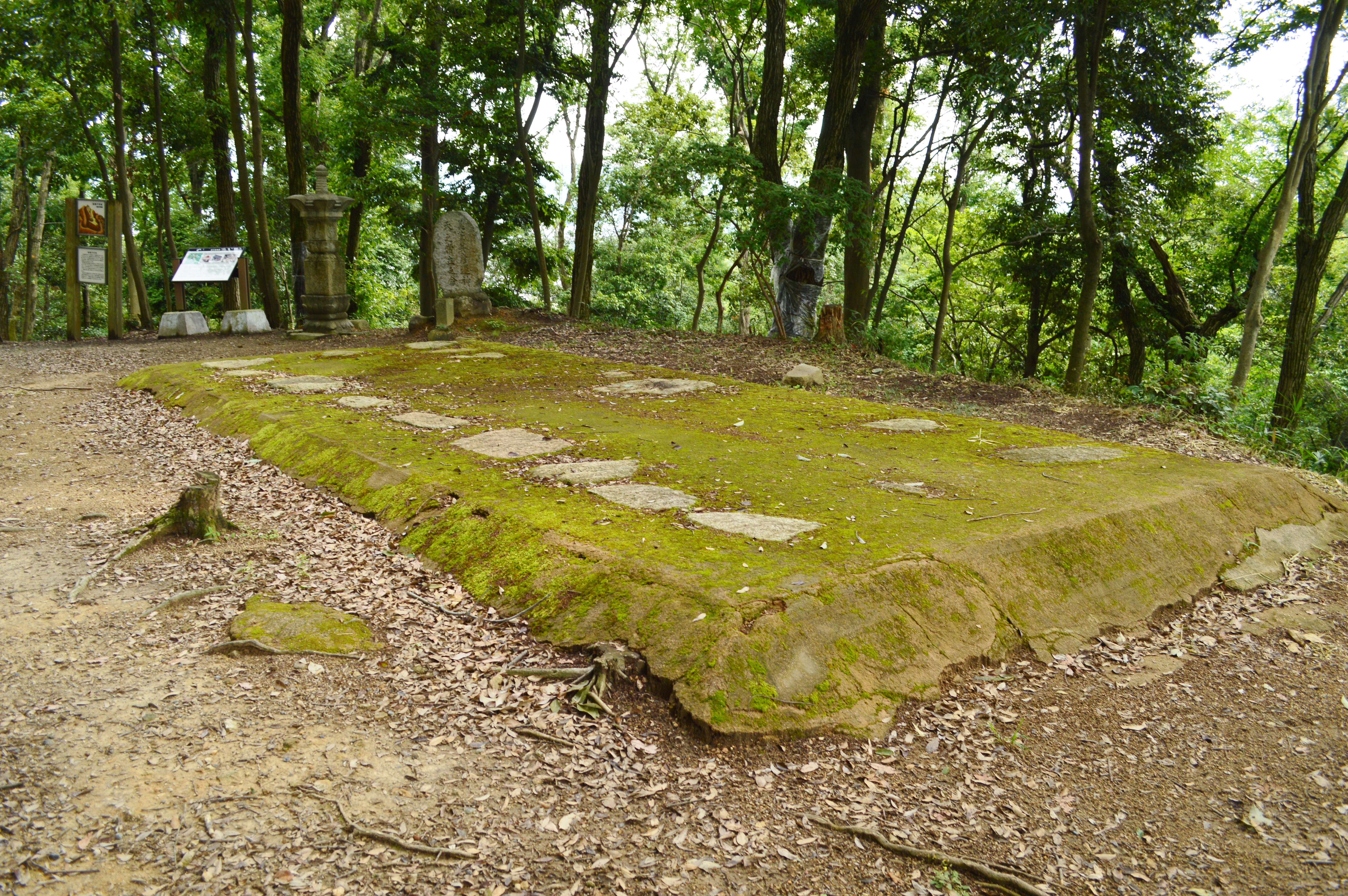
Eboshigata Castle
Of all the castles Kusunoki Masashige built to defend the emperor's cause, this is the one the shrine saved. Eboshigata Castle sits at the crown of a 182-meter hilltop in Kawachinagano, Osaka Prefecture, wrapped in the precincts of Eboshigata Hachiman-gu, a shrine established in 1480 on its eastern slope. While the castles Masashige is famous for -- Chihaya, Akasaka -- are well-known landmarks, this compact fortification quietly survived the centuries because monks and priests treated its earthworks as sacred ground rather than quarry stone. The result is one of the best-preserved late Kamakura period mountain castles in the Osaka region, a National Historic Site since 2012 and a designated Japan Heritage location.
The Loyalist's Watchtower
Kusunoki Masashige completed Eboshigata Castle in 1332 as an outlying defense for his stronghold at Akasaka Castle, part of a network of seven fortresses arrayed across the hills south of Osaka. The site was chosen with a warrior's eye. Cliffs guard the north and west flanks. The Ishikawa and Amami rivers shield the south and east. The single entrance is a steep, narrow path climbing from the south -- the kind of approach that turns any attacking column into a thin, vulnerable line. Measuring only 180 meters east to west and 150 meters north to south, the castle was never meant to house an army. It was a watchtower, a chokepoint, a place where a small garrison could hold a critical crossroads: the Koya Kaido, the main road linking Kyoto, the sacred monastery of Mount Koya, and the prosperous port of Sakai.
Three Centuries of Contested Ground
The castle may predate Masashige entirely. Tradition holds it could be the "Nagano Castle" described in the Heike Monogatari, where defenders held off a siege by Minamoto no Yukiie decades before Masashige was born. What is certain is that after the Kamakura period ended, the fortress became a prize fought over by some of the era's most powerful factions. During the Muromachi period, the Hatakeyama clan, the Miyoshi clan, and the Negoro-shu warrior-monks all seized and lost it. In 1575, Oda Nobunaga razed it during his drive to consolidate the region. The temple Kongoji rebuilt it soon after, but the story took an unexpected turn: the Portuguese Jesuit missionary Luis Frois recorded that the castle's new commander had converted to Christianity, turning the fortress into a gathering point for converts across the Minamikawachi region.
From Hideyoshi's Launchpad to Silence
In 1584, Toyotomi Hideyoshi appropriated the castle as a forward base for his conquest of Kii Province. For a brief moment, this small hilltop fort stood at the center of one of Japan's great unification campaigns. But Hideyoshi's own edicts soon reached back to erase part of the castle's recent past. In 1587, he banned Christianity, and the converts who had found community here were expelled from the area. Without its strategic value -- Hideyoshi had no more provinces to conquer from this direction -- and without the community that had sustained it, Eboshigata Castle drifted into irrelevance. By 1617, it was abandoned entirely, its earthen walls and dry moats given over to forest and silence.
Sheltered by Sacred Ground
What saved Eboshigata from the fate of most abandoned Japanese castles -- dismantlement for building materials, conversion to farmland -- was the Hachiman-gu shrine that had occupied its eastern slope since 1480. Because the castle ruins lay within the shrine's precincts, they were treated as part of the sacred landscape rather than unclaimed real estate. Earthen walls, dry moats, and the foundations of buildings in the honmaru (main enclosure) survived largely intact. Today the site is preserved as Eboshigata Park, which also encompasses the Eboshigata Kofun, a sixth-century burial mound that predates the castle by seven hundred years. The park sits a fifteen-minute walk from Kawachinagano Station on the Nankai Electric Railway Koya Line, the same rail corridor that follows the ancient Koya Kaido the castle once guarded.
From the Air
Located at 34.44N, 135.56E in the hills south of Osaka, at an elevation of 182 meters. The castle ruins sit atop Mount Eboshigata in Kawachinagano. From the air, look for the forested hilltop surrounded by the Ishikawa and Amami river valleys. The Nankai Koya Line rail corridor below traces the ancient Koya Kaido road. Nearest major airport: Kansai International (RJBB) approximately 25nm southwest, Osaka Itami (RJOO) approximately 20nm north. The site is in the foothills of the Kongo mountain range, with terrain rising to the south and east. Expect good visibility in the Osaka plains, with potential orographic cloud buildup along the ridgeline.