Echigo-Tsumari: Where Snow Country Became an Art Gallery
Walk into the Kiyotsu Gorge Tunnel and the rock walls fall away into a reflective pool that turns the landscape upside down. Peer through a rusted window frame perched on a hillside, and the rice terraces beyond become a painting. Step inside a decommissioned village school, and the classrooms have been reimagined by artists from forty-four countries. This is the Echigo-Tsumari Art Field, spread across 750 square kilometers of Niigata Prefecture's snow country, where one of the world's most ambitious art experiments has been unfolding since the year 2000. The premise is deceptively simple: scatter contemporary art across a depopulating rural landscape and see what grows. What grew was one of Japan's largest art festivals, a model studied by cultural planners worldwide, and a stubborn argument that art belongs not in galleries but in rice paddies.
The Art Necklace Plan
The idea began in 1994 with a government initiative called the Art Necklace Plan. Niigata's rural interior was hemorrhaging population -- young people leaving for Tokyo, villages aging and emptying, schools closing. The prefectural government tapped Fram Kitagawa, director of Tokyo's Art Front Gallery, to envision something that might reverse the tide. Kitagawa's answer was radical: instead of building a museum in a city, scatter art across six rural regions -- Tokamachi, Kawanishi, Nakasato, Matsushiro, Matsunoyama, and Tsunan -- turning the entire landscape into an exhibition space. The first Echigo-Tsumari Art Triennale opened on July 20, 2000, presenting 153 works by 138 artist groups to an estimated 162,000 visitors across 28 participating villages. The concept was grounded in satoyama, the Japanese idea of the space where mountains meet arable land, where human cultivation and wild nature overlap.
A Tunnel, a Window, a Rice Field
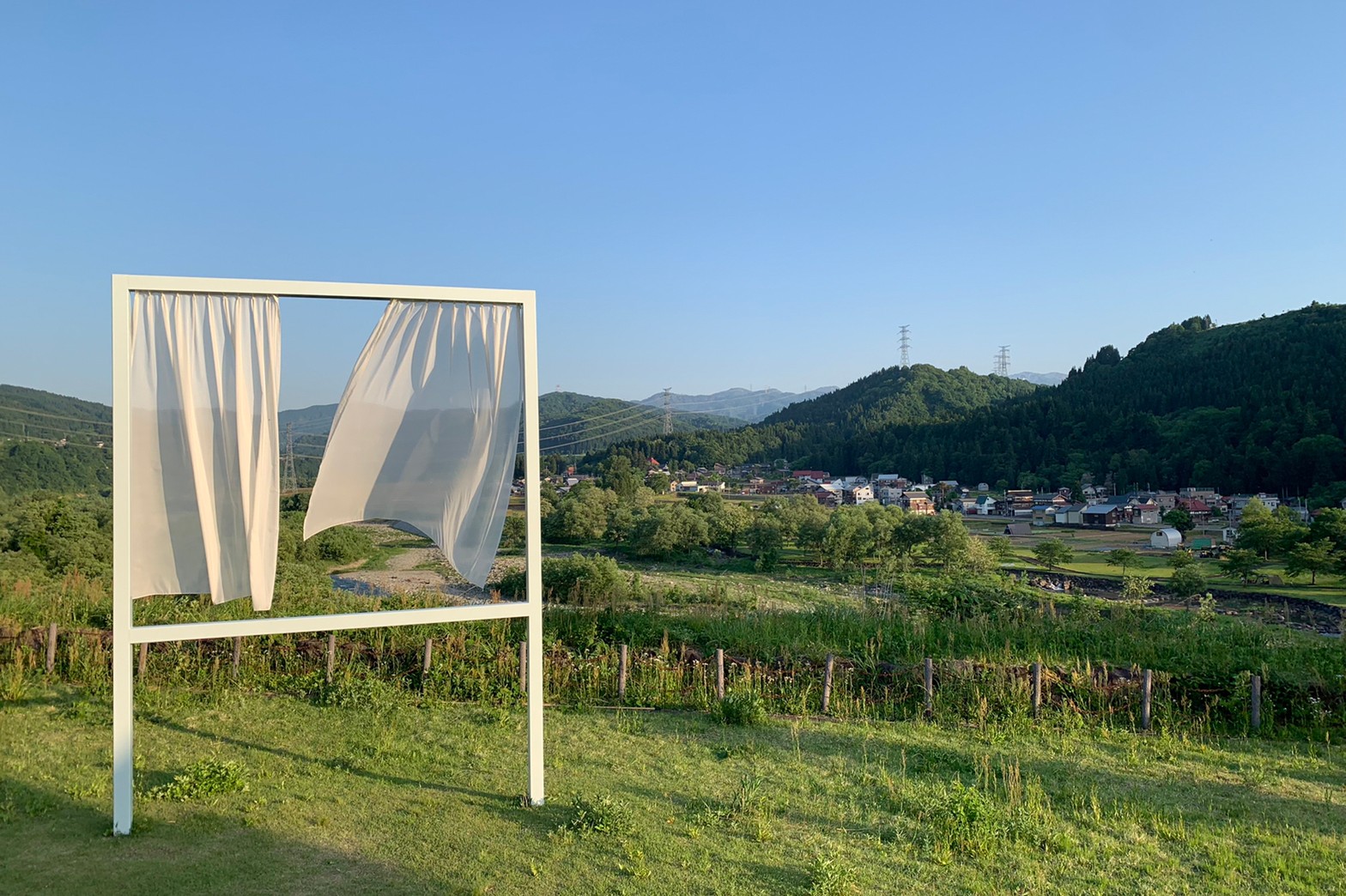
The installations at Echigo-Tsumari share a common language: they frame the landscape rather than replace it. The most celebrated work is the Tunnel of Light, designed by MAD Architects for the 2018 Triennale. A 750-meter tunnel carved through Kiyotsu Gorge was transformed into an immersive passage organized around the Japanese five elements -- fire, wood, earth, metal, and water. Visitors walk through shifting light and material, viewing the gorge's rock walls through portals, reflective pools, and observatory balconies that re-present the natural world as art. Elsewhere in the Art Field, Akiko Utsumi's For Lots of Lost Windows plants window frames across hillsides, turning views of terraced rice paddies into found paintings. Ilya and Emilia Kabakov's The Rice Fields celebrates the agrarian landscape itself. The recurring theme is framing: the art teaches visitors to see what was already there.
From 28 Villages to a Movement
The growth of the Triennale has been staggering. The inaugural 2000 festival drew 162,000 visitors to 28 villages. By the 7th edition in 2018, 363 artist groups from 44 countries presented 379 artworks, and attendance reached 548,380 -- more than triple the original numbers. Over a hundred villages participated. The 8th Triennale in 2022, postponed a year due to the pandemic, ran from April to November, making it the longest edition yet at over six months. The festival has won recognition from Japan's Prime Minister, the Ministry of the Environment, and international design organizations, earning the Good Design Gold Award in 2018. Artists who have contributed include Christian Boltanski, Cai Guo-Qiang, Jimmie Durham, and Ann Hamilton, alongside major Japanese artists like Daido Moriyama and Tadashi Kawamata.
The Tension Between Art and Place
Not everyone agrees that the model works perfectly. Scholar Brad Monsma has praised Echigo-Tsumari for being rural, scattered, and insistent upon the local, calling it a counterpoint to urban festivals that link art with commercial development. Susanne Klien described it as a new type of revitalization emphasizing human exchange in a rural setting. But Klien also noted a tension: the collaboration between visiting artists and local communities can strain rural rhythms, and the festival risks romanticizing country life for urban audiences rather than genuinely empowering the villages it occupies. Researcher Thekla Boven examined how eleven defunct elementary schools in Tokamachi were repurposed as art spaces, questioning whether the festival's needs always align with the community's. The debate itself is part of the legacy. Echigo-Tsumari raised a question no art festival had seriously asked before: can beauty save a dying village?
Year-Round in Snow Country
The Triennale comes every three years, but the Echigo-Tsumari Art Field is permanent. Each spring, the network of outdoor installations, converted schools, and small museums opens to the public, making the Art Field a year-round destination. Local tourism offices collaborate with the Art Field to create itineraries that weave past installations from previous Triennales, through village galleries, and into restaurants serving regional cuisine. The landscape itself shifts dramatically with the seasons -- this is one of Japan's heaviest snowfall regions, and the same rice paddies framed by Kabakov's installation in summer disappear under meters of white in winter. The Art Field invites return visits precisely because the art and the land it inhabits are never the same twice.
From the Air
The Echigo-Tsumari Art Field is centered around Tokamachi at approximately 37.017N, 138.600E in Niigata Prefecture's mountainous interior. The art installations are scattered across 750 square kilometers of rural terrain including river valleys, forested hills, and terraced rice paddies. From altitude, the region is characterized by the patchwork geometry of rice terraces and the winding course of the Shinano River. The Kiyotsu Gorge area, home to the Tunnel of Light installation, lies to the southeast of Tokamachi. Nearest airport is Niigata Airport (RJSN), approximately 80 km to the north. Tokyo Haneda (RJTT) is roughly 200 km south. Heavy snowfall is common from December through March; this area receives some of the heaviest snow in Japan.