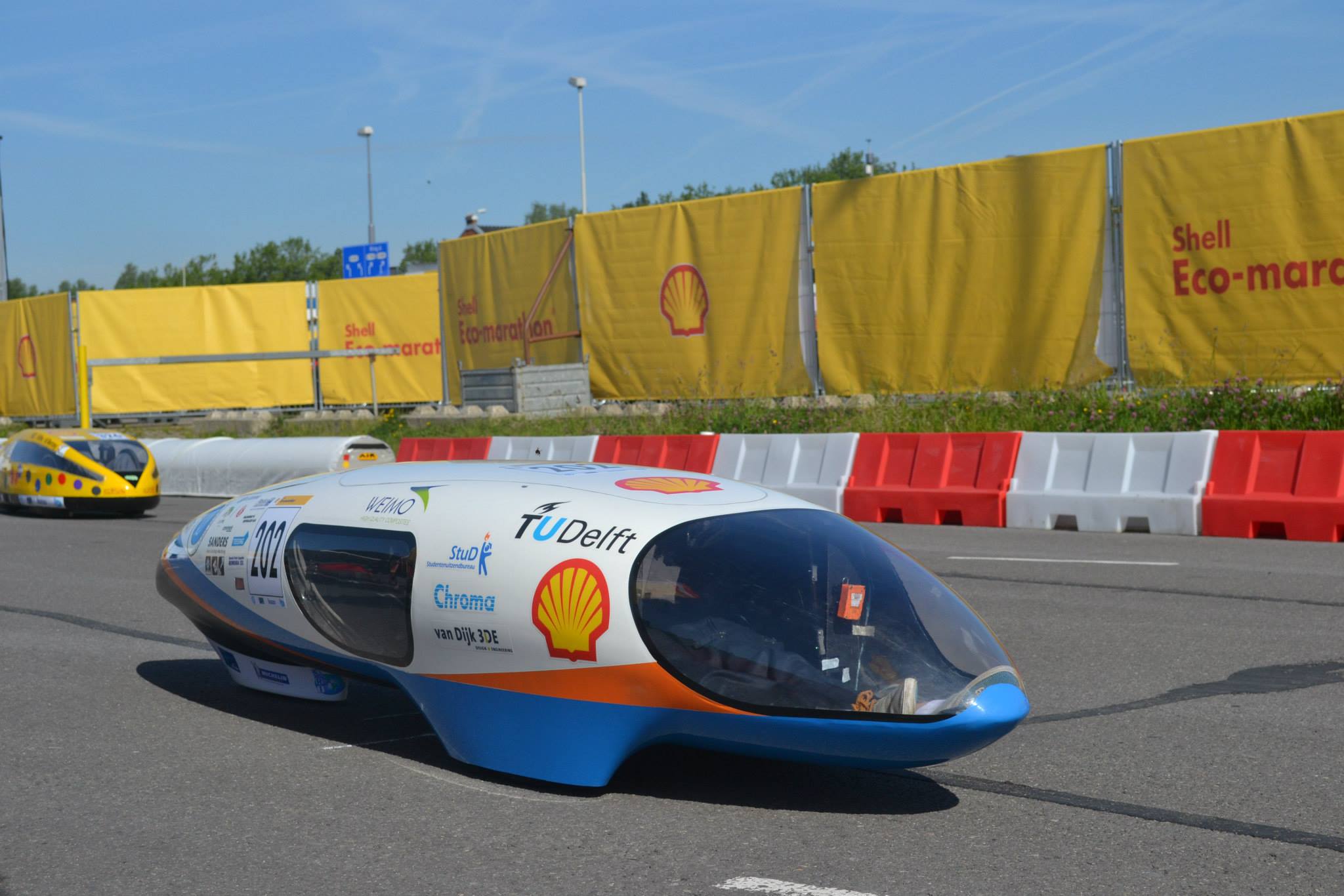
Eco-Runner Team Delft
Picture less than a kilogram of hydrogen - 950 grams, about the weight of two cans of soup. Now picture driving from Rotterdam to Munich and back on that hydrogen, then continuing on past Vienna before finally running out. In June 2023, a streamlined teardrop-shaped car called the Eco-Runner XIII did exactly that around a closed track in Germany, setting a Guinness World Record by covering 2,488.5 kilometers on 950 grams of hydrogen. The car was built by 24 students who had never built a car before. By the end of the academic year they would graduate and hand the workshop keys to the next batch, who would start over and build a different car.
Eleven Students in 2005
It started in November 2005, when eleven second-year students at the Delft University of Technology's Faculty of Aerospace Engineering - seven Belgians and four Dutch - decided to enter the Shell Eco-marathon at Rockingham Motor Speedway in England the following July. They built the Eco-Runner 1 with limited time and limited money. It did not have a functional fuel injection system. It still managed 557 kilometers on a single liter of petrol, beating their stated goal of 500 km/L. That number convinced them to keep going. The team's offices and workshops now sit in the D:DREAM Hall on the TU Delft campus, and the roster cycles through completely every year or two - 26 students at a time, split across Management, Operations, Bodywork, Powertrain & Electronics, and Vehicle Dynamics. It is, in the most literal sense, a generational project.
The Switch to Hydrogen
Eco-Runner H2, finished in 2007, was the first hydrogen car the team built and the template for everything that followed. The car carried two propulsion experiments at once: a fuel cell driving an electric motor, and a peculiar six-stroke petrol engine that injected a drop of water after the fourth stroke. The water flashed to steam against the cylinder head, giving a 'free' fifth stroke - elegant in theory, corrosive in practice. The fuel cell setup, by contrast, worked. At the 2007 Eco-Marathon the car set a Dutch fuel-efficiency record of 2,282 km/L equivalent, even with a poorly functioning cruise control system. Every Eco-Runner since - H2 through XIV - has been hydrogen-powered. The team essentially bet on hydrogen as a transport fuel almost two decades before it became fashionable to do so.
Lighter, Lower, Less
The engineering history of these cars is the engineering history of subtraction. The fourth Eco-Runner weighed about 38 kilograms, less than its driver. The ninth dropped 19 percent of the eighth's mass by switching from a chain transmission to an in-wheel motor. The twelfth, in 2022, achieved a 41 percent weight reduction by making the entire car body load-bearing - the same monocoque concept used in Formula 1 - and replacing aluminum parts with carbon fiber. That car won the Shell Eco-marathon Urban Concept class at TT Circuit Assen with an efficiency of 5,407 km/kg hydrogen. The Eco-Runner XI had earlier driven non-stop for 36 hours on a single 450-gram hydrogen tank, covering 1,195.74 kilometers and breaking the world record for longest distance in a hydrogen vehicle. Each car is a small argument against the idea that efficiency has to mean misery.
From Prototype to Street-Legal
Until 2019, Eco-Runner competed in the Prototype class - tiny, single-seat aerodynamic shells optimized purely for fuel efficiency. In 2020 the team shifted to Urban Concept, which forces the car to look and behave more like something you might actually drive: headlights, windshield wipers, a luggage compartment, doors. The first Urban Concept car, the Eco-Runner X, looked something like a city car styled by a wind tunnel. The Eco-Runner XIV in 2024 went further. It was designed from the start to be street-legal - more than 1,300 regulatory requirements that had to be met with help from the Dutch vehicle authority RDW. Classified as an L7EA2 heavy quadricycle, it became the first Eco-Runner authorized to drive on public roads. To prove it, the team attempted to drive the car along the route of the Elfstedentocht, the legendary Frisian eleven-cities ice-skating tour - a planned 2,056 kilometers on just 1.45 kg of hydrogen - covering 1,273 kilometers on public roads before the attempt ended.
The Next Fuel
For 2025 the team announced a sharp turn. The new car will not run on a hydrogen fuel cell at all. It will be powered by an externally fired gas turbine - a thermodynamic configuration that decouples the combustion process from the working fluid, letting the engine accept almost any heat source. Wood gas. Ammonia. Biofuels. The point of the architecture is to let future teams test alternative sustainable fuels without having to redesign the powertrain each time. It is a striking decision: after nearly two decades of optimizing one drivetrain to extraordinary fidelity, the team is rebuilding the basic platform on the bet that no single fuel will win, and that the right vehicle is the one that can burn whatever the world ends up making.
From the Air
The Eco-Runner workshop is in the D:DREAM Hall on the TU Delft campus, at approximately 52.00°N, 4.38°E - on the southeast edge of Delft, between the city center and the A13 motorway. Closest airport is Rotterdam The Hague (EHRD), about 7 km south; Schiphol (EHAM) is roughly 45 km north. From the air the TU Delft campus reads as a cluster of modernist research buildings south of the historic Delft town center, with the white wedge of the university library's grass-covered roof unmistakable. Cruising altitude 3,000-5,000 feet is best for picking out the layout; expect EHRD CTR boundaries. Cars are tested on the campus and at TT Circuit Assen (EHGG nearby) in the northeast Netherlands - about 180 km northeast.