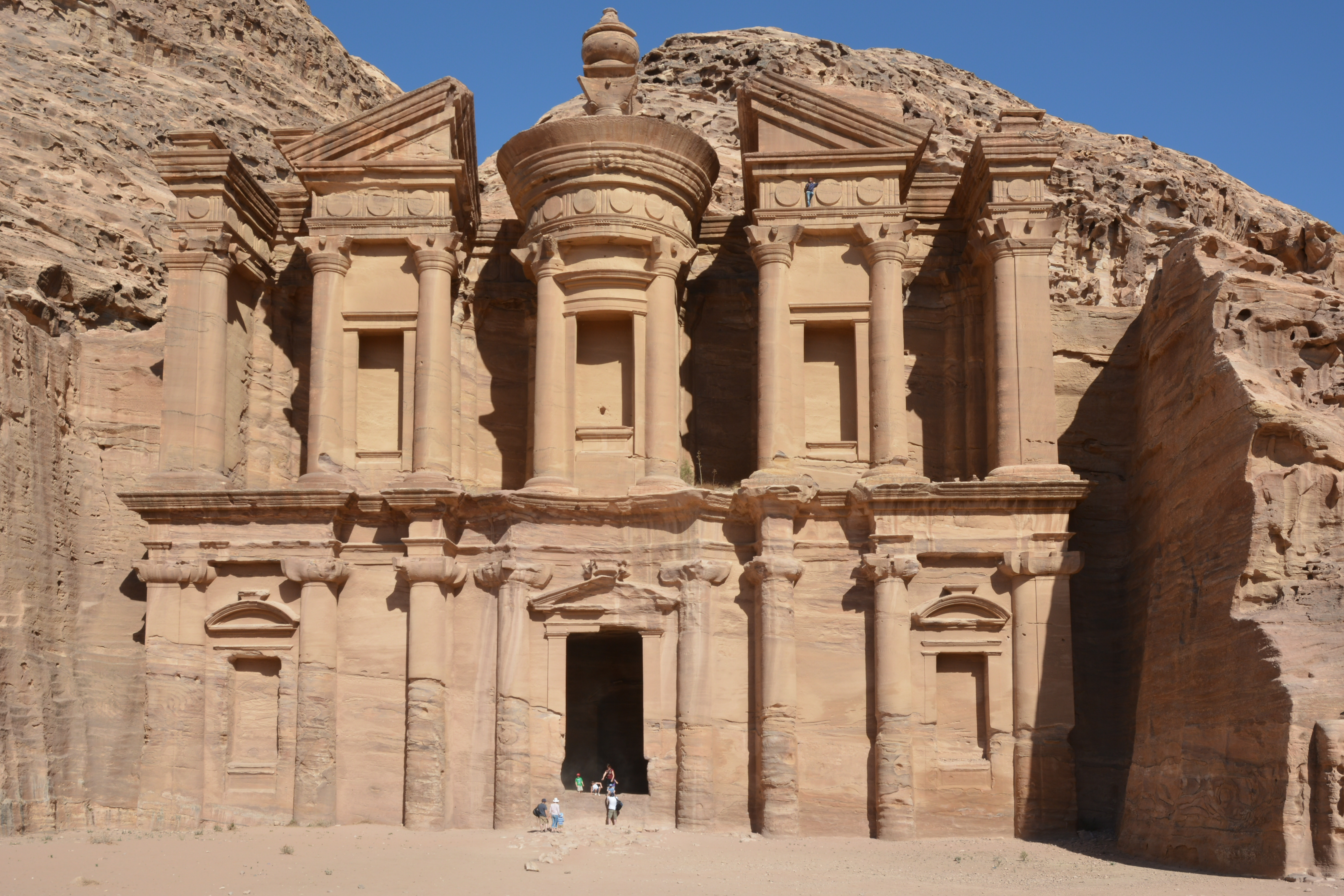
Ed-Deir, Petra
Eight hundred steps. That is what separates the main basin of Petra from its largest carved monument, a forty-minute climb up a winding path past the Lion's Tomb, small biclinia, and grottos cut into the canyon walls. At the top, the cliff face opens into a flat terrace -- leveled by human effort centuries ago -- and there stands the Deir. Forty-seven meters high, forty-eight meters wide, its broken pediment flanking a central tholos topped by a stone urn. The door alone is eight meters tall, the sole opening through which light enters the single square chamber within. The Nabataeans carved it in the mid-first century AD, but the name by which we know it -- the Monastery -- comes from the Byzantine-era Christians who repurposed it centuries later.
Where Three Traditions Meet
The Deir's architecture is a conversation between civilizations. Its facade carries a Doric entablature -- the moldings and bands that crown Greek temple columns -- but the metopes are blank, decorated only with simple roundels instead of the sculptured figures a Hellenistic builder would have included. The broken pediment is classical in form, yet the single massive entrance and the plain, window-like depressions flanking it follow Mesopotamian conventions. Square-topped tower structures on either side reinforce the eastern influence. The overall effect is neither Greek nor Mesopotamian but distinctly Nabataean: a culture of desert traders who absorbed artistic ideas from every civilization they traded with and synthesized something that belonged only to them. The columns inside the chamber are purely decorative -- the entire structure is carved directly into the sandstone cliff and needs no structural support.
A God Named Obodat
The Deir's original purpose remains debated, but it was clearly religious. During cleaning of a nearby structure in 1991, archaeologists found an inscription mentioning "the mrzh' of Obodat the god" -- a reference to the deified Nabataean king Obodas, and to a mrzh', a type of sacred feast or cultic banquet. Scholars believe the flat terrace in front of the monument was deliberately leveled to accommodate large religious gatherings. The Deir was not a tomb, or at least not primarily one. It was a place of communal worship, oriented around the niche in the back wall of the inner chamber -- a broad recess framed by pillars and a segmental arch, with four steps at each end, possibly serving as a platform for ritual objects or offerings. The room was once painted and plastered, though no trace of those decorations survives.
Monks Among the Ruins
After Petra's main churches near the city center were abandoned in the Byzantine period, a Christian presence lingered in the wider ruins. Greek Orthodox hermits and cenobites established small lavra- and coenobium-type communities among the ancient necropolis, and the area around the Deir shows a particular concentration of these settlements. They left at least one epigraph on the monumental facade's entablature, observed by the Swiss explorer Johann Ludwig Burckhardt when he rediscovered Petra in 1812, though the inscription had already disappeared by 1865. These monastic communities persisted until the late nineteenth century -- nearly a thousand years after Petra had ceased to function as a city. The Deir earned its name from these monks, who saw in the Nabataean monument's vast interior a ready-made church.
The View from the Monastery
From the terrace in front of the Deir, the landscape opens dramatically. The valleys of Wadi Araba stretch to the west, and the gorges that define Petra's geography cut through the semi-arid terrain below. It is a vantage point the Nabataeans chose deliberately -- this was not a hidden shrine but a monument meant to be approached through ritual ascent, with the journey itself as preparation. The 800-step path winds through increasingly dramatic canyon scenery, each turn revealing carved tombs and rock-cut chambers that frame the climb as a passage from the everyday world into sacred space. In 2013, the Zamani Project created a 3D laser-scanned record of the Deir, generating a permanent digital archive for research, education, and conservation. The sandstone continues to weather, as it has for two thousand years. What the Nabataeans carved from the living rock is slowly returning to it.
From the Air
Located at 30.34N, 35.43E within the ancient city of Petra in southern Jordan. The Deir is carved into a cliff face on the western edge of the Petra archaeological site and is not easily visible from high altitude due to the surrounding canyon terrain. Nearest airport is King Hussein International Airport in Aqaba (OJAQ), about 120 km to the south. The broader Petra site is identifiable from the air by the distinctive pink-red sandstone canyons and the Wadi Araba valley to the west. Best viewed at 3,000-5,000 feet AGL, though the Deir itself requires low-altitude overflight of the canyon system.