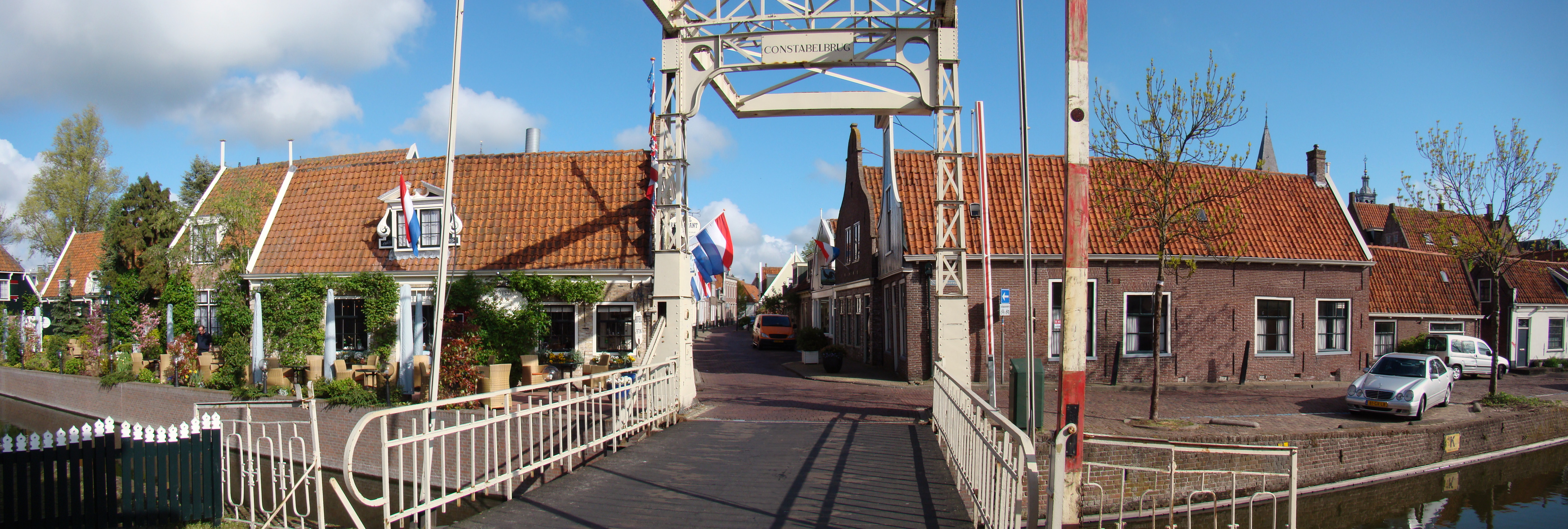
Edam
The wheel of yellow wax in your supermarket cooler began here, in a town so small you can walk across it in fifteen minutes. Edam gave its name to one of the world's most exported cheeses sometime in the late Middle Ages, and the town has never quite let the world forget it. But the cheese is the cover story. Long before the dairy farmers rowed in with their flat-bottomed boats, Edam was a shipbuilding town, with 33 wharves crowding the waterfront and oceangoing vessels gliding out toward the Zuiderzee. The harbour silted up. The shipwrights moved on. The cheese stayed.
A Dam on a Tiny River
The name is literal. Around 1230, settlers built a dam across a small river called the E or IJe, where it met the open water of the Zuiderzee. Travelers between inland Holland and the sea had to transfer cargo at the dam, and the dam-keepers could collect a toll. That toll built a town. Count Willem V of Holland granted Edam borough rights in 1357, partly to reward loyalty in the long, bitter civil war between the Hoeken and the Kabeljauwen - two noble factions whose feud over who would rule Holland's towns had turned the countryside into a battleground. With borough status came the right to dig a deeper harbour, and Edam dug one. Within two centuries the town would punch far above its weight, vying with Enkhuizen, Hoorn, and even Amsterdam for a share of the international trade.
When the Wharves Ran the World
By the sixteenth century, 33 shipyards lined Edam's waterfront. Hulls rose along the canals; sawpits filled the air with the smell of green oak; carpenters' guilds grew rich enough to commission their own stained-glass windows for the parish church. Then, in 1544, Emperor Charles V intervened. The town's open connection to the sea was flooding the hinterland, and the Emperor ordered the harbour closed with lock gates. The gates went up in 1569. They saved the polders, but they doomed the shipyards. Without easy access for deep-keeled vessels, the harbour silted, the trade routes shifted, and by the end of the seventeenth century the wharves were quiet. The cheese carts kept rolling.
A Church Built Like a Ship
Walk into the Grote Kerk - the Great Church, also called St. Nicholaaskerk - and look up. The vaulted ceiling above you is wood, not stone. The builders, working on Edam's soft, peat-laced soil, knew that a real stone vault would sink the foundation pilings into the marsh, so they carved a wooden copy and painted it to fool the eye. The trick worked for six centuries. The church is the largest hall church in the Netherlands and one of the largest three-aisled churches in Europe. After a lightning fire in 1601 destroyed much of the interior, the surrounding towns and Edam's own guilds - the ship's carpenters chief among them - paid for thirty-two enormous stained-glass windows in Renaissance style, donated as gifts between 1602 and 1627. They still glow there today, a Dutch town's collective memory rendered in coloured light.
The Cheese That Carried the Name
On 16 April 1526, Charles V granted Edam a weekly cheese market; Prince Willem I confirmed the right in perpetuity in 1594, as thanks for Edam's support during the Siege of Alkmaar. Farmers came in by boat, their cheeses stacked on the decks, and porters lifted the wheels onto wooden sledges and ran them up the dam to the weigh-house. Buyers tested the wax-coated wheels, slapped palms to seal each price, and sent them on to be aged in cool warehouses. The commercial market ran without a break until 1922, when modern dairy cooperatives finally killed it. Since 1989, the town has revived it as a Wednesday-morning re-enactment in July and August. The cheese sledges look the same. The wheels are real. The haggling is theatre.
Time Folded Small
Across the dam from the town hall stands Edam's oldest brick house, built around 1530. Step inside and you find a kitchen with a cellar that floats - a brick room set into groundwater, suspended freely so the water can rise and fall around it without flooding the floor. Local folklore says a sea captain built it because he missed the sound of water. More likely, the floating box solved a practical problem: in a town built on swamp, a watertight cellar was easier than a watertight foundation. Across town, the late-Gothic Speeltoren - all that remains of the demolished Church of Our Dear Lady - still chimes every fifteen minutes with bells cast by Pieter van den Ghein in 1566. The whole town threatened to fall once. Steel girders went in. The town held. It usually does.
From the Air
Edam sits at 52.52°N, 5.05°E on the western shore of the IJsselmeer (the former Zuiderzee), about 22 km northeast of Amsterdam. Visible from altitude as a compact, oval old town surrounded by a network of polders and drainage ditches, with the silted-up harbour basin and the Grote Kerk's stubby tower as landmarks. Edam and neighbouring Volendam blur together from the air. Nearest airport: Amsterdam Schiphol (EHAM), about 42 km southwest. Best viewed VFR in clear weather at 2,000-3,000 ft.