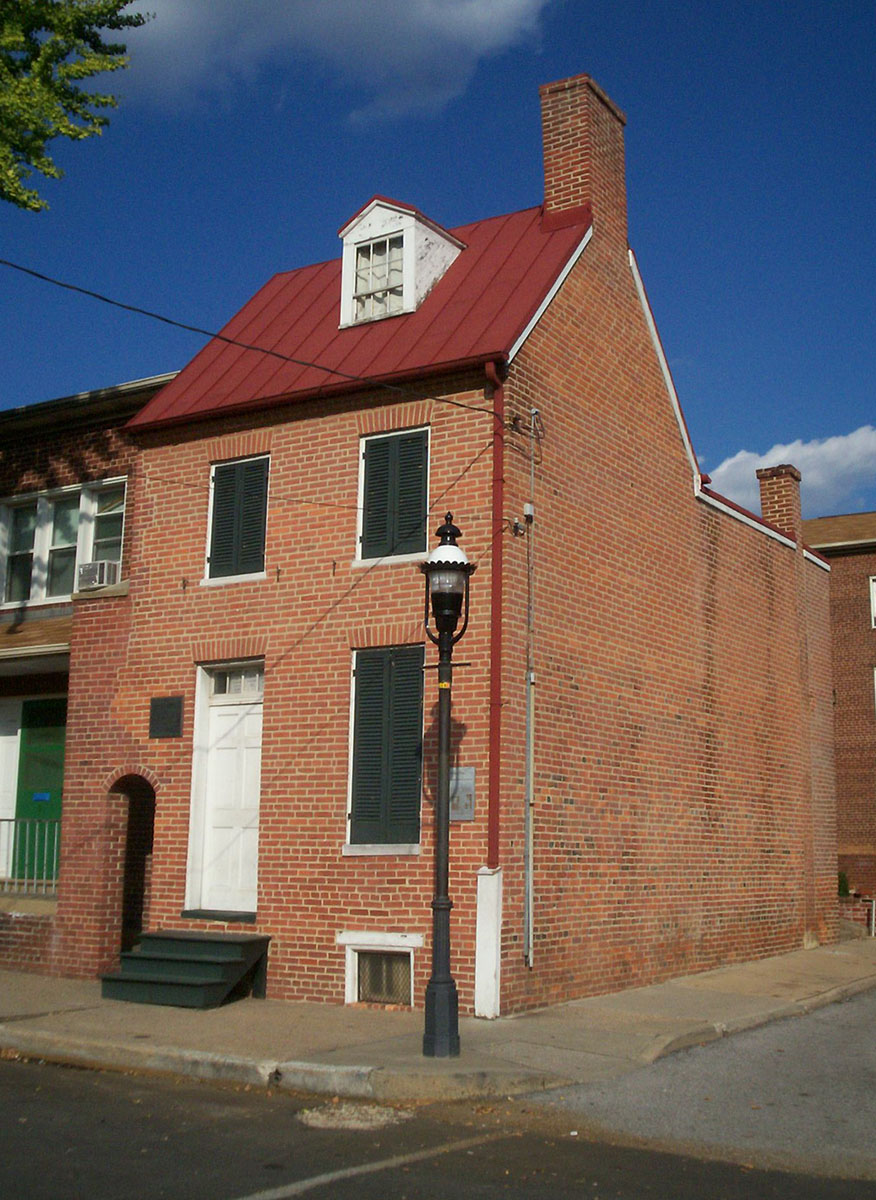
Edgar Allan Poe House and Museum
In 1979, workers renovating the small brick row house at 203 North Amity Street in Baltimore pried up the floorboards and found bones beneath. Skeletal remains, hidden under the home of the man who wrote "The Tell-Tale Heart." The bones turned out to be animal, discarded into a trash pit beneath the foundation, but the coincidence was too perfect. This is the kind of place where life and literature blur. Edgar Allan Poe lived here from 1833 to 1835, sharing the cramped quarters with his aunt Maria Clemm, her daughter Virginia -- whom Poe would later marry -- and Clemm's ailing mother Elizabeth. The house is so small that Poe's room in the garret has a ceiling only six feet high at its tallest point. In this attic, America's master of the macabre began the career that would reshape literature.
A Garret on Amity Street
The brick house, then numbered 3 Amity Street, was built around 1830. Maria Clemm rented it in 1832 using pension money that her mother Elizabeth collected -- Elizabeth's late husband, David Poe Sr., had served in the American Revolutionary War. When Poe arrived in 1833, he was 24 years old and largely unknown. He had published poetry and been expelled from West Point, had quarreled with his foster father John Allan, and was nearly destitute. The Clemm household gave him stability. He entered and won a literary contest sponsored by the Baltimore Saturday Visiter that year, launching his career as a prose writer. Downstairs, visitors today pass through the front living room into a dining room set two steps lower, then climb narrow stairs to the second floor's two bedrooms and up again to the tiny garret. The house retains most of its original woodwork, and its dimensions put you physically inside the world Poe inhabited.
Saved by a Newspaper Woman
The neighborhood around Amity Street changed over the decades. By the 1930s, the city targeted the block for demolition to build the Poe Homes public housing project -- named, with unconscious irony, after the writer whose actual home they planned to tear down. The house was saved largely through the efforts of the Edgar Allan Poe Society of Baltimore, which negotiated with the city and opened the building as The Baltimore Poe House in 1949. For decades, visitors could see a lock of Poe's hair, a piece of his coffin, china belonging to his foster father John Allan, and a reproduction of the portrait of Virginia Clemm painted after her death. An original 1849 obituary by Rufus Griswold -- the rival who would spend years destroying Poe's reputation -- was also on display.
Closure and Resurrection
The museum thrived from 1980 to 2011, hosting the largest Poe birthday celebration in the world each January at nearby Westminster Hall and Burying Ground, where Poe is buried. In 2009, over 1,200 people attended a theatrical third funeral for Poe staged for the bicentennial of his birth. But in 2011, the City of Baltimore cut its $85,000 annual subsidy. The museum limped along on $380,000 in reserve funds before closing on September 28, 2012, with no advance public notice. Its curator of more than three decades, Jeff Jerome, was laid off. Rescue efforts came from unexpected quarters -- a nonprofit called Pennies for Poe, a New York theatre company that staged a benefit play, and the 2012 film The Raven, starring John Cusack as Poe.
Poe Baltimore
In 2013, a new nonprofit organization called Poe Baltimore took over the house and reopened it to the public on October 5. The museum sits on the western edge of the Poe Homes housing project in the Poppleton neighborhood of west Baltimore -- the same public housing development that nearly destroyed it. In 2020, the house became the first historical site in Maryland to be entered into the American Library Association's United for Libraries Literary Landmarks Register, with a dedication ceremony held on January 19, the anniversary of Poe's birthday. New annual programs include the International Edgar Allan Poe Festival and the Saturday Visiter Awards, keeping alive the name of the contest that launched Poe's career nearly two centuries ago. The house endures the way Poe's stories endure -- small, unsettling, and impossible to forget.
From the Air
Located at 39.29°N, 76.63°W at 203 North Amity Street in the Poppleton neighborhood of west Baltimore. The house is a small row home, not individually visible from altitude, but it sits adjacent to the Poe Homes public housing project, which forms a distinctive low-rise complex. Westminster Hall and Burying Ground, where Poe is buried, is approximately 0.5 miles east at Fayette and Greene Streets. Baltimore/Washington International Airport (KBWI) is approximately 9nm south. Martin State Airport (KMTN) is roughly 12nm northeast. The Inner Harbor and Camden Yards provide nearby visual reference points. Best appreciated in the context of west Baltimore's urban grid at 1,500-2,500 feet AGL.