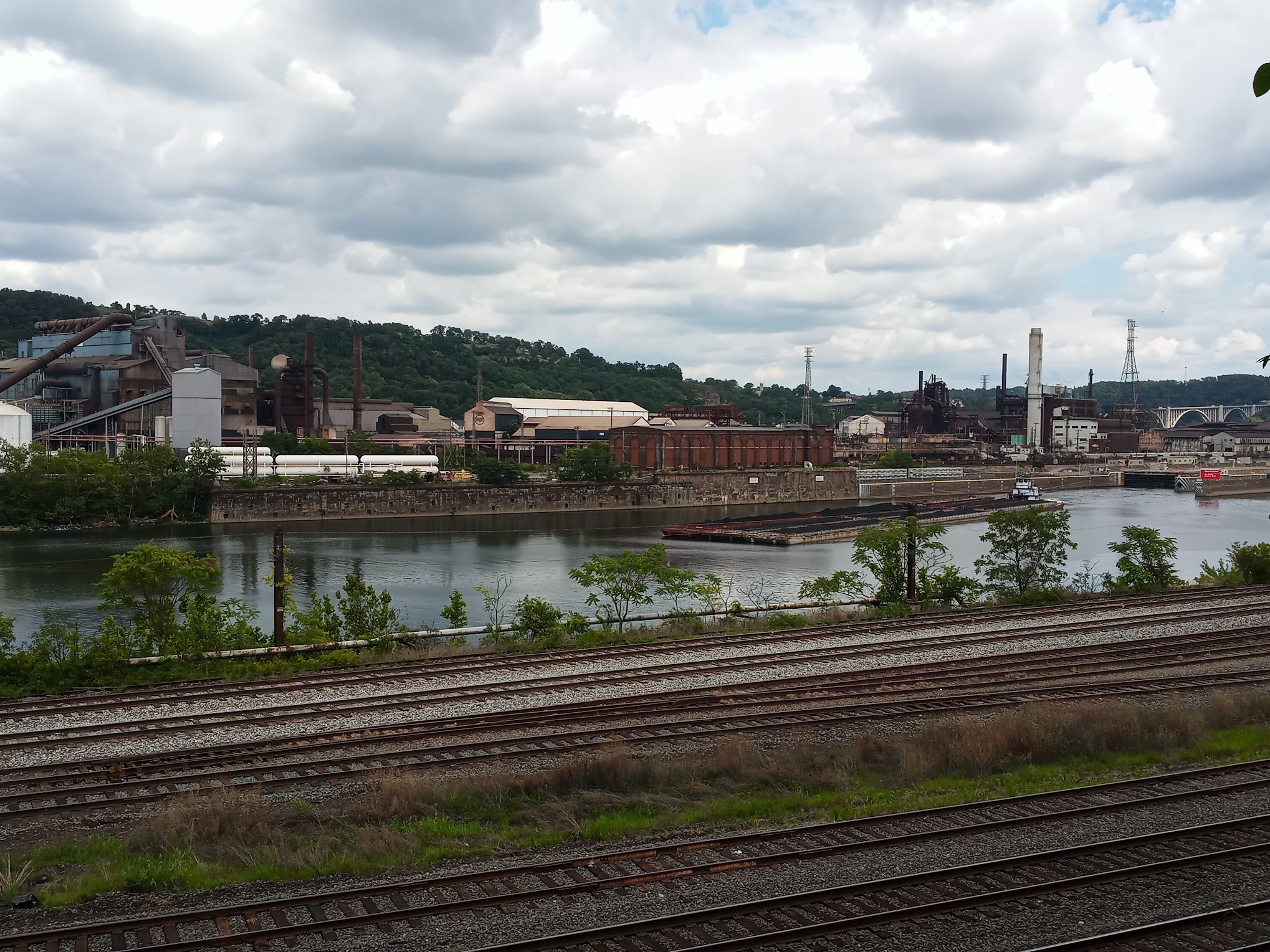
Edgar Thomson Steel Works
On August 22, 1875, a hulking Bessemer converter at the Edgar Thomson Steel Works produced its first heat of liquid steel. That molten metal became 2,000 rails for the Pennsylvania Railroad, and the act launched an industrial revolution in the Monongahela Valley. A century and a half later, the Edgar Thomson plant is still running. Every other integrated steel mill in the Mon Valley has gone dark - the Homestead Works, National Tube in McKeesport, Duquesne Works - but Edgar Thomson endures, two blast furnaces still firing on the banks of the same river that once carried General Edward Braddock to his death.
Blood and Whiskey Before the Steel
The ground beneath the Edgar Thomson Works holds layers of American history older than the republic itself. On July 9, 1755, French and Indian forces from Fort Duquesne routed the expedition of British General Edward Braddock at this very site on the Monongahela River. Braddock was mortally wounded in the battle that gave Braddock's Field its name. Four decades later, the field served a different kind of rebellion. On August 1, 1794, rebellious militiamen and farmers rallied at Braddock's Field during the Whiskey Rebellion before marching on Pittsburgh. The site's position on the Monongahela was no accident of history - the river provided the cheap, reliable transportation of coke, iron, and finished steel that would make the location ideal for industrial purposes.
Carnegie's Bessemer Gamble
Andrew Carnegie returned from Europe in the summer of 1872 carrying plans that would reshape American industry. He had witnessed the Bessemer process firsthand - the first inexpensive method for mass-producing steel, in which air blown through molten iron removed impurities via oxidation inside a large, ovoid converter lined with clay or dolomite. Carnegie assembled partners including William Coleman, Henry Phipps Jr., and his brother Thomas M. Carnegie, forming Carnegie, McCandless, and Company. They named the plant after J. Edgar Thomson, president of the Pennsylvania Railroad and a crucial customer. Ground was broken on January 1, 1873. The mill was designed by Alexander Lyman Holley, who hired Civil War veteran Captain Bill Jones to manage it. Jones drove the operation hard, boasting that the plant could roll a 62-pound rail, 120 feet long, in five minutes. Within a year of first production, the mill had turned out 32,228 tons of steel rail.
The Homestead Conflagration
In 1892, the workers of Edgar Thomson were drawn into one of the most violent labor disputes in American history. The Homestead Strike erupted when Henry Clay Frick, managing Carnegie's interests while the boss traveled in Scotland, attempted to slash wages. Steelworkers at Duquesne and Edgar Thomson shut their mills in solidarity. Frick responded with thousands of strikebreakers and 300 Pinkerton guards. A riot erupted at Homestead that left 10 dead and thousands injured. Governor Robert Pattison sent two brigades of state militia to end the fighting. The strike was broken, and Carnegie's operations resumed with non-union immigrant labor. The episode scarred the Mon Valley for generations and set back steel worker unionization efforts for decades.
The Last Mill Standing
In 1901, Carnegie sold his steel empire - including Edgar Thomson - to J.P. Morgan and Elbert H. Gary, forming the foundation of U.S. Steel. The mill survived world wars, market shifts, and the devastating collapse of the American steel industry in the 1980s. In October 1984, a Merrill Lynch analyst predicted U.S. Steel would close Thomson within a few years. The prediction was wrong. The Homestead Works shut down. National Tube in McKeesport went silent. An area that once employed 90,000 people in basic steel was gutted. But Edgar Thomson kept producing. By 2005, its two remaining blast furnaces were turning out 2.8 million tons of steel annually - 28 percent of U.S. Steel's domestic production. Some of the mill's 900 employees belong to the second or third generation of their families to work there.
A Landmark That Still Breathes
In April 1995, ASM International designated the Edgar Thomson Works a historic landmark - placing it alongside the Statue of Liberty and the Eiffel Tower. But unlike those monuments, this one is still a working industrial plant. A $250 million continuous caster installed in 1992 converts liquid steel directly into slabs. In 2019, U.S. Steel announced plans to invest over $1 billion in the Mon Valley Works, including an endless casting and rolling facility at Thomson that would have been the first of its kind in the United States. The upgrade was cancelled in 2021, but the mill grinds on. From the air, the works stretch along the Monongahela in Braddock, a tangle of stacks and structures that have been pouring steel since Ulysses S. Grant was president.
From the Air
Located at 40.392°N, 79.854°W on the Monongahela River in Braddock, Pennsylvania. The mill complex is visible from altitude as a dense cluster of industrial structures and smokestacks on the river's east bank. Look for active steam and emissions from the two operating blast furnaces. The Monongahela River curves past the plant, providing a strong navigational reference. Nearby airports include Allegheny County Airport (KAGC) approximately 5 miles south and Pittsburgh International Airport (KPIT) approximately 20 miles west. The neighboring Homestead Steel Works site (now The Waterfront shopping center) is visible upstream along the river.