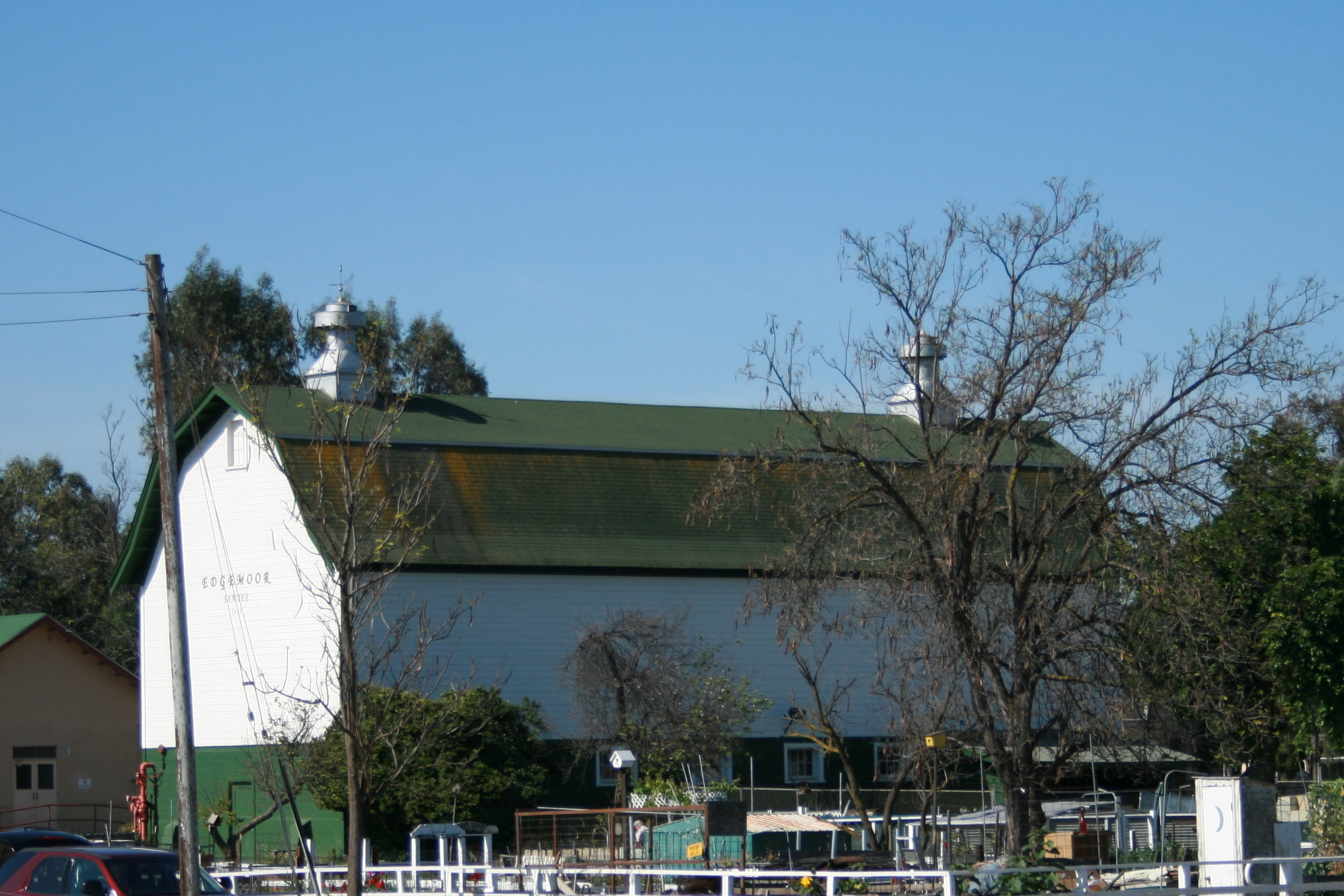
Edgemoor Farm Dairy Barn
The barn went up in 1913 on land that had once been part of a Spanish land grant, and over the following century it outlasted every institution that occupied the surrounding property. The Guernsey dairy that built it earned national recognition. The county poor farm that replaced it cared for hundreds of indigent elderly. The geriatric hospital that followed served thousands more. Through all of it, the Dutch gambrel-roofed barn stood — the one original structure still standing when everything else had been demolished or replaced — until the Santee Historical Society moved in and gave it a purpose suited to its age.
A Spanish Land Grant and a Gentleman Farmer
The land in Santee where the barn stands traces its ownership back through María Antonio Estudillo, who married Miguel de Pedrorena of Madrid — a Spanish land grant family whose name appears across the history of San Diego County. By 1913, the property had passed to Walter Hamlin Dupee, who built the dairy barn and set about creating what would become one of the most celebrated Guernsey cattle operations in the United States. The Guernsey Breeders Association named him the foremost authority and breeder in the country in 1921, a recognition that reflected years of careful breeding and the kind of obsessive attention to bloodlines that distinguished serious dairy operations from ordinary farms. The barn he built to house this work — Dutch gambrel-roofed, well-proportioned, clearly meant to last — became the physical center of a nationally recognized agricultural enterprise.
The County Takes Over
San Diego County purchased the Edgemoor Farm property in 1923 for a purpose that said something honest about the limits of American social provision before the New Deal: it would become a home for the aged and indigent, one of the last institutions of its kind in the United States. Poor farms — publicly funded residential facilities where people who had no other options could live and work in exchange for their keep — were already disappearing by the 1920s as states developed more modern welfare systems. San Diego County was running one of the country's last examples. By the mid-1920s, the farm was caring for 520 people. The work continued for decades, the institution evolving and eventually becoming Edgemoor Geriatric Hospital in 1955 as the concept of the poor farm gave way to something with a more clinical name.
What Survived
Time and institutional change consumed most of what had been built at Edgemoor. The dairy infrastructure, the residential buildings, the additions of successive eras — most of it is gone. The dairy barn, built in 1913 to house Dupee's Guernseys, survived. Its Dutch gambrel roof, designed to maximize hay storage in the upper loft while keeping the cattle dry below, remained sound. In 1986, the barn was listed on the National Register of Historic Places — recognition that it represented something worth preserving, both architecturally and historically. The Santee Historical Society eventually established itself in the building, turning the barn into an archive and gathering place for the history of the surrounding region.
The Long Thread
The history embedded in the Edgemoor barn runs from Spanish land grants through prize-winning agriculture through the Depression-era safety net through twentieth-century geriatric medicine — a longer and more varied thread than most surviving structures carry. The barn itself is indifferent to this weight; it is a functional agricultural building that has outlasted the functions it was built for. What makes it interesting is precisely that it kept standing while everything around it changed, absorbing each successive use without losing the form that Dupee's carpenters gave it in 1913. It is the kind of building that accumulates history without appearing to, which is usually what makes a building worth saving.
From the Air
The Edgemoor Farm Dairy Barn is located at approximately 32.843°N, 116.969°W in Santee, California, northeast of El Cajon in San Diego County's East County. The site is near the junction of Magnolia Avenue and Edgemoor Road. Gillespie Field (KSEE) is approximately 2 miles to the southwest. Nearest airports: KSEE (Gillespie Field) 2 miles southwest, KSAN (San Diego International) 17 miles west. Best observed at 1,500–2,000 feet MSL; the distinctive gambrel roofline is visible among suburban development.